



Exosomes Explained: Inside Skincare’s Tiniest Delivery System
Skincare's smallest delivery system, explained — how exosomes are taken up by skin cells, and what our Cica exosomes were clinically proven to do.
Author
askINKEY skincare advisor
Published
16 January, 2026
Time to read
20 minutes
Exosome serums are on every shelf and in every feed right now, but very few of them explain the part that actually matters: what happens in the space between the pump and your skin cells. This article covers that gap. It is a mechanism explainer, which means we are looking at three things only: what an exosome physically is, what it carries inside it, and how skin takes it in.
Start with the number that makes the rest of it possible. Exosomes measure roughly 30 to 150 nanometers across, which puts them at approximately 300 times smaller than a pore. That scale is not a marketing flourish. It is the entire reason exosomes are discussed as a topical delivery vehicle at all.
Here is the honest framing before we go further. Exosomes in skincare are a delivery story. The genuinely interesting science sits in the packaging and the absorption, not in the language some brands use about cellular conversations. We are going to stay on the side of that line that can actually be described.
If what you want is the decision-level overview, what exosomes are and which product suits you, start with our complete exosome guide instead. If you want to know how the thing actually gets in, keep reading. And the first question any mechanism discussion has to answer is how small “small” really is.
How Small Is an Exosome? Understanding Nanometer Scale
Size is not a detail in this story. Size is the story. Before we can talk sensibly about absorption, cargo, or sourcing, you need a physical sense of what we are dealing with, because almost everything that makes exosomes interesting as a delivery system follows directly from how astonishingly small they are.
The technical term is extracellular vesicle. It means a small, sealed parcel with a lipid wall that exists outside a cell. Exosomes are one specific type of extracellular vesicle, and the peer-reviewed literature on the exosome journey from biogenesis to uptake places them in a size range of roughly 30 to 150 nanometers in diameter. That is the term introduced and defined. From here on, we will mostly just call them what they are: tiny lipid-walled parcels.
A nanometer is one billionth of a meter. Written out, that is 0.000000001 of a meter. This is a number the human brain is genuinely not built to hold, so it needs anchoring to things you can actually picture.
- A single human hair is roughly 80,000 to 100,000 nanometers wide. Line up exosomes across the width of one hair and you would need somewhere in the region of a thousand of them.
- A pore, which already sits at the edge of what you can see in a magnifying mirror, is vastly larger again. INKEY’s plant-derived exosomes are approximately 300 times smaller than a pore.
- A grain of fine sand is around 100,000 nanometers. A red blood cell is roughly 7,000 nanometers. An exosome at 100 nanometers is a fraction of even that.
Sit with the pore comparison for a second, because it is the one that reframes how people think about skincare. Most of us picture pores as the openings through which things enter the skin. At exosome scale, a pore is not a doorway. It is a canyon. The parcel is operating at a completely different order of magnitude from the surface features we can see.
Why scale is the whole point when you ask how do exosomes work
If you want to understand how do exosomes work in a topical formula, the answer starts and largely ends with physics rather than biology. Skin is an extremely competent boundary. Its outermost layer, the stratum corneum, is built from flattened cells packed into a lipid-rich matrix, and it spends its entire existence keeping the outside world outside. That is a feature, not a flaw.
The consequence for skincare is that molecular size is one of the sharpest limits on what any active ingredient can achieve. Formulators have worked around this constraint for decades: fragmenting hyaluronic acid into lower molecular weights so some of it can travel further than the surface, encapsulating retinol so it survives long enough to be useful, and choosing vitamin C derivatives partly on the basis of how they behave against a lipid-rich barrier. Every one of those innovations is, at heart, a size and compatibility problem being solved.
Exosomes arrive at that problem from a different direction. Rather than shrinking a molecule or wrapping it in a synthetic shell, they are already a naturally occurring parcel that operates in the nanometer range and is built from the same class of material as the skin’s own structures. That combination, very small plus lipid-compatible, is what places them in a distinct category of delivery vehicle rather than simply another active on the ingredients list.
This is worth being precise about, because it is where a lot of category marketing goes wobbly. Small does not automatically mean effective. Small means plausible. It means the conversation about topical delivery is a serious one rather than a wishful one. What turns plausibility into a result is everything else: what the parcel contains, how stable it is, what concentration it is used at, and how the formula around it behaves on skin. We will cover each of those.
What “delivery system” actually means here
The phrase gets used loosely, so let us pin it down. A delivery system, in this context, means a structure that holds its contents together as a unit until it reaches its destination, rather than releasing them as free-floating individual molecules the moment the product hits your face.
Picture the difference between scattering loose seeds across a field and planting them in a sealed, biodegradable pod. The seeds are identical. The delivery is not. A single free molecule of an active is exposed to everything: oxidation, dilution, degradation, and the simple physical challenge of getting anywhere at all. A vesicle is a wall around its contents, and that wall is made of lipids, which is the same broad material family as the skin’s own lipid matrix.
That compatibility is the quiet advantage. It is not that exosomes force their way through skin. It is that they are structurally similar to what they encounter, and similarity is the most underrated property in topical delivery.
If your interest is more practical than technical and you mainly want to know what exosomes are and how to choose one, the complete exosome guide is the better starting point and will get you there faster. For everyone still here, we have established how small the parcel is. The obvious next question is what is inside it.
What Is Inside an Exosome? The Cargo Explained
A parcel is only interesting because of what it holds. When researchers analyze exosome contents, the picture that emerges is consistent across sources: three broad categories of cargo, held inside a lipid wall. Lipids, proteins, and genetic material. That is the inventory.
We are going to describe each one as cargo, as something carried and delivered. That is a deliberate choice and worth explaining. There is a great deal of marketing language in this category that describes exosomes as sending messages or issuing directions to your cells. We are not going to write that, because what can be described accurately and honestly is the composition and the transport. The rest is a leap. Describing what is in the parcel and how the parcel gets in is the substance. Everything past that is decoration.
Lipids: the wall itself is an ingredient
The most easily overlooked fact about an exosome is that its container is part of its composition. The outer wall is a lipid membrane, and the peer-reviewed literature on exosome structure documents that this membrane is notably enriched in specific lipid classes, including ceramides, sphingomyelin, and cholesterol.
If those names ring a bell, that is not a coincidence, and it is the most satisfying connection in this whole article. Ceramides are among the most established ingredients in barrier-focused skincare, and cholesterol sits alongside them in the skin’s own lipid matrix. The exosome membrane is built from materials that are already fundamental to skin’s surface structure.
That structural family resemblance is what makes the lipid wall more than just packaging. Two lipid-based surfaces meeting each other behave very differently from a foreign particle meeting a lipid surface. Hold onto this point, because it becomes directly relevant when we get to the first absorption route.
The membrane also does the straightforward job you would expect of any container. It holds the contents in one place. It keeps the interior separated from the exterior. It gives the whole structure a defined shape and a defined surface, and that surface is where the next cargo category lives.
Proteins: the surface and the interior
Exosomes carry proteins in two distinct positions, and the distinction matters for this article.
Surface proteins are embedded in or attached to the outer membrane. They give the vesicle a specific external profile, a kind of molecular texture on the outside of the parcel. For our purposes, they are relevant for one reason: they influence how a vesicle makes physical contact with a cell surface. Different surface protein profiles mean different contact behavior. This is the setup for the receptor docking route in the absorption section, so it is worth noting now.
Internal proteins sit inside the vesicle, enclosed by the membrane. These are part of the carried load, transported inside the sealed container along with everything else.
The reason researchers pay close attention to surface proteins is that they are also how vesicles are identified and characterized in the first place. Specific surface markers are used to confirm that what you have isolated is genuinely the vesicle population you think it is. When you see references to characterization in exosome research, surface protein profiling is usually a large part of what is meant.
Genetic material: cargo, described as cargo
Exosomes can carry small fragments of genetic material, including short RNA sequences. This is the cargo category that attracts the most breathless coverage, and it is where we are going to be the most disciplined.
Here is the accurate description: genetic material is one of the categories of cargo that a vesicle can carry, and it is transported inside the lipid membrane alongside lipids and proteins. That is what the science supports and that is what we will say. It is carried. It is delivered. We are not going to characterize it as instructions, messages, or commands, because that framing overstates what can be honestly claimed about a topical cosmetic product.
We would rather tell you what is genuinely known than dress up the uncertainty. This is a young and fast-moving area of research. The composition is well documented. The topical behavior is being actively studied. Both of those things can be true at once, and saying so is more useful to you than confident-sounding filler.
Why packaging is the honest headline
Pull the three categories together and the picture is clear. An exosome is a lipid-walled parcel, made of materials structurally related to skin’s own lipids, carrying a mixed load of proteins and genetic material, at a scale where topical delivery is physically plausible.
That is a packaging story. And packaging genuinely matters in skincare, more than the industry usually admits. The history of effective formulation is substantially a history of delivery problems being solved: encapsulation, molecular weight fractioning, stabilization, pH targeting, penetration enhancers. None of those change what an active is. All of them change what it can do in practice.
A naturally lipid-compatible carrier operating at the nanometer scale is a delivery advantage. It is a real one, and it is interesting on its own terms. It is not a magic one, and it does not need to be.
A parcel this specific, with a defined wall, a defined surface, and a sorted interior, does not assemble itself by accident. Which raises the question of where exosomes are actually made.
Where Exosomes Come From: Inside the Cell’s Packaging Process
This is the part of the exosome story that almost never gets told in beauty content, and it is the part that most changes how you think about the category. Exosomes are not shed. They are not debris. They are not fragments that happen to break off a cell and float away. They are assembled, on purpose, inside a cell, through a multi-stage process with dedicated molecular machinery.
Understanding that changes the frame entirely. You are not looking at biological offcuts. You are looking at a manufactured product of the cell, and manufacturing implies consistency.
The process is called biogenesis, and the research on exosome biogenesis machinery and regulation lays out a sequence that can be described in four plain steps.
-
An endosome forms inside the cell. The cell’s outer wall folds inward and pinches off a small pocket, drawing a piece of the outside world into the interior. That pocket, now a sealed compartment floating inside the cell, is called an endosome. Everything that follows happens inside this compartment.
-
The endosome matures and buds inward on itself. This is the strange and elegant part. The wall of the endosome starts folding inward and pinching off tiny vesicles into its own interior. The result is a compartment containing many small vesicles inside it, like a pouch that has filled itself with a collection of much smaller sealed pouches. The technical name for this structure is a multivesicular body. That term is now introduced and we will simply call it the packed compartment from here.
-
Cargo is sorted and packed by dedicated machinery. The sorting is handled by a set of protein complexes known as the ESCRT pathway, which stands for Endosomal Sorting Complex Required for Transport. Its job has two parts: selecting which cargo goes into each forming vesicle, and physically pinching that vesicle off once it is loaded. It is selection followed by sealing. There are also ESCRT-independent routes that reach the same outcome by other means, which tells you the cell has more than one way to get this done.
-
The packed compartment merges with the cell’s outer wall and releases its contents. The compartment travels to the edge of the cell, fuses with the outer membrane, and the small vesicles held inside are released into the surrounding space. Those released vesicles are exosomes.
Exosomes are packed on purpose, not shed by accident. That single distinction is what separates a delivery vehicle from a by-product.
Why the ESCRT pathway matters to someone shopping for a serum
That step three is doing quiet but heavy lifting, and it is worth spelling out why a sorting mechanism should matter to anyone standing in front of a bathroom mirror.
Sorting means selection. Selection means the contents of a vesicle are not a random sample of whatever happened to be floating nearby when the wall folded over. There is a mechanism determining what goes in and what stays out. That is the difference between a sealed parcel packed by a process and a bag of whatever was on the floor.
Selection is what produces consistency. And consistency is the entire precondition for using something in a formula. A cosmetic product has to behave the same way in the thirtieth bottle as it did in the first, and in the tenth week of a stability test as on day one. Ingredients that vary unpredictably from batch to batch are a formulator’s nightmare, no matter how promising they look in isolation.
So when you read that exosomes are deliberately assembled and sorted before release, the practical translation is this: they are structurally consistent enough to be characterized, standardized, and formulated with. That is an unglamorous point and it is one of the most important ones in this article.
A brief note on nomenclature and honest labeling
One more piece of transparency, because it comes up constantly and the category is not always straight about it.
Isolating vesicles is technically demanding, and the various methods produce populations that can overlap in size and composition with other extracellular vesicle types. Research groups have been increasingly careful about this, which is why you will sometimes see the more cautious phrase “exosome-like nanovesicles” in the literature rather than a flat “exosomes.”
That caution is a sign of a field maturing rather than a reason for suspicion. It reflects researchers being precise about what they can definitively confirm. We would rather point that out than let you discover it later and wonder why nobody mentioned it.
Plants run their own version of this process
Everything described so far comes from research conducted largely on animal and human cell systems, but cells across the biological world face the same fundamental logistics problem, and they have converged on comparable solutions.
Plants produce their own lipid-walled vesicles through related processes, and the growing body of work on plant-derived exosome-like nanoparticles for biomedical applications documents structures that fall into a comparable size range and share the same basic architecture: a lipid wall enclosing a mixed cargo load. The specifics differ, as we will get into shortly, but the underlying design is recognizably the same.
This is not a minor footnote. It is the foundation of the entire plant-derived exosome category, and it is why a vesicle sourced from a botanical can be discussed in the same structural terms as one described in the mammalian literature.
We now know how the parcel is built and how it is released. That leads directly to the question this whole article is built around: how does skin take it in?
How Are Exosomes Absorbed? The Four Routes Into a Skin Cell
This is the section that matters most, and it is where the majority of exosome content on the internet either goes vague or goes too far. So let us be specific and let it breathe.
When researchers study how a vesicle gets taken up by a cell, they do not describe one mechanism. They describe several distinct routes, and the review literature on exosome mechanisms of uptake sets out four principal ones. Importantly, these are not competing theories where one turns out to be correct. More than one can happen at the same time, and which route dominates appears to depend on the cell type involved, the surface characteristics of the vesicle, and the surrounding conditions.
Understanding how are exosomes absorbed means understanding all four, because in practice they operate as a set rather than a single pathway.
Route one: direct membrane fusion. The most structurally elegant route, and the easiest to picture. The exosome’s lipid wall makes contact with the outer wall of the cell, and the two membranes merge into one continuous surface. As they merge, the contents of the vesicle pass directly into the cell interior. There is no pocket, no wrapping stage, no intermediate compartment. The parcel does not go through a door. The parcel becomes part of the wall, and what it was holding is now inside.
This works for exactly the reason we flagged back in the cargo section. Both surfaces are lipid-based. Two lipid membranes brought into close enough contact can reorganize into a single membrane, because they are made of compatible material arranged in compatible ways. This is the clearest single illustration of why the lipid wall is not incidental packaging but a functional part of how the whole thing behaves.
Route two: receptor docking. Surface proteins on the outside of the exosome come into contact with matching structures on the outside of the cell. Think of it as physical fit: specific shapes on one surface making contact with complementary shapes on another, holding the vesicle against the cell rather than letting it drift past.
We are describing this strictly as contact and physical docking, and we are stopping there deliberately. Docking is what can be observed and described. It is the reason surface protein profiles matter, and it explains why vesicles from different sources make contact with different cell types in different ways. It is also the route that most often gets embellished in marketing copy, so consider this the deliberately unembellished version.
Route three: endocytosis. Here the cell takes an active part. The cell’s outer wall curves around the vesicle, wraps it, and draws it inward inside a pocket that then seals shut, carrying the vesicle into the cell interior.
Researchers distinguish several sub-types by the machinery involved, and they are worth naming without over-explaining:
- Clathrin-mediated endocytosis, in which a protein called clathrin assembles a scaffold that shapes the inward-curving pocket.
- Caveolin-mediated endocytosis, which uses flask-shaped pits in the cell wall formed with a protein called caveolin.
- Lipid-raft mediated endocytosis, which happens at specialized cholesterol-rich patches within the membrane.
The names are less important than the shared principle: the cell wraps the vesicle and pulls it in. Endocytosis is widely reported as a dominant uptake route across many cell types, which makes it central to any serious answer about how do exosomes penetrate skin at the cellular level.
Route four: macropinocytosis. The least selective route and, in a way, the most indiscriminate. Rather than targeting a specific particle, the cell ruffles its outer membrane and takes in a comparatively large gulp of the surrounding fluid, along with whatever happens to be suspended in it. Any vesicles in that fluid come along for the ride.
Where the first three routes involve some degree of specificity, this one is bulk intake. It is a genuine and recognized uptake route, and it is a useful reminder that biology is frequently less tidy than a diagram suggests.
What happens after uptake, and the part most articles leave out
Getting inside a cell is not the end of the journey, and honesty here separates real explanation from hype.
Once a vesicle has been drawn in, particularly through endocytosis, it enters the cell’s internal trafficking system and moves through a series of compartments. Some of those compartments are degradative by design, because breaking material down is one of the core jobs of that system. The literature on the exosome journey from biogenesis through to uptake is direct about this: not every vesicle’s contents survive that internal journey intact.
That is a real limitation and we are not going to hide it. Uptake and intact delivery are related but not identical outcomes, and researchers are still actively working out the ratios in different systems.
We include it because it is true, and because a category this new is better served by candor than by polish. If a brand only ever tells you the flattering half of the mechanism, you have no way to calibrate anything else it tells you.
Why this science changes how you should apply the product
Here is the genuinely practical payoff, and it follows directly from everything above.
Every single one of these four routes begins with the same prerequisite: contact between the vesicle and the cell surface. No contact, no uptake. That is not a formulation opinion, it is a structural fact of all four mechanisms.
Which explains two things about how topical exosome products are designed and used.
First, the formula should be lightweight and non-occlusive. A heavy, thick, film-forming product that sits on the surface as a barrier works directly against contact. Whatever is suspended in that film has a harder time reaching where it needs to be. This is why a well-built exosome product tends to feel like a light fluid rather than a rich cream, and that texture decision is a mechanism decision, not an aesthetic one.
Second, apply to clean, damp skin. Clean, because residual cleanser, sunscreen, makeup, or the day’s accumulated grime all sit between the product and the surface. Damp, because water on the skin helps a lightweight fluid spread evenly across the whole surface rather than pooling in patches, and even distribution means more contact area.
So the standard advice to apply an exosome serum to freshly cleansed, still-damp skin as the first step after cleansing is not a routine convention inherited from other product categories. It falls out of the uptake science directly.
Now that you know what the real absorption routes look like, you are in an excellent position to spot the claims that do not hold up. Our piece on 5 Exosome Skincare Myths Debunked takes on the most common ones, and it will read very differently now that you know the mechanism.
Uptake explains how skin takes in vesicles in general. The next question is which vesicles, and why the source they come from changes the answer.
Plant-Derived Cica Exosomes: Why the Source Matters
Everything so far has been about exosomes as a structural category. Now we get specific, because not all exosomes are the same, and the source is one of the most consequential and least discussed variables in the entire category.
Plants produce their own tiny lipid-walled vesicles. The formal term you will meet in the literature is plant-derived exosome-like nanovesicles, and research comparing plant-derived nanocarriers and nanostructures documents structures that sit in a comparable size range to the ones we described earlier, with the same fundamental architecture: a lipid wall enclosing a mixed cargo load.
Comparable is not identical, though, and the differences are worth stating plainly rather than glossing over.
Plant-derived vesicles carry plant-specific contents, which include secondary plant compounds that simply are not present in vesicles from animal sources. Their surface protein profile is also different, which, given what we covered in the receptor docking route, is a meaningful structural distinction rather than a trivial one. Comparative reviews of mammalian and plant-derived exosomes for delivery applications set out these differences alongside the shared size and structural characteristics, and one point that comes through consistently is that plant-derived vesicles are generally regarded as having very low immunogenicity in humans, meaning they are not typically recognized as a foreign threat.
There are also practical advantages that follow from a plant source, including scalability and a sourcing story that is far easier to trace and verify. If sourcing is the question you actually came here with, our comparison of plant-derived versus fermentation-derived exosomes goes deeper into how the different production routes stack up.
Why Centella Asiatica
INKEY uses 1% Cica Exosomes, sourced from Centella Asiatica.
Cica is not a trend ingredient that arrived last season. Centella Asiatica has one of the longer and better-documented histories in skincare of any botanical, with a long-established reputation for soothing and comforting skin, and it has been studied extensively enough that it is a familiar name to dermatologists and formulators alike.
That track record is exactly why it makes sense as a vesicle source. Taking a botanical with a well-understood profile and using it as the origin for a delivery vehicle is a considerably more grounded proposition than sourcing from something novel and unfamiliar simply because it sounds impressive on a label.
The in-vitro data supports the choice, and we will present those specific figures with their full context in the results section shortly.
Because the source is a plant, the formula is certified vegan by The Vegan Society. It is suitable for all skin types including sensitive skin, and it is safe to use during pregnancy and breastfeeding. Those are not incidental footnotes. For a large number of people, they are the difference between a product being usable and being off the table entirely.
The concentration conversation nobody else wants to have
Now the part that matters most, and the part where this category currently has a transparency problem.
INKEY discloses the concentration. 1% Cica Exosomes. It is on the front of the pack, in the same way percentages appear across the entire range, because putting the number where you can see it is the whole point.
Here is why that is worth flagging. A number of exosome products on the market are marketed using vesicle counts, headline figures running into the billions or trillions of particles. Those numbers are impressive and they are attention-grabbing. They are also, on their own, close to uninformative.
A count tells you how many particles are claimed to be present. It does not tell you what proportion of the formula those particles represent, what condition they are in, or how that figure was measured, and measurement methodology in this area varies considerably. Two products quoting similar counts can be formulated very differently. A big number with no denominator is not transparency, it is arithmetic without context.
Concentration is the figure that lets you compare like with like, because it is expressed as a proportion of the formula. It is the standard the rest of skincare already works to, which is precisely why you know what 2% salicylic acid or 10% niacinamide means before you have read a single line of the marketing copy.
We have written about this at length in how much exosome is enough and why concentration matters more than count, because it is the single most useful thing a shopper can understand about this category right now.
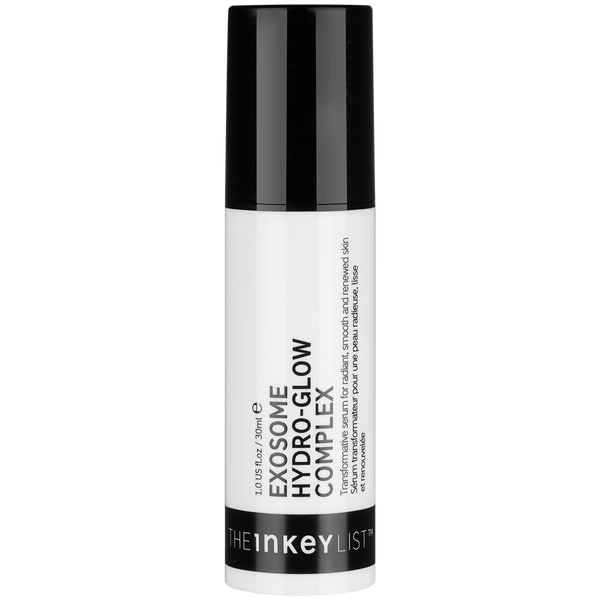
All of that science lives in one product: Exosome Hydro-Glow Complex, $24.00 for 30ml. It is worth noting that we have arrived at the product only now, after the mechanism has been fully laid out. That order was deliberate. The science should earn the product, not the other way around.
A delivery vehicle is only ever as good as the formula built around it. So what else is in the bottle?
The Formula Around the Exosomes: Hydration, Peptides and Support
Exosomes do not work in isolation, and a formula is not an ingredient list with a hero at the top. Every other component either supports the delivery mechanism, contributes something distinct, or has no business being there.
The starting principle follows directly from the uptake section. Because all four absorption routes depend on surface contact, the base has to be lightweight and non-occlusive. Anything heavy or film-forming works against the mechanism. That constraint shapes the entire texture of the product, and it is the reason this is a fluid rather than a cream.
Here is what sits alongside the 1% Cica Exosomes, and the specific job each one is doing.
1% Hyaluronic Acid, at multiple molecular weights. Not a single form but several, and the reason is straightforward. Different molecular weights of hyaluronic acid behave differently: larger ones hold water at the immediate surface, smaller ones travel further across the skin’s upper layers. Using a blend delivers hydration across different levels rather than concentrating it all in one place, which is what produces that immediate plumped look. If persistent tightness, dullness, and skin that drinks up product without ever feeling satisfied sound familiar, our guide to dehydrated skincovers why that happens and what to do about it.
1% Ectoin. An extremolyte, which is a compound produced by microorganisms that survive in genuinely hostile environments, from salt flats to extreme heat. It supports the skin’s moisture barrier and helps hold water in place. It is also the ingredient behind one of the product’s substantiated claims: Proven to deliver up to 12-hours of hydration**
1% Kollaren Tripeptide-1. A tripeptide, which means a short chain of three amino acids. Peptides are among the most-researched categories in modern skincare and this one contributes to visibly improved firmness and skin structure. Helps support natural collagen production. If peptides are unfamiliar territory, our peptides explainer breaks down the different types and what each is used for.
Q10, also listed as Ubiquinone. An antioxidant that helps defend skin against the daily environmental stressors it meets constantly: pollution, UV exposure, the general oxidative load of being outside in a city. Antioxidant support is defensive work, which makes it easy to overlook precisely because it prevents rather than corrects.
Prickly Pear extract. A gentle natural resurfacer that supports a smoother, more radiant finish. Note the word gentle. This is not an aggressive exfoliating acid, and in a product designed around surface contact and lightweight delivery, anything harsher would be working against the brief.
Put those together and you have the composition behind the glow boosting, six-in-one positioning: hydration at multiple levels, moisture barrier support, peptide support for firmness, antioxidant defense, and gentle resurfacing, all built around a nano-scale delivery vehicle. The claim is a description of what is in the bottle, not a slogan attached to it.
For the full deep-dive on the product, including texture, feel, and how it performed in testing, meet Exosome Hydro-Glow Complex covers it properly.
How to actually use it
The application advice follows from the mechanism rather than from convention.
Apply to clean, damp skin as the first step after cleansing, morning and evening. A pea-sized amount covers face and neck comfortably. Follow with your treatments, then your moisturizer.
Step two is the right position for a specific reason. Applying it before other treatments means it makes contact with skin directly rather than through a layer of something else, which is what the uptake science calls for. Damp skin helps it spread evenly across the whole surface.
On the housekeeping that people genuinely search for and rarely find easily: the formula is fragrance-free, alcohol-free, paraben-free, and non-comedogenic. It sits at a pH of 6.0 to 6.5. It is dermatologically and clinically tested. It is suitable for all skin types including sensitive, certified vegan by The Vegan Society, and safe during pregnancy and breastfeeding.
Once people understand the layering position, the immediate follow-up question is always what else it can be used with. Retinol is the most common pairing question by a distance, and boost your retinol results with exosome answers it in full.
That covers what is in the bottle. Now for what it has been shown to do, and what the same technology costs anywhere other than your bathroom shelf.
The Clinical Results and What This Would Cost in a Clinic
Mechanism is only half of an honest argument. The other half is evidence, presented with enough context that you can judge it yourself.
Here is what the testing showed, stated exactly as it was substantiated:
- 100% saw more glowing skin, clinically proven*
- Clinic worthy rejuvenated skin in 14 days*
- 6-in-1 skin rejuvenation: clinically proven to visibly improve radiance, hydration, tone, firmness, elasticity, and texture*
- 55% reduction in visible signs of skin stress (redness, puffiness, visible irritation)*
- 63% increase in skin renewal activity in 8 hours*
Those asterisks are doing real work, so let us explain what they mean rather than hoping you skip past them.
A clinical study on people means real participants used the product over a defined period under study conditions, and the results were measured and recorded. The first three claims come from a four-week study of 26 people. That is a genuine consumer study with a modest sample size, which is standard practice for cosmetic testing and which we would rather describe accurately than leave you to guess at.
In-vitro testing means testing conducted on cells in a laboratory setting rather than on people. The last two figures come from in-vitro testing of Cica Exosomes. Laboratory results are meaningful evidence and they are also not the same thing as a result on a face, which is exactly why they carry a different footnote marker.
We flag the distinction because knowing which is which makes you a better judge of every product you look at, including ours. Transparency that only extends to the flattering details is not transparency.
For independent context on the wider category, an NIH-hosted review on the efficacy of exosome-based therapies for skin rejuvenation is a useful read. It reports encouraging early clinical effects while noting that the existing evidence base is heterogeneous and would benefit from longer follow-up. That is a fair summary of where the science stands, and pointing you to a source that includes the caveats is the point.
What the same technology costs in a clinic
Exosomes reached skincare shelves by way of the aesthetics clinic, and clinic pricing is where the accessibility argument becomes concrete.
In the United States, in-clinic exosome treatments commonly run from several hundred to a few thousand dollars per session. Practitioner guidance on exosome therapy benefits and cost puts a single session typically in the range of $700 to $2,500, varying by treatment area, provider, and location. Exosome microneedling specifically is frequently quoted in the $750 to $1,200 per session range, and because these treatments are typically recommended as a course rather than a one-off, multi-session packages run into several thousand dollars.
Set against that: Exosome Hydro-Glow Complex is $24.00 for 30ml, used twice daily at home. No appointment, no needles, no recovery time, no travel.
Now the necessary caveat, because a price comparison without one is not an argument, it is a sales pitch.
A topical serum and an in-clinic procedure are not the same thing. A clinical treatment typically uses a device to create micro-channels in the skin, delivers a different concentration under professional supervision, and works on a completely different schedule. Topical application and clinical delivery are genuinely different procedures with genuinely different profiles, and anyone claiming otherwise is not being straight with you.
What is fair to say is that the underlying technology, plant-derived exosomes at a disclosed concentration, is now available in a daily-use format at a price that does not require a consultation to consider. We have written about how that shift happened in the glow revolution.
The pairing that completes the loop
There is one more step that makes structural sense, and it brings this article back around to where it started.
Remember what the exosome wall is built from. Ceramides, sphingomyelin, and cholesterol. The same lipid family that makes up the skin’s own surface matrix, and the reason direct membrane fusion is possible in the first place.
So following a lightweight exosome serum with a ceramide moisturizer is not simply a routine habit. It is thematically and structurally coherent. Bio-Active Ceramide Moisturizer, $22.00, layers over the serum to seal in hydration and supports the skin’s own lipid structure with the same class of material the vesicle wall is made from.
Lightweight fluid first, for contact and uptake. Moisturizer second, to seal. The order follows the science.
That covers mechanism, formula, evidence, and cost. What follows are the questions people ask most once all of that has landed.
What the Exosome Mechanism Story Actually Tells Us
Follow the thread from the start and it holds together neatly. Exosomes are lipid-walled vesicles measuring 30 to 150 nanometers, around 300 times smaller than a pore. They carry lipids, proteins, and genetic material inside a membrane built from ceramides, sphingomyelin, and cholesterol. They are deliberately assembled and sorted inside cells before release, not shed as debris. And skin takes them in through several recognized routes: direct membrane fusion, receptor docking, endocytosis, and macropinocytosis.
That is the whole mechanism, and notice what it did not require. No claims about cellular conversations. The value of exosomes in skincare is delivery and packaging, and that is a genuinely interesting piece of science that does not need inflating to be worth your attention.
What we find most worth saying is this. This technology arrived through clinic doors at several hundred dollars a session, and it now sits at $24.00 for 30ml on a bathroom shelf. That is what access looks like when the science is explained rather than mystified.
If you want the decision-level view of what exosomes are and which product fits your skin, our complete exosome guide is the place to go next. Clear guidance, proven ingredients, real results.
Ready to Try It on Your Own Skin?
Exosome Hydro-Glow Complex, $24.00 for 30ml. Clinic worthy rejuvenated skin in 14 days*
Layer it with Bio-Active Ceramide Moisturizer, $22.00, to seal in hydration after your serum.
Not sure where either fits in your routine? Take the skincare quiz and we will build you a personalized routine from the ground up.
Because at The INKEY List, We Give A Care.
*4-week clinical study of 26 people.
**Clinical study of 31 people.
*In-vitro testing of Cica Exosomes showed a 55% reduction in pro-inflammatory markers and a 63% increase in markers associated with skin renewal after 8 hours.
Frequently Asked Questions
Got a question?
Our askINKEY team are a friendly bunch of skincare experts with deep product knowledge and zero judgement. Whether you're an ingredient obsessive or just starting out, we'll make it make sense. No question too big. No question too small. We Give A Care, Every Day.


