


Does Caffeine Work for Hair Growth? What the Science Says
Does caffeine work for hair growth, or does it cause hair loss? We explain what the research actually shows and how to use caffeine on your scalp for thicker-looking hair.
Author
askINKEY skincare advisor
Published
19 October, 2026
Time to read
13 minutes
Does Caffeine Work for Hair Growth? What the Science Says
Does caffeine work for hair growth, and is caffeine good for hair at all? This article answers both questions in plain English, without the hype that usually surrounds anything linked to thicker, fuller-looking hair. And if you have landed here because you are worried that caffeine might be making things worse, you can relax a little: we address the question of whether caffeine causes hair loss directly, and the evidence is reassuring.
Here is what we will cover: what caffeine does at the follicle, whether caffeine can cause hair loss, what the clinical studies and reviews actually show, the difference between applying caffeine to your scalp and drinking a cup of coffee, the practical gap between a rinse-off caffeine shampoo and a leave-on treatment, exactly how to use caffeine on your scalp, and how long you should realistically wait before judging the results.
If you want to put the science into practice right away, you can explore our Caffeine Stimulating Scalp Treatment, and you can read more about the bigger picture of looking after your scalp health.
One thing to be clear about from the start: caffeine is a genuinely well-researched, supportive cosmetic ingredient, not a miracle cure. It is one useful tool in a routine, and it rewards consistency. If you only want the quick answer, that comes first.
The short answer: does caffeine help hair growth?
Applied to the scalp, caffeine shows real promise as a supportive ingredient for the look of fuller, thicker hair, but it works best as part of a consistent routine rather than as a standalone fix. The nuance matters. Most of the encouraging evidence is for topical caffeine, meaning caffeine that goes directly onto the scalp, not the caffeine you swallow in coffee, tea, or energy drinks.
Results also take time, because the natural hair growth cycle is slow by design. A sensible expectation is around three months of consistent, nightly use before you start judging whether caffeine for hair growth is doing anything for you. So, is caffeine good for hair? The honest answer is that it can be a helpful, gentle, affordable part of your approach, provided you use it properly and give it time.
To understand why, it helps to know what caffeine actually does once it reaches the scalp.
What caffeine actually does at the scalp
Caffeine is a small molecule, and that size matters more than you might expect. Because it is small and water-friendly, caffeine can penetrate the outer layers of the scalp when it is applied topically, reaching the area around the hair follicle where the action happens. That is the whole premise behind putting caffeine on your head rather than relying on your morning brew: you are delivering the ingredient to the place it needs to be.
Researchers have focused on two headline mechanisms. The first is caffeine’s potential to support the active growth phase of the hair cycle, which is the phase that keeps hairs anchored, growing, and looking dense. The second is caffeine’s association with stimulating activity at the scalp, including local blood flow, which supports the general environment that follicles like to grow in. According to the 2025 systematic review published in the journal Healthcare, the leading explanation is that caffeine interacts with the adenosine pathway, nudging cellular activity in the follicle and acting as an antioxidant that helps protect cells from day-to-day oxidative stress. You can read the full review on PubMed Central.
None of this is magic, and it is worth being precise about the language. Caffeine is studied as a supportive, appearance-focused ingredient. It is not a drug, and the claims that stand up are about helping hair look fuller and thicker, not about curing baldness. Keeping that distinction in mind is the difference between realistic expectations and disappointment.
To make sense of the evidence, it helps to break those two mechanisms apart, starting with the hair growth cycle itself.
Caffeine and the hair growth cycle (anagen phase)
Every hair on your head is moving through a cycle. The first stage is the growth phase, known as anagen, when the hair is actively lengthening and can last for years. Next comes a short transition phase, and finally a resting and shedding phase, known as telogen, after which the hair falls out and the follicle eventually begins again. This is completely normal, and we all shed hair every day. The look of thinning and increased shedding tends to appear when a greater proportion of hairs shift into the resting phase and stay there, or when the growth phase shortens over time.
This is exactly where caffeine becomes interesting. Caffeine has been studied for its potential to help keep follicles in that active growth phase for longer, which is what you would want if your goal is denser, thicker-looking hair. The foundational work here is the often-cited study by Fischer and colleagues, published in 2007 in the International Journal of Dermatology. In a laboratory setting, using human hair follicles grown in culture, the researchers observed that caffeine appeared to counteract the growth-suppressing effect of testosterone on those follicles. You can read the original paper in the International Journal of Dermatology.
Here is the plain-English summary of that landmark finding: in a dish, caffeine seemed to help follicles keep growing even in conditions that would normally slow them down.
It is crucial to read that carefully. This was in-vitro research, meaning it happened in a controlled lab environment and not on a living human scalp. It is a promising clue about mechanism, and it is a big reason the whole field took caffeine seriously, but it is not a promise of regrowth. When people ask “does caffeine thicken hair” or “can caffeine make your hair grow”, this lab research is the origin of the optimism, tempered by the honest caveat that a dish is not the same as a human head.
One reason this matters so much is the role of a hormone called DHT.
Caffeine and DHT (the hormone linked to thinning)
DHT, short for dihydrotestosterone, is a hormone that is linked to hereditary hair thinning in some people. In those who are genetically sensitive to it, DHT is associated with the gradual miniaturization of hair follicles, where hairs become finer, shorter, and less visible over successive cycles. This is the mechanism behind the most common pattern of thinning, and it is the reason so many people searching for caffeine and hair growth eventually land on the subject of DHT.
Caffeine enters the conversation because it has been studied for its potential to counteract DHT-related suppression of follicle growth in laboratory settings. That is precisely what the Fischer work explored: caffeine offsetting the growth-dampening influence linked to testosterone-derived signaling in cultured follicles.
Now for the careful part, because this is the section where precision really matters. The accurate way to describe this is that caffeine has been studied for its potential and may help counteract certain effects in lab research. It is not accurate to say caffeine blocks DHT or stops hair loss, and we will not say that. Those are medical-sounding claims the evidence does not support. What caffeine can honestly be described as is a gentle, supportive, appearance-focused ingredient.
On that note of gentleness, there is genuinely reassuring news. Across the clinical trials gathered in the 2025 systematic review, caffeine products were generally well tolerated, with participants reporting good satisfaction and very few side effects. That makes caffeine suitable for most people and most scalp types, including sensitive ones.
So what does the wider body of research actually conclude when you put the studies together?
What the science says: a plain-English summary of the research
When a single lab study gets repeated endlessly online, it is easy to lose sight of the bigger picture. This is where a systematic review earns its keep, because it gathers the available human studies, assesses their quality, and gives a balanced verdict instead of a headline.
The most current and comprehensive source we have is that 2025 systematic review, which searched the major scientific databases and ultimately analyzed nine clinical trials involving 684 people with androgenetic alopecia, excessive shedding, or hair thinning. In plain English, here is what it found: across every one of those trials, the conclusions leaned in favor of topical caffeine, with participants and investigators reporting improvements in hair and high levels of satisfaction. That is a consistent, encouraging signal.
But the review is admirably honest about the limitations, and so are we, because transparency is the only way to earn your trust. Most of those studies were of low or very low quality by strict scientific standards. Many lacked proper control groups or randomization, and most did not even disclose the exact concentration of caffeine used. The authors’ bottom line was measured: topical caffeine preparations appear safe and show supportive potential, but better-designed, larger, longer trials are needed before anyone can make a definitive statement. As they put it, commercial caffeine products may well be worth a try, even if a guaranteed outcome cannot be promised.
If the dense scientific paper is not your idea of light reading, the dermatology trade press offered an accessible interpretation. Practical Dermatology summarized the same review under the plain headline that topical caffeine may provide a hair growth benefit, which captures the balanced spirit of the findings well.
So the honest verdict on what the science says about caffeine for hair growth is this:
- The evidence is promising but not definitive.
- The positive findings are overwhelmingly for caffeine applied to the scalp, not consumed.
- Results vary from person to person.
- Caffeine is best understood as a supportive ingredient within a routine, not a cure.
Since the research points so clearly toward topical use, a common question follows: does drinking coffee do anything for your hair?
Topical caffeine vs drinking coffee: does drinking coffee help hair growth?
Let us settle this one directly. When it comes to your hair, caffeine applied to the scalp beats caffeine poured into a mug. Topical caffeine delivers the ingredient exactly where it might help, right at the follicle, in a concentration intended for that purpose.
Drinking coffee works completely differently. When you swallow caffeine, it is absorbed into your bloodstream and processed by your entire body. It is distributed everywhere, broken down by your liver, and cleared out over a matter of hours. By the time any of that circulating caffeine reaches the tiny blood vessels around your hair follicles, the amount is vanishingly small. To get a meaningful dose to your follicles through drinking alone, you would need to consume an amount of coffee that no sensible person should attempt. In other words, the math simply does not work in your favor.
This is why the question “does drinking coffee help hair growth” has a clear answer: not in any meaningful way. The debate over topical versus oral caffeine is not really a debate at all once you understand how differently the body handles the two. Oral caffeine has many well-studied effects, but delivering a useful hair-supporting dose to your scalp is not one of them.
None of this means you need to feel guilty about your morning cup. Enjoy your coffee, savor it, and love it for what it is. Just do not count it as a hair strategy. If supporting the look of your hair is the goal, the smart move is to put caffeine where it can actually make contact with the scalp. For the broader context on how scalp care fits together, our guide to scalp health is a useful companion.
That leads neatly into the biggest worry people have about caffeine and hair.
Does caffeine cause hair loss?
This is the question more Americans ask than almost any other on this topic, so let us answer the fear head-on and reassuringly: there is no good evidence that applying caffeine to the scalp causes hair loss. If anything, the entire research interest runs in the opposite direction, studying caffeine as a supportive ingredient that may help hair look fuller rather than thinner. So whether you are asking “does caffeine cause hair loss”, “will caffeine cause hair loss”, “can caffeine cause hair loss”, or “does caffeine affect hair loss”, the evidence-based answer is the same, and it is calming rather than alarming.
Where does the worry come from, then? A likely source of confusion is lifestyle. General factors such as stress, poor sleep, and an unbalanced diet can genuinely affect hair and increase shedding. Very high caffeine intake sometimes travels alongside those factors, acting as a marker of a hectic, high-stress lifestyle rather than being the direct cause of any shedding. In other words, the demanding week that has you reaching for a fourth coffee is more likely to be the culprit than the coffee itself. There is no need to catastrophize your caffeine habit.
It is worth underlining this point because so much online content is designed to frighten rather than inform. The honest, evidence-based position is that topical caffeine is not something the research links to hair loss. The anxiety is understandable, but it is not supported by the studies, and fear is a poor basis for a scalp-care decision.
There is one more thing worth understanding gently. When you start any new scalp routine, it is not unusual to notice a short-term change in shedding as the hair cycle adjusts. Interestingly, the systematic review noted that even well-established hair treatments can briefly accelerate shedding before driving follicles back into the growth phase, so a small, temporary change is a common experience with many actives rather than a red flag. It usually settles. If you want to understand what genuinely drives shedding and how the natural hair growth cycle and what actually drives shedding really works, that deeper read will put your mind at ease.
To keep the framing honest: everything here is about the look and feel of your hair, not a medical treatment. Caffeine is a cosmetic, appearance-focused ingredient, and the reassuring news is simply that using it topically is not something the evidence links to hair loss.
If you are convinced caffeine is worth a try, the next question is how to get it onto your scalp effectively.
Is caffeine shampoo or a leave-on treatment better?
This is where a small, practical detail makes a big difference, and it comes down to one phrase: contact time. A rinse-off shampoo, by its very nature, spends very little time on your scalp. You lather, you wait a moment, and you rinse, often in under a couple of minutes. A leave-on treatment stays put for hours, which gives caffeine far more opportunity to make contact with the scalp and do whatever it is going to do.
So, does caffeine shampoo help hair growth, and does caffeine shampoo thicken hair? The honest answer is that a caffeine shampoo can contribute something, and the research does include shampoo studies with positive user feedback. But a leave-on format is generally the smarter way to deliver an active ingredient like caffeine, precisely because contact time is so limited in a wash-off product. Interestingly, the 2025 systematic review covered both formats, with four shampoo trials and five leave-on trials, and the leave-on serums and lotions are where many of the richer formulations sat.
Think of it like a leave-in conditioner versus a rinse-out one. Both have their place, but if you want an ingredient to work on your scalp over time, keeping it in contact for the whole night is a logical advantage. A leave-on overnight product pairs caffeine with your scalp while you sleep, hour after hour, instead of for the handful of seconds a shampoo allows.
This is simply a comparison of formats and contact time, not of brands. Our Caffeine Stimulating Scalp Treatment is built as a leave-on, overnight format for exactly this reason, though we will come to the full detail shortly.
So how do you actually use caffeine on your scalp, and how long before you see anything?
How to use caffeine for hair growth (and how long it takes)
The good news is that using caffeine on your scalp is refreshingly simple. Here is a straightforward routine you can follow every night:
- Start with a clean, dry scalp, ideally as the last step of your evening.
- Apply the treatment directly to the scalp, not just the hair.
- Massage it in gently with your fingertips for a few seconds.
- Focus on the areas where you notice thinning or increased shedding.
- Leave it on. There is no need to rinse.
- Go to bed, and carry on with your usual morning routine as normal.
That is genuinely all there is to the application. The real active ingredient in any scalp routine, however, is not in the bottle at all. It is consistency. Applying caffeine at the same time each night turns it into a habit, and habits are what deliver results over months. A product used sporadically cannot be judged fairly, because the hair cycle simply does not respond to the occasional effort.
Now for the honest timeline, because unrealistic expectations are the quickest route to disappointment. Hair grows slowly, roughly half an inch a month, and the changes you are hoping for happen at the pace of that cycle. Give caffeine around three months of consistent, nightly use before you decide whether it is working for you. Changes tend to show up gradually, which means a weekly mirror check will frustrate you, while a photo taken at the start and again at the three-month mark will tell you far more. That is the honest answer to how to use caffeine for hair growth and how long caffeine takes to work.
One more reassurance on suitability. A well-formulated caffeine leave-on is gentle enough for sensitive scalps and suitable for colored hair, which means most people can use it without fuss. If you are not sure where to begin or which steps your scalp actually needs, our Hair and Scalp Quiz is a quick, helpful starting point. For the exact routine built around these principles, see our Caffeine Stimulating Scalp Treatment.
Here is how our own caffeine treatment is built around exactly these principles.
How our Caffeine Stimulating Scalp Treatment fits in
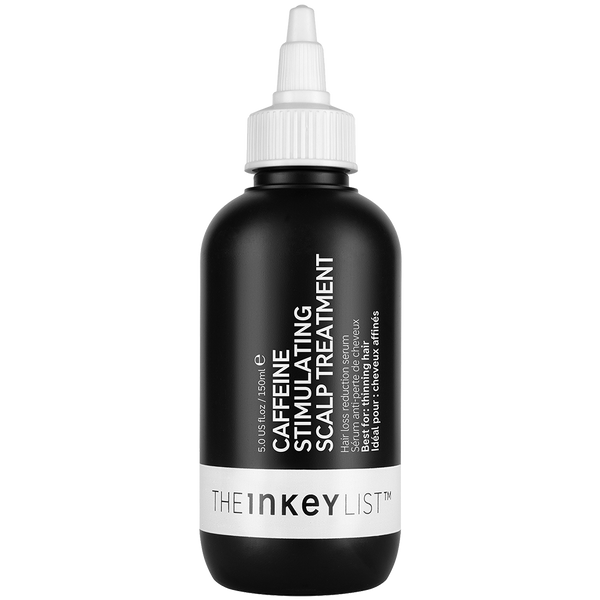
Everything above leads naturally to this point, so let us connect the science to something you can actually use. Our Caffeine Stimulating Scalp Treatment is a lightweight, non-greasy leave-on that you apply overnight to a dry scalp. The formula pairs 1% Caffeine with 1% Redensyl, and it is fragrance-free, suitable for sensitive scalps and colored hair, and vegan.
That formula is a deliberate reflection of the science in this article. The caffeine is there for scalp stimulation and to support the active growth phase of the hair cycle, exactly the mechanisms the research explores. Redensyl is a complex designed to help support the natural hair growth process and the look of density, so the two ingredients are chosen to complement one another rather than to dazzle you with a long, unproven ingredient list. The overnight, leave-on format is the whole point, giving caffeine the long contact time that a rinse-off product can never match.
On price, we believe in being straightforward. The treatment is $17. We frame that honestly: it is affordable and science-backed, with no false promises attached. What it can do, used consistently, is support the natural hair growth cycle, help promote thicker-looking and fuller-looking hair, and help reduce the look of shedding over time. Those are appearance-based benefits, described honestly, because that is what the evidence supports.
And we will say it one more time, because it is the single most important factor: give it at least three months of consistent, nightly use. This reflects our wider philosophy, which is simple enough to fit on the label: clear guidance, proven ingredients, real results. No hype, no overpromising, just a sensible product used sensibly.
If you want to place caffeine within a complete approach, our broader scalp health guidance is the natural next stop. And if thinning or shedding is your main concern, start here with our guide to preventing hair loss and thinning hair. For anyone whose scalp tends toward build-up or flakiness, a gentle exfoliating step such as our salicylic acid scalp treatment can be used before washing, pairing well with the overnight caffeine step.
Conclusion
Topical caffeine shows genuine, research-backed promise as a supportive ingredient for thicker-looking, fuller-looking hair. It works best applied directly to the scalp rather than drunk, used consistently each night, and given around three months before you judge it. And on the question that worries so many people, the evidence is reassuring: there is no good sign that applying caffeine to your scalp causes hair loss.
That is the honest verdict, and honesty is the whole point of how we approach hair and scalp care: clear guidance, proven ingredients, realistic results, and an honest price. Caffeine is not a miracle. It is a sensible, gentle, well-studied helper, and that is exactly why it deserves a place in a thoughtful routine.
If you would like the easy way to put caffeine to work on your scalp, our Caffeine Stimulating Scalp Treatment is a simple overnight step at $17, and you can build it into your wider routine with our scalp health guidance whenever you are ready.
Frequently Asked Questions

Got a question?
Our askINKEY team are a friendly bunch of skincare experts with deep product knowledge and zero judgement. Whether you're an ingredient obsessive or just starting out, we'll make it make sense. No question too big. No question too small. We Give A Care, Every Day.


