



The Best Cleanser for Acne-Prone Skin: What Actually Works
Cleansing is the most overlooked step in an acne-prone routine — here's how to choose the right cleanser and actually get results from it.
Author
askINKEY skincare advisor
Published
05 June, 2026
Time to read
18 minutes
Most people looking for the best cleanser for acne-prone skin have already spent a lot of attention, and a lot of shelf space, on everything else. Serums, spot treatments, masks, patches. The cleanser is usually whatever was closest to hand. That is the gap worth closing, because for acne-prone skin the cleanser is the one product that touches every pore, twice a day, every day. It either sets the rest of your routine up to work, or it quietly undermines it.
There are two ways a cleanser gets this wrong. The first is stripping. Skin feels tight, squeaky and slightly uncomfortable after rinsing, and that sensation gets mistaken for cleanliness. The second is the opposite problem: a formula so mild that it leaves oil, sunscreen and buildup sitting in the pore, where breakouts actually begin. Neither extreme helps, and plenty of people bounce between them for years without realizing that is what they are doing.
This article covers what to look for in a cleanser, why salicylic acid is the standout ingredient for congestion and breakouts, how to build a routine around it morning and night, what causes breakouts in the first place, and the common cleansing mistakes that make things worse. No hype, no miracle claims. Just the mechanics of how this step works and how to get more out of it.
Start with why this single step carries more weight for acne-prone skin than it does for any other skin type.
Why Your Cleanser Is the Foundation for Acne-Prone Skin
Acne begins inside the pore, not on top of it. Oil produced by the sebaceous gland mixes with dead skin cells that have not shed properly, and together they form a plug inside the follicle. That plug is the starting point for almost everything that follows: blackheads, whiteheads, congestion under the surface, and the inflamed spots that appear days later. If you want to understand the full picture, our guide to what acne is and why it happens breaks down the biology without the jargon, and what causes clogged pores goes deeper on the buildup mechanism specifically.
Here is why the cleanser matters more than its reputation suggests. It is the only step in your routine that addresses that buildup twice daily, before it has a chance to become a visible breakout. A serum works on what is already there. A spot treatment works on what has already surfaced. A cleanser is the step that intervenes earliest, at the point where oil and dead skin are still just accumulating rather than causing trouble. Getting in early is worth more than intervening late.
A cleanser sets the tone for everything applied after it
There is a second, less obvious reason this step carries weight. Your cleanser determines the condition of your skin at the exact moment every other product goes on.
If a cleanser over-strips, it removes not just the excess oil you wanted gone but a portion of the lipids that make up your skin’s protective barrier. Skin can respond to that in ways that work directly against you. It may feel tight and rough. It may become more reactive to actives you previously tolerated fine. And it can prompt the skin to produce more oil, not less, in an attempt to compensate for what was taken. That is the frustrating loop a lot of people find themselves in: the harsher the cleanser, the oilier the skin seems by mid-afternoon.
A damaged skin barrier also changes how everything else performs. Actives that would normally sit comfortably on skin start to sting. Moisturizer feels like it disappears within an hour. You end up spending the rest of your routine repairing the damage the first step caused, which is a poor use of five products and ten minutes.
The reverse is also true, and it is the more encouraging half of the point. A cleanser that removes buildup without compromising the barrier means every subsequent product lands on skin that is receptive rather than defensive. Your treatments get to do the job you bought them for, instead of running damage control.
Rinse-off is an advantage, not a limitation
There is a common assumption that an active ingredient in a cleanser is somehow a wasted opportunity, because it washes down the drain. In practice, the rinse-off format is one of the most useful things about it.
An active in a leave-on product stays on your skin for hours. That is powerful, and it is also exactly why leave-on exfoliants usually come with instructions to start slowly, use them a few nights a week, and watch for irritation. The same active in a cleanser has contact time measured in seconds to a minute, then it is gone. You get meaningful action inside the pore with a far lower irritation risk, which is what makes daily use realistic rather than something you have to schedule and ration.
That daily consistency matters more than intensity. Breakouts form continuously, so a modest amount of pore-clearing action every single day tends to outperform an aggressive treatment applied twice a week.
The 60-second rule
Most people cleanse for about five seconds. Wet the face, a quick pass with the hands, rinse. That is enough to move surface oil around and not much else.
Give it a full sixty seconds instead. Massage the formula across the whole face, including the areas that get skipped by default: the sides of the nose, along the jaw, the hairline, and the chin. Sixty seconds gives an active ingredient time to actually reach the pore and start dissolving what is inside it, and it gives the surfactants time to properly lift oil and sunscreen. It is the single cheapest improvement available in any acne routine, and it costs you nothing but the time.
Honest limits
A cleanser cannot do everything, and any article that suggests otherwise is selling rather than explaining. It is genuinely excellent at managing oil, clearing buildup and keeping pores from congesting. It cannot change your hormones, it cannot replace a prescription for severe or cystic acne, and it will not fade the marks left behind by breakouts that have already healed. It is the foundation of a routine, not the entire routine.
If you are still deciding between cleanser types more broadly, and breakouts are only part of the picture, our guide to which INKEY cleanser is right for you covers the full range and the skin concerns each one is built for.
Now that the case for the cleanser is made, the practical question is what actually makes one suitable for skin that breaks out.
What to Look For in a Cleanser for Acne-Prone Skin
You do not need to memorize an ingredients dictionary to choose well. You need a short checklist and the confidence to apply it to any product you pick up, including ones nobody has recommended to you. Here is what a cleanser for acne-prone skin needs to get right.
- An active that works inside the pore, not just on top of it
- A formula that cleans without stripping
- Soothing support alongside the active
- Oil control that manages rather than eliminates
- A texture suited to your skin type
- Nothing abrasive
Each of those deserves a little unpacking.
An active that reaches inside the pore
Surface cleansing removes what is sitting on top of your skin: sweat, sunscreen, makeup, pollution, the oil that has already made it out of the follicle. That is necessary, and it is not sufficient. Acne forms below that surface, inside the pore, and a formula that only works on the outside will never reach it.
This is where an exfoliating active earns its place. Salicylic acid is the standout here for reasons that are worth understanding properly rather than taking on faith, and the next section covers exactly why. For now, the checklist item is simply this: if a cleanser contains no active capable of getting inside the follicle, it is a face wash rather than a treatment step, and for acne-prone skin that is a missed opportunity.
Buildup inside the pore is also what produces blackheads, which are simply plugs that have reached the surface and oxidized. Clearing the pore addresses both the visible blackheads and the congestion you cannot see yet.
A formula that does not strip
Use the tightness test. Rinse, pat dry, and wait sixty seconds. If your skin feels tight, squeaky, or faintly uncomfortable, the cleanser has taken more than it should have.
That squeaky feeling has been marketed as the sensation of clean skin for decades, and it is worth unlearning. What you are actually feeling is the absence of the lipids your barrier needs. Properly cleansed skin feels comfortable and soft. It does not announce itself. If you find yourself reaching for moisturizer urgently because your face feels uncomfortable, the cleanser is the problem, not the moisturizer.
Soothing ingredients working alongside the active
An active ingredient does a job, and a well-built formula supports the skin while that job happens. Allantoin is a good example: it is a well-established soothing agent that helps keep skin comfortable and calm during exfoliation.
This is not a nice-to-have detail. It is precisely what makes daily use sustainable. An active on its own can be tolerable at first and cumulatively irritating over weeks. An active paired with soothing support is far more likely to still be working for you in month three, which is when consistency starts paying off.
Oil control without over-drying
There is a meaningful difference between managing excess oil and trying to eliminate it. Your skin needs oil. It is part of the barrier, it keeps skin flexible and protected, and stripping it away triggers the rebound production described earlier.
A zinc compound is a smart inclusion here because it helps regulate excess oil rather than scorching it off. The goal is skin that stays comfortable through the day, not skin that is bone dry at 9am and slick by lunchtime. If you want to understand why some skin overproduces oil in the first place, our pillar on excess oil and why skin overproduces itexplains the drivers, several of which have nothing to do with your cleanser.
A texture that suits your skin
Texture is not just preference, it is function. Lightweight gel formulas tend to suit oily and combination skin because they rinse clean without leaving residue. Balms and cream cleansers suit dry and sensitive skin, and they are also excellent as a first cleanse for anyone wearing makeup or sunscreen, regardless of skin type.
If you are not certain where your skin sits, what’s your skin type is a quick way to place yourself before you commit to a formula.
What to skip
Harsh physical scrubs are the main one. Abrasive particles do not reach inside a pore, and dragging them across inflamed skin tends to spread bacteria and worsen irritation. Chemical exfoliation reaches places physical exfoliation cannot, and it does so without the friction.
Beyond that, skip anything that leaves your skin feeling stripped, no matter what the label promises. That is not a rule about specific ingredients, it is a rule about outcomes, and outcomes are what you can actually observe.
One clarification worth making: if sensitivity is your dominant concern and breakouts are secondary, the priorities shift. In that case, the best cleanser for sensitive skin is the more relevant guide, and it approaches formula selection from the reactivity angle rather than the congestion angle.
Run through that checklist and you will notice it keeps pointing toward one ingredient in particular. Here is why it earns that position.
Salicylic Acid: The BHA That Reaches Inside the Pore
Salicylic acid gets recommended for breakouts so consistently that the reasoning behind it often goes unexplained. The reasoning is genuinely interesting, and understanding it makes every other decision in your routine easier.
Oil-soluble versus water-soluble, and why it decides everything
Exfoliating acids fall into two broad families. Alpha hydroxy acids, or AHAs, include ingredients like glycolic acid. They are water-soluble, which means they work across the surface of the skin, loosening the bonds between dead cells so they shed more readily. That is excellent for texture, dullness and surface roughness.
Beta hydroxy acids are different, and salicylic acid is the one that matters here. It is oil-soluble. Since the inside of a clogged pore is filled with oil, an oil-soluble acid can travel into that environment in a way a water-soluble one simply cannot.
Oil-solubility is the whole point. It is the reason salicylic acid can get inside an oil-filled pore and work on the blockage itself, while surface exfoliants are left working on the skin above it.
That single property is why salicylic acid is the default recommendation for congestion and breakouts, and why AHAs are the default for texture and tone. Neither is better in the abstract. They are built for different jobs. If you want the full comparison, glycolic acid vs salicylic acid lays out when each one makes sense.
What actually happens inside the pore
Once salicylic acid reaches the follicle, it works on the plug itself, dissolving the mixture of oil and dead skin cells that has collected there. It also helps the dead cells lining the pore wall shed more efficiently, so the pore is less likely to re-clog immediately.
The visible result is fewer blackheads and less of that rough, congested texture across the nose, chin and forehead. Salicylic acid for blackheads goes further into that specific application, since blackheads are the clearest illustration of what pore-clearing looks like in practice.
There is a second, less visible result that matters more over time.
The prevention angle most people miss
When you use a pore-clearing active, it is easy to judge it entirely on what happens to the spots you can currently see. That undersells what it is doing.
Every breakout on your face today started forming days or weeks ago as a microscopic plug inside a follicle. Salicylic acid is working on those too. So while you are assessing whether today’s spots are shrinking, the more consequential work is happening on next week’s breakouts, which are still invisible.
This reframes what consistency means. The person who uses a pore-clearing cleanser twice daily for two months is not just treating what they can see, they are steadily lowering the number of new breakouts that form. That is a slower and far more durable kind of progress than any spot treatment can offer, and it is why abandoning a routine at week two is such a common and costly mistake.
This is also the clearest point of difference when people compare actives. Benzoyl peroxide is antibacterial and works on the bacterial component of inflamed acne. Salicylic acid excels at unclogging and prevention. They are answering different questions, and salicylic acid or benzoyl peroxide works through which one suits which situation.
Why 2% is the number that matters
In the United States, 2% is the maximum concentration of salicylic acid permitted in over-the-counter acne treatment products under the FDA monograph. That is a regulatory ceiling, and it is also a well-chosen one.
It is worth being clear about what that means, because the instinct with actives is often to assume that a higher number equals a better result. It does not. Above a certain concentration you do not get proportionally more pore-clearing, you get proportionally more irritation, and irritated skin breaks out more, not less. 2% is the level that is effective without being unnecessarily aggressive, which is exactly what you want in a product used twice a day indefinitely.
pH, and why it is not a technicality
A formula’s pH determines whether salicylic acid stays stable and active. Our Salicylic Acid Cleanser sits at a pH of 4.5 to 5.0, slightly acidic, which is the range where the acid remains effective while staying gentle enough for daily use.
This is a good example of why concentration alone never tells the whole story. A formula can contain the right percentage of the right acid and underperform because the surrounding chemistry is not supporting it. The percentage is the headline. The formulation is the substance.
Can you use it every day?
Yes. This is one of the most common questions about salicylic acid, and the answer for a 2% rinse-off formula is straightforward: it is suitable for daily use, morning and night.
Two things make that true. The concentration is capped at a level intended for regular use, and the format rinses away rather than remaining on skin for hours. Combined, they keep the irritation risk low enough that daily use is the intended pattern rather than an ambitious one.
It is also worth addressing a persistent worry: salicylic acid does not cause tolerance build-up. Your skin does not become immune to it, and you will not need to escalate the concentration over time to keep getting results. If a routine stops working after a few months, the cause is almost always something else, and the mistakes section later in this article covers the usual suspects.
With the ingredient understood, here is what to actually reach for.
The Best INKEY Cleansers for Acne-Prone Skin
Two cleansers cover the vast majority of acne-prone routines. One is the core treatment step. The other is the removal step that makes the first one work properly. You may need both, and you may well not.
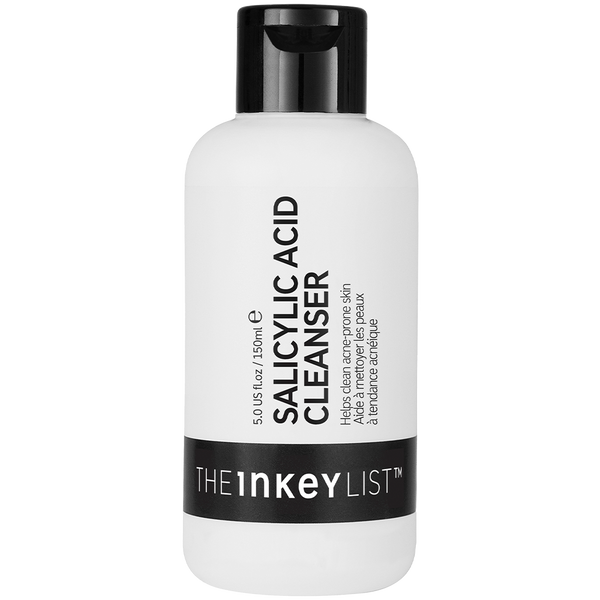
Salicylic Acid Cleanser: the core recommendation
The Salicylic Acid Cleanser is the one to start with, and for most people it is the only cleanser they need.
It is built around 2% salicylic acid, working inside the pore to dissolve the oil and dead skin buildup that leads to blackheads and breakouts. Alongside it, a zinc compound helps manage excess oil through the day rather than stripping it away, and 0.5% allantoin soothes skin while the active does its work. That combination is deliberate: the active handles the congestion, the supporting ingredients keep the experience comfortable enough to sustain twice daily.
The texture is a lightweight gel that rinses completely clean. The intended result is skin that feels genuinely clean and balanced, never tight, squeaky or stripped. If you have used a salicylic acid product before and found it uncomfortable, that experience is usually about the formula around the acid rather than the acid itself.
It suits oily, combination and normal skin, and it works well for teenagers, who are often navigating breakouts for the first time and do not need a complicated regimen. It is fragrance-free, gluten-free, and certified vegan by The Vegan Society. It has earned over 1,300 reviews, which for a cleanser is a meaningful body of real-world feedback.
Use it morning and night, on damp skin, for a full sixty seconds.
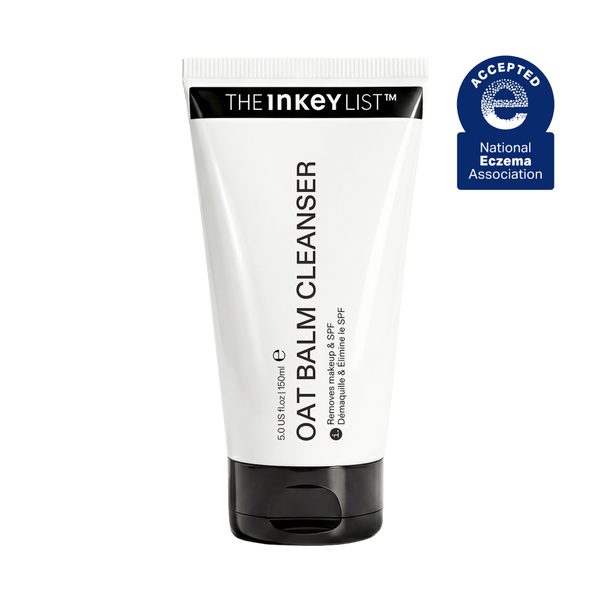
Oat Cleansing Balm: the first cleanse
The Oat Cleansing Balm does a different job, and it is worth understanding the distinction rather than treating the two as alternatives.
Colloidal oatmeal soothes skin and helps visibly reduce redness, while oat kernel oil lifts away impurities, makeup and sunscreen. It melts through the things that a water-based cleanser struggles to fully remove, which is exactly the point: if your second cleanse is spending its energy dissolving a layer of sunscreen, it never reaches the pore where the actual work needs to happen.
There is a hesitation worth addressing head-on here. People with acne-prone skin are often wary of anything described as a balm or an oil, on the reasonable assumption that rich textures and clogged pores do not mix. In a leave-on product, that caution has some merit. In a first cleanse, it does not apply in the same way, because the balm is emulsified with water and rinsed away completely within a minute. It is a removal tool, not a layer you are leaving on your face overnight.
When you need both, and when you do not
This is the honest part. The Salicylic Acid Cleanser works perfectly well on its own. If your evenings involve no makeup and no sunscreen, a single thorough cleanse is genuinely enough, and adding a second step will not make your skin clearer.
Double cleansing earns its place on specific days:
- Days you have worn makeup, particularly anything long-wear or full coverage.
- Any day you have worn sunscreen, which for most people should be every day. Sunscreens are designed to resist water and sweat, which also means they resist a quick wash.
- After heavy sweat, from exercise, heat or a long day.
On those days, the sequence is balm first, salicylic acid formula second. The complete guide to double cleansing covers the technique in detail.
If you want the pairing ready-made, the Acne Double Cleanse Duo brings the two together, and the wider Double Cleanse Duos collection has other combinations if your skin has a second concern to account for.
Do not forget everything below the jaw
Here is a point that surprises a lot of people: the Salicylic Acid Cleanser can be used on the chest, back and arms in exactly the same way as on the face.
Breakouts on the back and chest work through the same mechanism as facial acne. The skin there has a high density of sebaceous glands, it spends the day under fabric, and it gets exposed to sweat that sits against it for hours. The result is the same oil-and-dead-skin congestion, just somewhere harder to reach.
Use it in the shower, massage it in, give it a moment before rinsing. Back acne covers the specific triggers involved, including several that are about laundry and clothing rather than skincare at all.
If you would rather browse the full range and see what fits alongside your cleanser, the Acne & Breakouts collection is the place to start.
Products chosen, the next question is how they fit into a routine that works.
How to Build an Acne-Prone Skin Cleansing Routine
Technique first, because the best formula applied badly will underperform a decent formula applied well.
How to cleanse properly
- Start with damp skin. Splash with lukewarm water first. Applying cleanser to dry skin makes it harder to spread and more likely to drag.
- Use a raspberry-sized amount. More product does not clean more thoroughly, it just makes rinsing harder.
- Massage for a full sixty seconds. Use your fingertips in small circles. Cover the sides of the nose, the jaw, the hairline and the chin, which are the areas most people skip.
- Add a little warm water to emulsify. This helps lift everything and makes the rinse more complete.
- Rinse thoroughly with lukewarm water. Not hot. Hot water strips the barrier and leaves skin flushed.
- Pat dry with a clean towel. Pat, do not rub, and use a towel that is actually clean.
That technique applies morning and night. Here is where it sits in the wider routine.
The morning routine
- Cleanse with the Salicylic Acid Cleanser to remove overnight oil and prepare the skin.
- Hydrate with a lightweight hydrating layer. Hyaluronic Acid Serum on damp skin works well here, and the hyaluronic acid pillar explains why hydration and oiliness are separate issues.
- Treat with your targeted active. Niacinamide Serum is the standout for the morning, since niacinamide helps with oil control, the appearance of pores and redness across the day. If you prefer vitamin C in the morning, salicylic acid and vitamin C covers how the two sit together.
- Moisturize with something lightweight and oil-free.
- Apply sunscreen, every day, without exceptions.
The logic of that order is simple: thinnest to thickest, with anything water-based going on before anything that seals. Sunscreen goes last because nothing should be applied over it.
The evening routine
- First cleanse with the Oat Cleansing Balm to remove makeup, sunscreen and the day’s buildup. Skip this on days you wore neither.
- Second cleanse with the Salicylic Acid Cleanser, so the active reaches skin that is genuinely clear.
- Treat. This is where leave-on actives belong. Beta Hydroxy Acid (BHA) Serum offers a stronger leave-on exfoliating step for congestion, and the 360° Acne Clearing Serum is designed for anyone who wants one product working across all three stages of a breakout. For individual spots, Hydrocolloid Invisible Pimple Patches protect the area overnight, and Succinic Acid Acne Treatment is the targeted option for an active pimple.
- Moisturize to finish and support the barrier overnight.
Oily skin still needs moisturizer
This is the step that gets skipped most often, and skipping it is counterproductive.
The reasoning behind skipping seems sound: skin already produces plenty of oil, so why add more? But oil and water are not the same thing. Skin can be oily and dehydrated simultaneously, and that combination is extremely common in people using acne actives. When skin is left without hydration after cleansing and treating, the barrier struggles, and oil production can increase in response.
An oil-free, lightweight formula solves this without heaviness. Omega Water Cream is built for exactly this situation, and the best moisturizer for oily skin covers the wider category if you want to compare.
Pairing actives sensibly
Salicylic acid and niacinamide are a particularly good pairing for oily, acne-prone skin, since one clears the pore and the other manages oil and the redness that follows breakouts. Salicylic acid and niacinamide explains why they complement each other rather than competing.
That said, the most common routine-building error is enthusiasm. Introduce one new product at a time, give it two to three weeks, and only then add the next. Patch test anything new, and check what not to layer together before combining actives. A three-step routine used consistently will beat an eight-step routine abandoned in week two.
Sunscreen is not optional
Exfoliating actives increase sun sensitivity, and sun exposure darkens post-acne marks and prolongs how long they take to fade. Daily SPF is what protects the progress the rest of your routine is making. What is SPF explains how protection is measured and what the numbers mean, and Mineral Sunscreen SPF 30 is a straightforward daily option. Remember to remove it properly at night.
Realistic timelines
Most people notice a change within a few weeks of consistent use, typically starting with texture and congestion before inflamed breakouts follow. Stubborn or deeper breakouts take longer. Skin renews on its own schedule, and no cleanser overrides that.
Judge your routine on months, not days. Take a photo at the start so you have something honest to compare against, because gradual improvement is genuinely hard to perceive in a mirror you look into daily.
With the routine set, it is worth stepping back to ask what is actually causing the breakouts.
What Causes Breakouts (and What Your Cleanser Can Help With)
Skincare marketing tends to imply that every breakout has a topical solution. That is not true, and knowing which triggers your cleanser can influence, and which it cannot, is what stops you from blaming a perfectly good product for a problem it was never able to solve.
The core mechanism
Four things combine inside the follicle: excess oil, dead skin cells that have not shed, bacteria that thrive in that environment, and the inflammation that follows. Change any one of those and you change the outcome. A pore-clearing cleanser works directly on the first two.
Hormones
Hormonal fluctuation is one of the largest drivers of adult acne, particularly breakouts along the jaw, chin and lower cheeks. Androgens increase sebum production, which feeds the whole cycle.
A cleanser supports skin through hormonal breakouts by keeping pores clearer and managing oil. It does not change your hormones, and no topical product does. Hormonal acne covers what actually helps, including options that sit outside skincare entirely. If you assumed breakouts were something you would leave behind after your teens, adult acne after 25 is worth reading.
Stress
Stress is a well-documented acne trigger, working partly through cortisol’s effect on oil production and partly through inflammation. It is also the trigger people feel most defensive about, since “reduce your stress” is rarely actionable advice. Does stress cause acne covers the mechanism and what can realistically be influenced.
Diet
Diet and acne is an area where the evidence is genuinely more nuanced than most headlines suggest, and where a lot of unnecessary guilt gets generated. Rather than making claims here, does diet cause acne walks through what the research actually supports.
Product buildup and clogged pores
This one is squarely in your cleanser’s territory. Heavy makeup, sunscreen, rich moisturizers and hair products that migrate onto the face all contribute to congestion when they are not fully removed. If you have added products and noticed more breakouts, incomplete removal is a likely explanation, and it is one of the most fixable causes on this list.
Excess oil
Also directly addressable. Managing oil through the day reduces the raw material available for pore blockages. Excess oil explains why some skin produces more, and blackheads covers what happens when that oil oxidizes at the pore opening.
Post-acne marks are a separate problem
The flat brown or red marks left after a breakout heals are not active acne. They are pigmentation and lingering inflammation, and no cleanser will clear them, because there is nothing left in the pore to clear.
They need different ingredients and considerably more patience, and they fade far more slowly when exposed to sun without protection. Acne scars and post-acne marks explains the distinction between marks and true textural scarring, which are treated very differently.
Sensitive and acne-prone at the same time
Plenty of people have skin that both breaks out and reacts easily, which makes standard acne advice feel like a trap. Sensitive skin and acne addresses that combination directly, including how to introduce actives when your skin protests at everything.
The honest summary
A cleanser is excellent at managing oil, clearing buildup and keeping pores from congesting. For everything else, hormones, stress, genetics, it plays a supporting role. That is not a weakness. It is just worth knowing what you are asking of it.
When to see a dermatologist
If breakouts are persistent, painful, deep or cystic, or if they are leaving scarring, see a dermatologist. Cystic acne in particular responds to prescription treatment in ways that no over-the-counter routine can match, and delaying often means more permanent scarring. There is no version of that advice that needs hedging.
Understanding the causes raises an obvious follow-up: how do people accidentally make things worse?
Common Cleansing Mistakes That Make Breakouts Worse
If your routine seems to have stopped working, the cause is far more likely to be on this list than in your product selection.
Over-cleansing
The most consequential mistake here. Cleansing more than twice a day, or scrubbing aggressively, compromises the skin barrier. A damaged skin barrier means more irritation, more redness, more sensitivity and frequently more breakouts, which is the exact opposite of the intention.
The instinct is understandable. Skin feels oily, so you wash it again. But the extra wash strips the barrier, skin compensates with more oil, and the cycle tightens. Twice a day is the ceiling, with a third rinse after heavy exercise if genuinely needed. If you recognize tightness, stinging or flaking, over-exfoliated skin: signs and how to repair it covers recovery. On frequency specifically, how often should you double cleanse is the direct answer.
Chasing the squeaky-clean feeling
Worth repeating because it drives so many poor product choices. Tightness after rinsing means over-stripping, not cleanliness. Comfortable skin is correctly cleansed skin.
Water that is too hot
Hot water feels thorough and does real damage, stripping lipids and leaving skin flushed. Lukewarm, always.
Rushing
A five-second wash does not give any formula time to work. Sixty seconds. It is the easiest fix on this list.
Skipping moisturizer because skin is oily
Covered earlier, and it belongs here too, because it is one of the most common self-inflicted causes of a routine underperforming. Withholding hydration from oily skin frequently produces more oil.
Stacking too many actives at once
Adding a salicylic acid cleanser, a leave-on exfoliant, a retinol and a vitamin C in the same week is a reliable route to an irritated barrier. Irritated skin breaks out. Add one thing at a time, and check what not to layer together first.
Quitting too early
Many people abandon a routine in week two, sometimes during a purge, which is often the point immediately before things improve. The FAQ below covers purging in detail, because knowing the difference between purging and a bad reaction is what tells you whether to continue.
Not removing sunscreen and makeup properly
If your second cleanse is fighting through a layer of sunscreen, the active never reaches your pores. How to remove makeup properly and how to remove sunscreen properly cover the technique.
Using face wipes as the entire routine
Wipes move product around and leave residue behind. Fine as an emergency measure, inadequate as a routine. Are face wipes bad for your skin has the full picture.
Forgetting pillowcases, phones and hands
Small practical wins that cost nothing. Change your pillowcase regularly, wipe your phone screen, and stop resting your chin on your hands. None of these will clear acne alone, and all of them reduce the friction and transfer that make it worse.
These questions come up constantly, so here are direct answers to the ones that matter most.
The Takeaway on Choosing a Cleanser That Works
The cleanser is the foundation. For acne-prone skin, the right one does real work rather than simply removing surface dirt, because it reaches the place where breakouts actually begin and it does so twice a day, every day.
Three things determine whether a cleanser earns that description. It needs an active that reaches inside the pore, which in practice means salicylic acid and its oil-soluble ability to get where surface exfoliants cannot. It needs a formula that cleans without stripping, judged by how your skin feels sixty seconds after rinsing rather than by any claim on the label. And it needs to be used consistently, because prevention compounds in a way that occasional intensive treatment never will.
Set your expectations accordingly. Consistency over weeks beats intensity over days, every time. The routine that quietly runs twice a day for three months will outperform the ambitious eight-step regimen that lasted a fortnight.
Be honest about the limits too. A cleanser is one part of a routine, and a routine is one part of the picture. Hormones, stress and genetics all play a role that no topical product can override. If your breakouts are persistent, painful or cystic, a dermatologist will get you further, faster.
Skincare has become genuinely complicated, and a lot of that complexity exists to sell more products rather than to solve more problems. Understanding one step properly is worth more than adding five more. If you take one thing from this article, make it the sixty seconds. The Salicylic Acid Cleanser is a good place to put them.
If you want a personalized read on what your skin is actually dealing with, the Acne Analyzer Pro will give you a tailored assessment in a couple of minutes. You can also browse the full Acne & Breakouts range, or take the Skincare Quiz if you would rather have a complete routine built around your skin.
Because at The INKEY List, We Give A Care.
Frequently Asked Questions
Got a question?
Our askINKEY team are a friendly bunch of skincare experts with deep product knowledge and zero judgement. Whether you're an ingredient obsessive or just starting out, we'll make it make sense. No question too big. No question too small. We Give A Care, Every Day.


