

Bio-Active Ceramides vs Regular Ceramides
Not all ceramides work the same way — here’s what “bio-active” actually means, and how to choose the right one for your skin.
Author
askINKEY skincare advisor
Published
25 February, 2026
Time to read
19 minutes
Not all ceramides are equal. Two moisturizers can both say “ceramides” on the front of the pack, sit on the same shelf, and behave completely differently once they are on your skin. That is not marketing spin. It is a straightforward consequence of the fact that “ceramide” is a category, not a single ingredient.
Here is what the word on the label actually tells you: a ceramide is present in the formula. That is it. It does not tell you which type of ceramide. It does not tell you how that molecule is structured. It does not tell you what percentage is in there, what it has been formulated alongside, or whether the rest of the product is built to support it. Four fairly important pieces of information, all missing from the one word most people shop by.
This article is a comparison piece, not a beginner primer. It is written for people who already know roughly what ceramides do and now want to understand the differences between the options in front of them. If you are earlier in the journey and want the foundations first, start with the complete ceramide guide and come back here afterwards. Nothing below will make less sense for waiting.
What we are covering: what “bio-active” genuinely means when it appears on a ceramide product, how Ceramide NP, Ceramide AP and Ceramide EOP differ and why chain length is the thing that separates them, how bio-active ceramides relate to phytoceramides, how ceramides compare to hyaluronic acid and how they work with peptides, and finally which INKEY product suits which skin. By the end you should be able to read a ceramide ingredient list and know what you are looking at.
All of it starts with one badly explained word on the label. That word is “bio-active”.
What “Bio-Active” Actually Means
Most people assume “bio-active” is a sourcing claim. Something natural, something derived from a plant, something with a green leaf on the box. That assumption is understandable and it is wrong.
Bio-active describes how the molecule is built, not where it came from.
That single line is the foundation of everything else in this article, so it is worth sitting with. Bio-active refers to molecular structure. Specifically, it means the ceramide has been engineered to be skin-identical: built to match the structure of the ceramides your skin already produces on its own.
Why does that matter? Because your skin barrier is not a random pile of oils sitting on your face. It is an organized structure with a specific architecture, and lipids that match what is already there integrate into that architecture more neatly than lipids that do not. A structurally matched ceramide can slot into the skin’s own lipid organization rather than simply resting on the surface. Same destination, very different relationship with the material around it.
Here is the part that surprises people. A bio-active ceramide and a standard ceramide can both be Ceramide NP. Identical name on the ingredient list, same family of molecule, different structural engineering behind it. This is precisely why reading the ingredient list alone will only take you so far, and why the distinction is worth understanding before you spend money.
None of this requires you to relearn barrier biology from scratch, but a little context helps the structural explanation land. If the barrier itself is fuzzy territory, what your skin barrier actually is covers the fundamentals properly and we will not repeat them here.
What is worth knowing is the scale of the role ceramides play. They are a major structural component of the skin’s outermost layer rather than a minor additive, and the skin’s ability to maintain its own supply changes over time. That is the underlying reason topical ceramides became a genuine category rather than a passing trend, and it is well documented across dermatological literature published by the NIH and in patient guidance from organizations such as the Cleveland Clinic and WebMD.
So when a formula is described as bio-active, the claim being made is about construction quality at the molecular level and the formulation built around it. Not about a delivery gimmick, and not about where the raw material was grown. Structure and formulation. Hold onto those two words, because the honest comparison later in this article rests entirely on them.
One more thing before we go further. “Ceramide” is a family, not a single ingredient, and the family members do noticeably different jobs.
Ceramide NP, Ceramide AP and Ceramide EOP Explained
There are several ceramide classes used in skincare. Three come up often enough on ingredient lists that they are worth knowing by name, and the thing that separates them is chain length.
Think of your skin barrier as brickwork. Skin cells are the bricks, lipids are the mortar holding them together. Different ceramides behave differently within that mortar depending on the length of their fatty acid chain. Longer chains are better suited to sealing the outer surface. Shorter structures are better suited to rebuilding within it. Same wall, different construction jobs, and you need both for the wall to hold.
Ceramide NP: Rebuilding the Structure
Ceramide NP, formerly known as Ceramide 3, is the most researched ceramide type in skincare. If you have seen a single ceramide named on a product in the last decade, statistically it was probably this one.
Its job is structural rebuilding. Ceramide NP replenishes the structural lipids that hold the barrier together, restoring the mortar between the bricks where it has been depleted. When people talk about ceramides restoring a barrier that has been stripped by over-exfoliation, cold weather, harsh cleansers or simply time, Ceramide NP is usually the molecule doing the heavy lifting in that conversation.
It is also the ceramide used in INKEY’s bio-active formulas, which is a deliberate choice rather than a default one. The most researched ceramide type, engineered to a skin-identical structure, is a reasonable place to concentrate effort. Depletion of these structural lipids is what makes skin feel tight, look dull and react to products it previously tolerated. Replenishing them is the most direct response available.
Ceramide AP: Calming Reactivity
Ceramide AP, formerly Ceramide 6-II, is associated with calming reactivity. In practical terms, it is the one linked to skin looking and feeling less reactive and less sensitized.
If your skin has entered that frustrating phase where products you used comfortably for years suddenly sting, where flushing arrives without obvious cause, or where everything feels a bit too close to the surface, AP is the ceramide most associated with settling that picture. It works as part of a set rather than in isolation, which is why you rarely see it named alone.
Ceramide EOP: Sealing the Surface
Ceramide EOP, formerly Ceramide 9, has the longest fatty acid chain of the three. That length is not trivia, it is the whole functional point.
EOP is the barrier’s waterproofing layer. Those long chains are structurally suited to sealing the outer surface, reinforcing the skin’s resistance to everyday environmental stress and helping hold water inside the skin where it belongs. Without adequate sealing lipids, water moves outward and escapes continuously, a process worth understanding in its own right. Why your barrier loses moisture explains the mechanism clearly, and it is the reason a dehydrated-feeling face is often a sealing problem rather than a hydration-input problem.
You can drink water all day and apply humectants generously. If the seal is not doing its job, that water leaves.
Reading the Label: INCI Names and the Old Numbering
Here is a genuinely useful piece of label literacy. These ingredients appear on packaging exactly as Ceramide NP, Ceramide AP and Ceramide EOP under the INCI naming system, which is the standardized international convention for listing cosmetic ingredients.
The older numbering system, Ceramide 1, 3 and 6, is still used informally in articles and conversation, but it is not what you will find printed on a box. Knowing the INCI names means you can turn a product over and verify exactly which ceramides are in it, rather than trusting whatever the front of pack has decided to emphasize. That distinction between what a product claims and what its ingredient list proves is the reason this brand is called what it is called.
The three jobs, summarized:
- Ceramide NP rebuilds structure, replenishing the lipids that hold the barrier together
- Ceramide AP calms reactivity, helping skin look and feel less sensitized
- Ceramide EOP seals the surface, reinforcing resistance to environmental stress and holding water in
This is not the complete list of ceramide classes, and this article is not attempting to be. The complete ceramide guidecovers the full family properly if you want to go wider.
With the types clear, we can get to the question the title promises.
Bio-Active vs Regular Ceramides: The Honest Comparison
Two things genuinely separate a bio-active ceramide from a standard one. Not five, not a list of proprietary-sounding terms. Two: structural match and formulation quality.
Structural match is what we established earlier. It describes how closely the ceramide’s build mirrors what your skin produces naturally, and therefore how readily it integrates into the lipid structure that is already there. A skin-identical molecule is working with the existing architecture rather than alongside it.
Formulation quality is the part that gets discussed far less and probably matters just as much. A ceramide is one component of a finished product. What it is formulated alongside, at what level, and in what base, changes what that product actually does on skin. A ceramide sitting on an ingredient list in a poorly built formula is not going to outperform a well-built formula, regardless of how impressive the molecule is on paper.
A ceramide on the label tells you it is there. It does not tell you how it is built, or what it is built into.
Now the part where honesty matters more than positioning.
Standard ceramide formulations are genuinely effective. They are not a lesser product, a compromise, or a budget alternative. They are the right product for a different skin profile, and pretending otherwise would be an easy sale and a bad answer. Plenty of people will get better real-world results from a well-formulated standard ceramide product than from a richer bio-active one, because the texture suits their skin and they will actually use it consistently. Consistency beats sophistication every single time.
The clearest example is the Omega Water Cream. It is a lightweight, oil-free ceramide option, and for oily and combination skin it is frequently the more sensible choice. A rich, velvety cream on skin that is already producing plenty of its own oil is not an upgrade, it is a mismatch. Barrier support does not have to feel heavy to count.
What bio-active ceramides are built for:
- Dry skin that stays tight and uncomfortable no matter how much you apply
- Sensitive or easily sensitized skin looking for structural support
- Barrier-compromised skin, whether from over-exfoliation, actives, weather or general wear
- Anyone who wants a skin-identical ceramide structure as the core of their barrier routine
- Skin that has started reacting to products it previously tolerated without issue
Where a standard ceramide formulation is a strong fit:
- Oily and combination skin that needs barrier support without added richness
- Anyone who dislikes heavier textures and will not stick with them
- Warmer, more humid climates where a lighter finish is simply more wearable
- Layering under makeup, where a lightweight base performs better
- Daily maintenance on skin that is functioning well and does not need rebuilding
The damaged skin barrier collection is a useful place to start if you have already recognized your barrier is compromised and want to shop the concern rather than the ingredient.
What we are deliberately not doing here is telling you one works sooner than the other. Skin varies, routines vary, and the honest answer is that structural match and formulation quality are the real variables, not a race.
That covers structure. But there is a second word readers arrive with from search, and it gets confused with this one constantly.
Are Bio-Active Ceramides the Same as Phytoceramides?
No, but they are not in conflict either. The two terms answer two completely different questions, which is exactly why they get tangled together.
Phytoceramides describe source. Bio-active describes structure. One tells you where the ingredient came from. The other tells you how it is built. A single ceramide can be both at the same time, and frequently is.
What Phytoceramides Actually Are
The prefix “phyto” means plant. Phytoceramides are therefore ceramides derived from plant sources rather than animal ones. That is the entire content of the word. It is a sourcing description and nothing more.
It says nothing about how the molecule is structured, nothing about the concentration used, and nothing about the quality of the formula it sits in. A phytoceramide could be beautifully engineered or fairly basic. The word does not distinguish between them, which is precisely why “phytoceramides” alone is not enough information to judge a product by.
The two questions, kept clean:
- “Where did this come from?” is answered by phytoceramide. Plant-derived rather than animal-derived.
- “How is this built?” is answered by bio-active. Skin-identical molecular structure.
INKEY’s ceramides are plant-derived and Vegan Society certified. They are therefore phytoceramides and bio-active at the same time. Plant-sourced, and structurally engineered to match what skin makes. The Bio-Active Ceramide Moisturizer is the clearest example of both descriptions applying to one product, which is the whole point of separating the terms in the first place.
The practical upside of plant-derived sourcing is simple and worth stating without a sermon: it supports vegan certification and avoids animal-origin lipids. For a significant number of people that is a requirement rather than a preference, and it is reasonable to want it stated plainly rather than buried.
Phytoceramide Supplements vs Topical Ceramides
This is where most of the confusion originates, and it deserves a direct answer.
Phytoceramides are widely sold in the United States as oral supplements, usually capsules, frequently marketed around skin hydration. Search the word and you will find as many supplement listings as skincare products. They are a different product category operating in a different regulatory context entirely.
This article is about topical skincare. A ceramide applied directly to the skin, working within the skin barrier, in the layer where those lipids already exist and do their job. That is a fundamentally different proposition from a capsule, and we are not going to make any claim about oral supplements in either direction. The distinction is the useful part: if you searched “phytoceramides” and landed on capsules, you were looking at a different category from the one discussed here.
So does plant-derived mean less effective?
No, and the reason is the entire argument of this section. Source and structure are separate variables. Where a ceramide comes from and how it is built are two independent questions, and the answer to one does not predict the answer to the other. A plant-derived ceramide engineered to a skin-identical structure is not making a compromise on the sourcing side. It is answering both questions well.
It is also worth remembering that ceramides are a structurally diverse family. Research into the outer layer of skin has documented a wide range of distinct ceramide species occupying different structural roles, which reinforces why treating “ceramide” as one interchangeable ingredient is a mistake in the first place.
If you want to go wider on sourcing and the full ceramide family, the complete ceramide guide is the place for it.
That covers what ceramides are and where they come from. The next question is how they behave next to everything else already in your routine.
Ceramides vs Hyaluronic Acid, and Ceramides With Peptides
Two questions come up constantly once people understand ceramides. Both have short answers, and both are worth understanding properly because they change how you build your routine.
Ceramides vs Hyaluronic Acid: Different Jobs Entirely
Hyaluronic acid pulls water in. Ceramides stop it escaping. Different jobs, no overlap, no competition.
These are complementary ingredients, not alternatives, and the framing of “ceramides vs hyaluronic acid” is slightly misleading as a result. You are not choosing between them. Hyaluronic acid is a humectant: it attracts and holds water in the skin. Ceramides are lipids: they build and seal the barrier so the water that is there stays there. One brings water in, the other keeps it. Doing one without the other is doing half the job.
The application order matters more than people expect:
- Apply hyaluronic acid to damp skin first, straight after cleansing while there is still moisture on the surface
- Follow with a ceramide moisturizer on top to seal everything in
- Do not reverse the order
Damp skin is not a fussy detail. Hyaluronic acid works by drawing water in, and it needs something to draw from. Applied to bone-dry skin in a dry environment, a humectant has limited local water to attract. Applied to damp skin and then sealed, it has exactly what it needs.
Reverse the order and the whole thing fails quietly. Seal the skin first with a ceramide moisturizer, then apply hyaluronic acid on top, and you have left the humectant sitting above the seal with nothing to work with and nothing holding it in place. The ingredients are fine. The sequence is not.
If layering is where you tend to lose confidence, the moisture sandwich method is the natural next read and turns this principle into a repeatable technique. For more on the underlying pillar, what hyaluronic acid does covers it in full, and the dehydrated skin collection is worth a look if the water-loss picture sounds familiar.
Ceramides and Peptides: Protect and Prompt
Ceramides protect, peptides prompt change. That is the one-line version and it holds up well.
The mechanisms are entirely separate:
- Ceramides are lipids. They rebuild and seal the barrier. Their role is structural, physical, architectural. They are building material.
- Peptides are chains of amino acids. They signal skin to firm. Their role is communicative rather than structural. They are messages.
Building material and messaging. Two different categories of ingredient doing two different things, which is why the question “should I use ceramides or peptides” does not really have a competitive answer.
They are also completely safe to combine. This is one of the most straightforward pairings in skincare: no irritation risk, no pH conflict, no waiting period between layers, no alternating nights. If you have been cautious about combining actives after a bad experience with something else, this is not the pairing to worry about. What peptides do covers the ingredient class in more depth if you want the full picture.
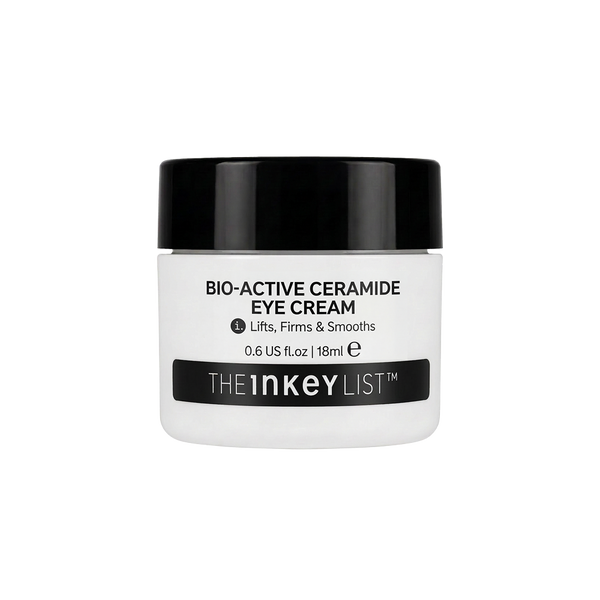
The two are formulated together in INKEY’s Bio-Active Ceramide Eye Cream, where the logic is easy to follow: ceramides strengthen the barrier in an area where skin is naturally thinner, peptides work on visible firmness. Which brings us neatly to the products themselves.
The INKEY Bio-Active Ceramide Range
Three hero products, three different jobs, plus one optional glow step. The education above should make choosing between them fairly quick.
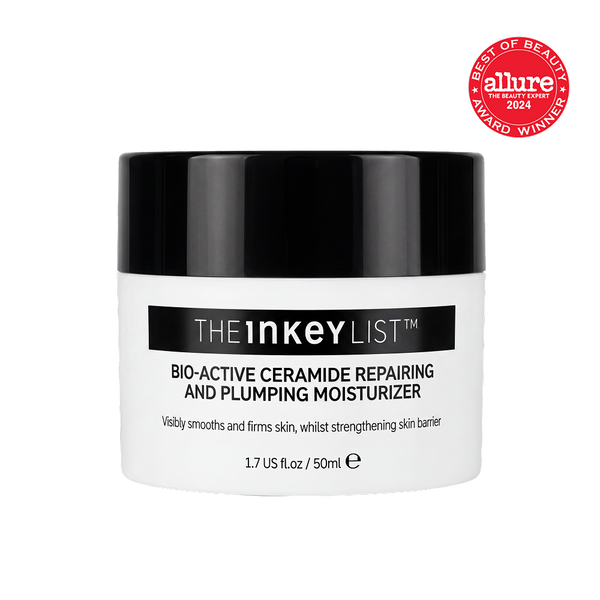
Bio-Active Ceramide Moisturizer
The Bio-Active Ceramide Moisturizer is $22 for 50ml and it is the core barrier step of the range.
It is formulated with Bio-Active Ceramide NP, the skin-identical structural ceramide discussed at length above. The texture is rich and velvety but absorbs without heaviness, which is a harder balance to strike than it sounds. Rich creams frequently sit on the surface and feel occlusive for an hour. This one is built to sink in.
Who it is for:
- Dry skin that feels tight and uncomfortable through the day
- Sensitive skin that needs structural support rather than more actives
- Barrier-compromised skin recovering from over-exfoliation, harsh weather or an over-enthusiastic routine
- Anyone who wants a skin-identical ceramide as the foundation of their moisturizing step
Bio-Active Ceramide Eye Cream
The Bio-Active Ceramide Eye Cream comes in an 18ml size and is the direct application of the ceramides-and-peptides principle covered earlier.
It is formulated with Bio-Active Ceramide NP plus a Tetrapeptide Complex. Ceramides strengthen the barrier, peptides visibly lift and firm. Protect and prompt, in one product, applied to the area where thinner skin makes barrier support particularly worthwhile.
The claims:
- Up to 4x wrinkle reduction¹
- Clinically proven to lift eyelids by 29% in 4 weeks²
- 89% saw fine lines smoothed and blurred instantly³
- Suitable for sensitive eyes. Dermatologist and ophthalmologist approved.
¹ 12-week independent clinical study of 30 people, Ceramide NP 0.2% vs placebo. ² Clinically tested on 32 participants over 28 days. ³ Tested on 32 participants.
For current pricing, check the product page directly.
Application technique genuinely affects results around the eye, more so than almost anywhere else on the face. Too much pressure, the wrong finger, the wrong placement, and you are working against yourself. How to apply eye cream the right way is a short read that will make whatever eye cream you own perform better.
If you are wondering whether it is too early or too late to start, when to start using anti-aging products addresses the timing question honestly.
Bio-Active Ceramide Neck Stick
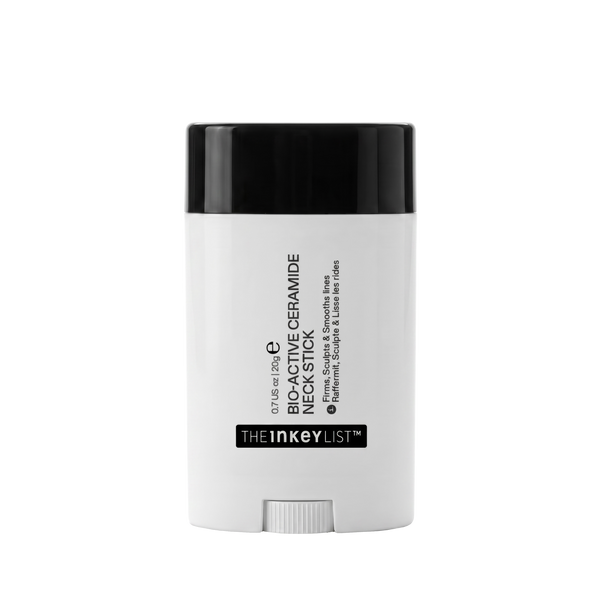
The Bio-Active Ceramide Neck Stick is $17 and targets the area most routines skip entirely.
It is formulated with 0.2% Bio-Active Ceramide NP, 1% Gatuline® In-Tense MB and 2% CO2llageneer®, in a gua sha-inspired stick format designed for the neck and chest. The shape is not decorative. The applicator is built for the contours of the neck, which is a genuinely different surface to work across than a flat cheek.
The claims:
- Clinically proven to lift, tighten and firm neck and chest in 14 days⁴
- Clinically proven to reduce ‘tech neck’ by 30% in 8 weeks⁴
- Jawline tightness improved by 32% in 56 days⁴
⁴ Clinically tested on 28 participants over 8 weeks.
The neck and chest raise several distinct concerns, and they are worth separating rather than lumping together. If hours spent looking down at a screen are the issue, fight tech neck is the page that covers that specifically and in far more detail than we will here.
Horizontal neck lines are a different matter with different causes, and how to get rid of neck lines addresses them directly.
Then there is the thin, papery texture that can develop across the chest and lower neck over time. What causes crepey skin explains why that happens, which is useful context before deciding what to do about it.
Adding Glow: Exosome Glow Serum
The Exosome Glow Serum is $24 and it does a different job from everything above.
Ceramides rebuild. Glow is a separate objective. If your barrier feels genuinely stronger, the tightness has gone and the reactivity has settled, but your skin still looks flat, that is not a barrier problem anymore. That is a radiance problem, and it needs a different tool.
Layer this underneath the ceramide moisturizer rather than instead of it.
- 100% saw more glowing skin, clinically proven*
- Clinic worthy rejuvenated skin in 14 days*
- 6-in-1 skin rejuvenation: clinically proven to visibly improve radiance, hydration, tone, firmness, elasticity, and texture*
- 55% reduction in visible signs of skin stress (redness, puffiness, visible irritation)*
- 63% increase in skin renewal activity in 8 hours*
- Proven to deliver up to 12-hours of hydration**
- Helps support natural collagen production
4-week clinical study of 26 people. Clinical study of 31 people. In-vitro testing of Cica Exosomes showed a 55% reduction in pro-inflammatory markers and a 63% increase in markers associated with skin renewal after 8 hours.
If exosomes are an unfamiliar ingredient category, what exosomes are covers the background properly.
Three heroes, three jobs, plus the glow step. Next, how they sit together in a routine you will actually keep up.
Building a Ceramide Routine That Works
Knowing what to buy is one thing. Knowing where it goes in the order is what stops products sitting unused in a drawer.
The general principle, which will serve you well beyond these specific products: apply thinnest to thickest. Watery textures first, richest last. It is not a rigid law, but it is right far more often than it is wrong, and it means you can slot a new product into your routine without looking up instructions every time.
AM routine:
- Cleanse
- Hydrating serum on damp skin
- Treatment serum, if you use one
- Ceramide moisturizer to seal
- SPF, every day, without exception
PM routine:
- Cleanse
- Hydrating serum on damp skin
- Treatment serum or retinol
- Ceramide moisturizer to seal
Pairing with retinol. Apply retinol first, then the ceramide moisturizer on top. Retinol supports skin’s natural renewal process, and it can also bring dryness and sensitivity along with it, particularly in the early weeks. Ceramides help buffer that, which matters more than it might sound: the single biggest reason people abandon retinol is that their skin becomes uncomfortable and they quietly stop. A strong barrier underneath makes consistency achievable. If you are layering multiple actives, what not to mix with retinol is essential reading, and what retinol does covers the ingredient itself.
Pairing with niacinamide. No conflict. Niacinamide works comfortably alongside ceramides and the pairing needs no special handling. What niacinamide does has the detail.
Daily SPF. A strong barrier and daily sun protection work together rather than substituting for each other. Why SPF matters covers the reasoning.
Supporting products. For oily and combination skin, the Omega Water Cream is the lighter option and delivers ceramide support without added richness. The oily skin collection is worth browsing if that is your profile. For an additional barrier layer underneath your moisturizer, the Ectoin Hydro-Barrier Serum sits well in the serum step and helps soothe and comfort skin.
Build the routine you will actually repeat. A simple four-step routine done nightly outperforms an elaborate one done twice a week.
Conclusion: Choosing the Right Ceramide for Your Skin
Two definitions carry this entire article. Bio-active describes structure, meaning a molecule engineered to match what your skin already makes. Phytoceramide describes source, meaning plant-derived rather than animal-derived. A ceramide can be both, and INKEY’s are.
The three named types, in one line: NP rebuilds structure, AP calms reactivity, EOP seals.
Where to start, depending on your skin:
- Dry, sensitive or barrier-compromised skin: begin with the Bio-Active Ceramide Moisturizer
- Oily and combination skin: the lighter Omega Water Cream is the better fit
- Sensitive and dehydrated skin: layer the Ectoin Hydro-Barrier Serum underneath your moisturizer
- Eye area concerns: the Bio-Active Ceramide Eye Cream
- Neck and chest: the Bio-Active Ceramide Neck Stick
- Skin that looks flat despite a healthy barrier: add the glow step
The genuinely useful takeaway is not which product to buy. It is that you can now read a ceramide label and know what it is telling you and what it is leaving out. Clear guidance, proven ingredients, real results. That is the whole job
Study References
Bio-Active Ceramide Eye Cream
¹ 12-week independent clinical study of 30 people, Ceramide NP 0.2% vs placebo.
² Clinically tested on 32 participants over 28 days.
³ Tested on 32 participants.
Bio-Active Ceramide Neck Stick
⁴ Clinically tested on 28 participants over 8 weeks.
Exosome Glow Serum
4-week clinical study of 26 people.
Clinical study of 31 people. In-vitro testing of Cica Exosomes showed a 55% reduction in pro-inflammatory markers and a 63% increase in markers associated with skin renewal after 8 hours.
Ready to put it into practice? Shop the Bio-Active Ceramide Moisturizer, $22, for skin-identical barrier support.
Still reading and learning? The complete ceramide guide goes wider on the full ceramide family.
Because at The INKEY List, We Give A Care.
Frequently Asked Questions
Got a question?
Our askINKEY team are a friendly bunch of skincare experts with deep product knowledge and zero judgement. Whether you're an ingredient obsessive or just starting out, we'll make it make sense. No question too big. No question too small. We Give A Care, Every Day.


