



PDRN vs Exosomes: What’s the Difference and Which Does Your Skin Need?
Two of skincare’s most talked-about ingredients, compared honestly, so you know which one your skin actually needs.
Author
askINKEY skincare advisor
Published
13 May, 2026
Time to read
17 minutes
PDRN and exosomes are the two ingredients people are most often trying to choose between right now. Both arrived in skincare from clinical settings. Both promise glow. Both have long waiting lists at aesthetic clinics and a growing shelf presence at home.
Here is the highest-level version of each. PDRN is a DNA fragment that works through one well-mapped route in the skin. Exosomes are tiny messengers that carry a set of signals between cells. If you want the full explainers, they live elsewhere: read what PDRN is and what exosomes are. This page is not a definition. It is a decision.
The two ingredients share more than most comparisons admit. Both are clinically backed. Both are 100% vegan in INKEY’s formulations. Both are suitable for sensitive skin. What separates them is not quality or strength. It is route. They take different paths to visible results, which means they suit different priorities.
Over the next few thousand words you will get four things: how PDRN Serum and Exosome Hydro-Glow Complexactually compare, which one suits which concern, whether it makes sense to use both, and exactly how to layer them if you do.
The Short Answer: PDRN vs Exosomes at a Glance
If you only read one section of this PDRN vs exosomes comparison, read this one.
PDRN works through one targeted, well-mapped route in the skin, which makes it precise and cumulative. Exosomes deliver a broader set of signals at once, which is why the visible improvements show up across several measures rather than in one place.
That is the whole comparison in two sentences. Everything below is detail.
Choose PDRN if
- Your main concern is fine lines, loss of bounce or skin that has started to feel less resilient than it used to
- You want an immediate glass-skin finish you can see on day one
- You are thinking in months rather than weeks and you want a structural, cumulative approach
- You like the idea of one ingredient doing one job extremely well
- You want a vegan alternative to the salmon-derived PDRN that dominates this category
Choose Exosome Hydro-Glow Complex if
- Your skin looks tired, dull, stressed or flat rather than lined
- Your concerns are situational: travel, pollution, bad sleep, deadline weeks, seasonal change
- You want visible results on a shorter timeline
- You would rather improve several things at once than one thing perfectly
- You want 6-in-1 skin rejuvenation: clinically proven to visibly improve radiance, hydration, tone, firmness, elasticity, and texture*
Choose both if
- You have more than one concern running at the same time, which is true of most people
- You already have a stable routine and you are adding, not rebuilding
- You want the structural work and the situational work happening in parallel
- You are willing to be consistent with two serums rather than sporadic with two serums
Some facts apply no matter which way you go. Both PDRN Serum and Exosome Hydro-Glow Complex are vegan. Both are fragrance-free. Both are suitable for sensitive skin. Both are fine to use during pregnancy, with the usual advice to check with your doctor or midwife. Neither requires an introduction period, and neither causes purging. You do not need to build up tolerance, alternate nights or brace yourself for a bad fortnight.
If your underlying issue is dehydrated skin or persistent redness, read on, because the honest answer in those cases may be a third product entirely.
What PDRN and Exosomes Actually Are (The Short Version)
You need just enough grounding for the comparison to make sense. Here it is, briefly, with the full detail one click away.
PDRN in short
PDRN stands for polydeoxyribonucleotide. It is a fragment of DNA, and that matters because skin cells already recognize DNA fragments as familiar material rather than foreign material. It is not an acid, not a retinoid and not an exfoliant, which is why it behaves so gently on the skin.
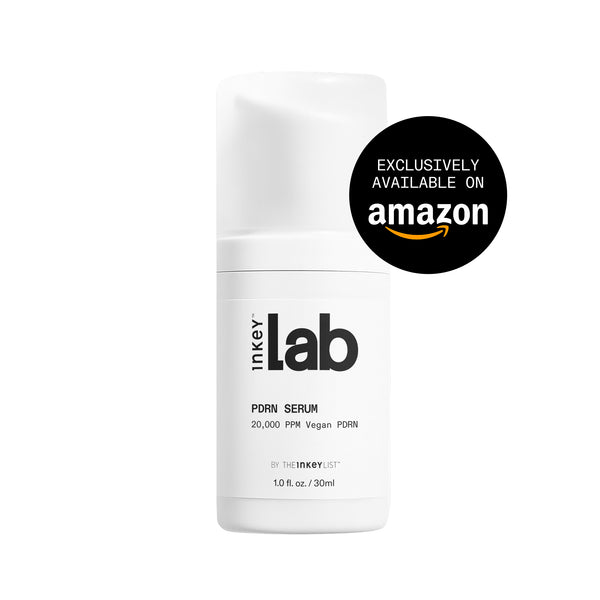
INKEY’s PDRN Serum uses 2% INJIN Vegan PDRN at 20,000 PPM, derived from the plant Artemisia capillaris. This is the “no salmon” point, and it is a genuine differentiator. Most PDRN in circulation is salmon-derived, which is why the category picked up the nickname explored in our guide to salmon sperm serum. INKEY’s is plant-derived and 100% vegan.
The formula also carries an 18% emollient blend. That blend is responsible for the immediate glass-skin finish you see the first time you use it. Full detail lives in the complete PDRN guide.
Exosomes in short
Exosomes are nanoscale messengers. They are naturally occurring packages that carry signals between cells, and the reason the skincare world got excited is that a message is a fundamentally different thing from an active ingredient. An acid does something to skin. A message tells skin something.
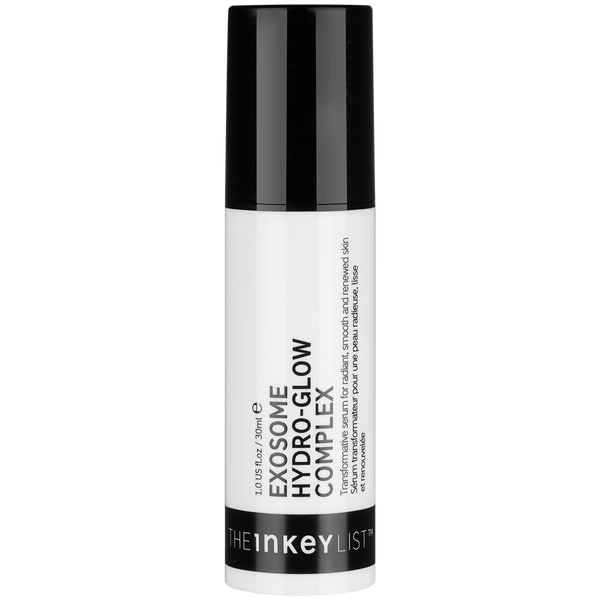
INKEY’s Exosome Hydro-Glow Complex uses 1% Cica Exosomes derived from Centella Asiatica, the plant better known as cica. Plant-derived, 100% vegan, no animal or human-derived material anywhere in the formula.
The supporting cast is doing real work too: 1% Hyaluronic Acid for water-binding hydration, 1% Ectoin for comfort and resilience, Kollaren peptide, Prickly Pear Extract and Q10.
Concentration is the number that matters here, not particle counts. For why, read the full exosomes guide.
That is deliberately all you get. The interesting question is not what these ingredients are. It is how differently they behave once they are on your face.
How PDRN and Exosomes Work Differently
This is where the comparison actually earns its keep. Two ingredients can both be described as “renewing” and still work in almost completely different ways.
PDRN takes one targeted route
PDRN’s activity is understood to run through the adenosine A2A receptor. In plain English: PDRN attaches to a specific docking point on the surface of fibroblasts, which are the cells in your skin responsible for producing its structural support network. One key, one lock, one destination.
This mechanism is documented in the pharmacological literature, most notably in Squadrito and colleagues’ 2017 review in Frontiers in Pharmacology, which sets out the evidence that PDRN’s effects are mediated through that receptor and that blocking the receptor blocks the effect.
An important piece of honesty here, and we would rather say it than let you discover it: that research concerns pharmaceutical-grade PDRN used in a clinical context. It is not a study of a topical cosmetic serum. It tells you the mechanism is real and well characterized. It does not tell you that a bottle on your bathroom shelf reproduces clinical outcomes. Those are two different claims, and only the first one is ours to make.
The practical consequence of a single targeted route is that PDRN is precise and cumulative. It is not a scattergun. It is one very detailed instruction, delivered repeatedly, to one type of cell. That is why the meaningful changes are measured in weeks and months rather than days.
Exosomes deliver a broader set of signals
Exosomes are not a molecule with a destination. They are a delivery format.
The scientific community defines extracellular vesicles, the family exosomes belong to, with real precision. The MISEV2018 position statement in the Journal of Extracellular Vesicles describes them as particles naturally released from cells, enclosed by a lipid bilayer, that cannot replicate themselves. That last part is worth sitting with. These are packages, not organisms. They carry contents; they do not multiply.
Because a package can carry many things at once, exosomes deliver a payload of signals rather than a single instruction. That is precisely why the visible benefits show up across several measures simultaneously instead of concentrating in one.
“They are best described as tiny communication bubbles that our cells naturally release, akin to emails or text messages.” Tony Kaliya, speaking to Marie Claire UK
That analogy is the clearest one in circulation. If exosomes are a batch of messages, PDRN is a single detailed memo hand-delivered to one department. Neither approach is better. A memo is not a worse form of communication than an inbox. They are built for different jobs.
Speed and shape of results
This is where the two ingredients feel most different in real life, and where honesty matters most.
PDRN, day one. You will see a glass-skin finish almost immediately. We want to be straightforward about why: that is the 18% emollient blend, not the PDRN. Emollients smooth and soften the skin surface, light reflects more evenly, and skin looks glassy. It is a real, visible, genuinely lovely effect. It is also a surface effect.
PDRN, over weeks. The structural work builds quietly underneath that finish. This is the slower half of the story, typically assessed over 8 to 12 weeks of consistent use. PDRN helps support natural collagen production, and support is the accurate word. Nothing here happens overnight, and any brand telling you otherwise about a structural ingredient is describing an emollient.
Exosomes, on a faster clock. Exosome Hydro-Glow Complex is clinically tested for clinic worthy rejuvenated skin in 14 days*. In-vitro testing recorded a 63% increase in skin renewal activity in 8 hours***, and the formula is proven to deliver up to 12-hours of hydration**.
There is also the stress dimension, which is increasingly what people actually mean when they say their skin looks tired. Testing recorded a 55% reduction in visible signs of skin stress (redness, puffiness, visible irritation)***. If that description sounds like your skin after a long-haul flight or a bad week, our guide to what skin stress is unpacks it properly.
What they genuinely share
Both are plant-derived. Both are 100% vegan. In a category where salmon-derived PDRN and animal-derived exosome material are common, that is not a marketing footnote. It is a sourcing decision that affects what is actually in the bottle, and it is one of the few points where INKEY’s two hero ingredients converge completely.
Understanding the mechanisms is useful. Choosing between them is more useful still, so let’s get specific about concerns.
Which One Does Your Skin Need?
People do not shop by mechanism. They shop by problem. So here is the guidance organized the way you actually think about your face in the mirror.
If your concern is fine lines and loss of bounce
Go with PDRN Serum.
This is a structural concern, and PDRN’s targeted route is aimed squarely at the cells that build and maintain skin’s structural support. It helps support natural collagen production, and that is exactly the kind of slow, foundational work that fine lines and reduced bounce respond to.
Set your expectations to weeks and months, not days. You will get the glass-skin finish immediately, which is a pleasant early reward, but the reason to stay consistent is the part you cannot see yet.
If your skin looks tired, dull or stressed
Go with Exosome Hydro-Glow Complex.
Stressed-looking skin is a different problem from aging skin, and it deserves a different answer. Think about the state your face is in after a red-eye flight, a week of four-hour sleeps, a stretch of city pollution or a genuinely brutal deadline period. Skin looks flat, puffy, blotchy and somehow thinner.
Testing on the Cica Exosomes recorded a 55% reduction in visible signs of skin stress (redness, puffiness, visible irritation)***, which maps almost exactly onto that description. This is the situational answer, and situational is not a lesser category. For most people it is the majority of their bad skin days.
If your concern is dullness and uneven tone
Go with Exosome Hydro-Glow Complex.
In a 4-week clinical study, 100% saw more glowing skin, clinically proven*. Glow is the thing this formula was built around, and tone evenness is part of the same package: 6-in-1 skin rejuvenation: clinically proven to visibly improve radiance, hydration, tone, firmness, elasticity, and texture*.
If you are weighing this against other glow ingredients, we compared them head to head in vitamin C vs niacinamide vs exosomes.
If your concern is dehydration
Either one works, but for different reasons.
PDRN Serum gives you that emollient-driven finish, which makes skin feel immediately smoother and more comfortable. Exosome Hydro-Glow Complex is proven to deliver up to 12-hours of hydration**.
Now the honest part. If your skin is dehydrated because your barrier is compromised, meaning it feels tight, stings when you apply things, flushes easily and never seems to hold onto moisture no matter what you layer on, then neither of these is your priority purchase. Start with Ectoin Hydro-Barrier Serum, get the barrier stable, and add a hero serum afterwards.
We would rather point you to the more appropriate product than the more exciting one. Our guide to dehydrated skinexplains how to tell dehydration and barrier damage apart.
If you have oily or combination skin
Both serums suit you. The variable that usually causes problems is what goes on top.
Pair either serum with Omega Water Cream rather than a richer moisturizer. You get the hydration without the heaviness, and you avoid the common mistake of blaming a serum for congestion that a heavy cream actually caused.
If your skin is sensitive or reactive
Both are suitable. Neither requires an introduction period. Neither has an adjustment phase.
We are not going to tell you one is calmer than the other, because that is not a claim we can stand behind. What we will tell you is to patch test regardless, which is true of any new product on reactive skin. If redness is a persistent feature rather than an occasional one, read the redness guide alongside this one.
If you are new to all of this
Either is a reasonable starting point, and you genuinely cannot get this wrong.
The tiebreaker is simple. Structural concerns, meaning lines, firmness and bounce, point to PDRN. Situational concerns, meaning dullness, tiredness and stress, point to exosomes. Pick the one that matches the sentence you would use to describe your skin out loud.
Now for the question almost everyone asks next.
Can You Use PDRN and Exosomes Together?
Yes. And for a lot of people it is the more complete approach, because the two are not doing the same job twice.
That is the crux of it. Layering two products that share a mechanism is redundancy. Layering two products with genuinely different routes is coverage. PDRN handles the structural, cumulative work. Exosomes handle the broader, faster, more situational work. There is no conflict between them and no need to alternate days.
The layering rule
Exosome Hydro-Glow Complex goes on first, applied to damp skin straight after cleansing. PDRN Serum goes on second.
The logic is thin-to-thick, which is the only layering rule most routines ever need. The exosome formula is the lighter, more water-based of the two, so it goes closer to the skin. The PDRN serum, with its 18% emollient blend, is richer and sits better on top. Apply it the other way around and the lighter formula has to fight through an emollient layer.
Damp skin matters for the first step. Applying to skin that is still slightly wet from cleansing gives the hydrating actives something to work with immediately.
Your morning routine
- Cleanse.
- Exosome Hydro-Glow Complex on damp skin.
- PDRN Serum.
- Optional: Hyaluronic Acid Serum if your skin wants extra water.
- Bio-Active Ceramide Moisturizer to seal everything in.
- Daily broad-spectrum SPF as your final morning step, every day, without exceptions.
On that last step: sun protection is the single highest-value thing in any routine aimed at glow or firmness. There is limited point supporting your skin’s structure all week and then skipping protection. Read why SPF matters if you need convincing.
Your evening routine
- Double cleanse, especially if you have worn SPF or makeup.
- Exosome Hydro-Glow Complex on damp skin.
- PDRN Serum.
- Optional: Ectoin Hydro-Barrier Serum if skin feels dry, tight or stressed.
- Optional: Starter Retinol Serum, PM only.
- Bio-Active Ceramide Moisturizer.
The ceramide step is not optional in the way the others are. Ceramides are what hold the whole structure together, and a moisturizer with them does more than sit on top of your serums.
If you are working Ectoin in alongside other actives, our guide to layering Ectoin with retinol and other actives covers the order in more detail.
INKEY Tip: A pea-sized amount of Exosome Hydro-Glow Complex and one pump of PDRN Serum is enough for your whole face. These are concentrated formulas. More product does not mean more results. It mostly means you finish the bottle faster.
What to expect, week by week
Day one. Glow from both. The exosome formula gives you an immediate fresh, hydrated look. The PDRN serum gives you the glass-skin finish from its emollient blend. This is the instant-gratification stage, and it is real, but it is not the point.
Two weeks. This is where the exosome data lands: clinic worthy rejuvenated skin in 14 days*. If you started for dullness or tiredness, this is your checkpoint.
Eight to twelve weeks. PDRN’s contribution to firmness and hydration builds across this window. It is slow, it is unglamorous, and it is the part most people quit before reaching. Take a photo on day one in consistent lighting. You will need it, because gradual change is almost impossible to perceive day to day.
What else can you use alongside them?
Both are compatible with Vitamin C, Niacinamide, AHAs, BHAs and retinol. There is no incompatibility list to memorize here.
The only rule that genuinely matters is order: thinnest to thickest, water-based before oil-based, retinol in the evening only. If you would rather not assemble it yourself, the Exosome + Ceramide Glow Duo pairs the exosome formula with a ceramide moisturizer as a ready-made combination.
Compatibility is one thing. Safety questions deserve their own section rather than a footnote.
Safety, Sensitivity and What to Know Before You Start
Most brands bury this in an FAQ accordion. We would rather put it in the middle of the article where you will actually read it.
Both are built for sensitive skin
PDRN Serum and Exosome Hydro-Glow Complex are both fragrance-free and suitable for sensitive skin. Neither has an introduction period. Neither has an adjustment phase. You do not need to start twice weekly and work up, and you do not need to sandwich them between moisturizer layers to soften the blow.
That is a meaningful practical difference from actives like retinol, where the first few weeks are genuinely a negotiation.
Neither causes purging
Purging is associated with ingredients that accelerate cell turnover, pushing existing congestion to the surface faster than it would have arrived on its own. Retinoids and certain acids do this. PDRN and exosomes are not in that category.
So the guidance is clear: if you break out after starting either of these, do not write it off as a phase you need to push through. Treat it as a reaction. Stop, simplify your routine, and reintroduce products one at a time. “It gets worse before it gets better” is legitimate advice for some ingredients and a bad excuse for others.
Neither causes photosensitivity
You can use both morning and evening. Neither makes your skin more vulnerable to UV.
Daily SPF still applies, because daily SPF always applies. Not as damage control for your serums, but as the foundation everything else is built on. See why SPF matters.
Pregnancy and breastfeeding
Both are suitable during pregnancy and breastfeeding.
Two pieces of standard advice hold. Patch test, because skin can behave unpredictably during pregnancy even with products you have used for years. And check with your doctor or midwife, because they know your circumstances and we do not. Our guide to pregnancy-safe skincare covers what to keep and what to pause across a full routine, including the ingredients that are genuinely off the table.
Using them with retinol
Entirely compatible. Retinol in the evening only.
The combination is intentional rather than merely tolerated. The Retinol Boost Duo pairs Starter Retinol Serum with Exosome Hydro-Glow Complex, which tells you something about how well the two sit together.
Order in the evening: exosome formula on damp skin, then PDRN, then retinol, then moisturizer. If you are new to retinoids, what not to mix with retinol and our complete retinol guide will save you some trial and error.
Topical versus clinic: the distinction that matters most
Everything in this article refers to topical, plant-derived cosmetic formulas that you apply to the surface of your skin.
Injectable exosome and PDRN treatments performed in clinics are a separate category. Different formulations, different concentrations, different delivery, and an entirely different regulatory framework. The research that made these ingredients famous, including the Squadrito review referenced earlier, largely comes from that clinical world.
Clinical findings do not automatically transfer to a bottle. A serum is not a diluted injectable, and any brand implying otherwise is borrowing credibility it has not earned. Both INKEY products are cosmetic products, not drugs, and we make no therapeutic claims for either.
If you are weighing the two delivery routes, PDRN injections vs topical sets out what each realistically offers.
Now, the specific questions people ask most.
PDRN vs Exosomes: Two Routes to the Same Goal
The distinction fits in one sentence. PDRN takes one targeted route to a specific type of skin cell, while exosomes deliver a broader set of signals that support several visible improvements at once.
This was never a competition. For a lot of people the honest answer to PDRN vs exosomes is both, applied in the right order, used consistently enough to matter. For everyone else, it is whichever one matches the concern they would name first if you asked them about their skin.
What the two have in common is worth restating, because it is unusual. Both are plant-derived. Both are 100% vegan. Both are clinically tested with the study sizes disclosed rather than buried. Both are fragrance-free, suitable for sensitive skin, and require no introduction period, no build-up phase and no bad fortnight.
If you want one line to carry away, take this one: Exosome Hydro-Glow Complex delivers 6-in-1 skin rejuvenation: clinically proven to visibly improve radiance, hydration, tone, firmness, elasticity, and texture*, while PDRN Serum does the slower structural work underneath.
Clear guidance, proven ingredients, real results. Choose the route that fits the skin you actually have, not the ingredient that happens to be loudest this month.
Shop PDRN Serum
Shop Exosome Hydro-Glow Complex
Not sure which suits your skin? Take our skincare quiz and get a routine built around your concerns in two minutes.
Keep Reading
- Complete Guide to PDRN
- Complete Guide to Exosomes
- PDRN vs Retinol: Two Approaches to Skin Regeneration
* 4-week clinical study of 26 people.
** Clinical study of 31 people.
*** In-vitro testing of Cica Exosomes showed a 55% reduction in pro-inflammatory markers and a 63% increase in markers associated with skin renewal after 8 hours.
Frequently Asked Questions
Got a question?
Our askINKEY team are a friendly bunch of skincare experts with deep product knowledge and zero judgement. Whether you're an ingredient obsessive or just starting out, we'll make it make sense. No question too big. No question too small. We Give A Care, Every Day.


