



Salmon Sperm Serum: What Is It, Does It Work & Is Vegan PDRN Better?
The viral "salmon sperm" ingredient, explained simply — what PDRN actually does, and why the vegan version may be the smarter choice.
Author
askINKEY skincare advisor
Published
13 May, 2026
Time to read
15 minutes
Salmon sperm serum is a skincare product formulated with PDRN, short for polydeoxyribonucleotide, a DNA fragment that has traditionally been extracted from salmon milt. That is the plain answer, and it is worth stating it plainly, because the name has done more to shape the conversation than the ingredient itself ever has.
Search interest in salmon DNA and salmon sperm for skin has climbed steeply over the past two years. Most of that climb traces back to two things: celebrity in-clinic treatments that got written up in the beauty press, and a steady stream of social content in which the shock of the name does most of the work. What tends to get lost in the middle is the actual question people are typing into a search bar, which is usually some version of “is this real science, or is this a gimmick with good marketing?”
This article answers four things in order. What salmon sperm serum actually is. Whether the evidence behind it holds up, and where that evidence is strongest. What an in-clinic salmon sperm facial involves compared with an at-home serum. And whether vegan PDRN, made from a plant rather than a fish, is a better route for most people.
Our position at INKEY has not changed since we started: we make the science simple so you can decide for yourself. Clear guidance, proven ingredients, real results. We are not going to oversell a topical serum, and we are not going to pretend an at-home product does the job of a clinical procedure.
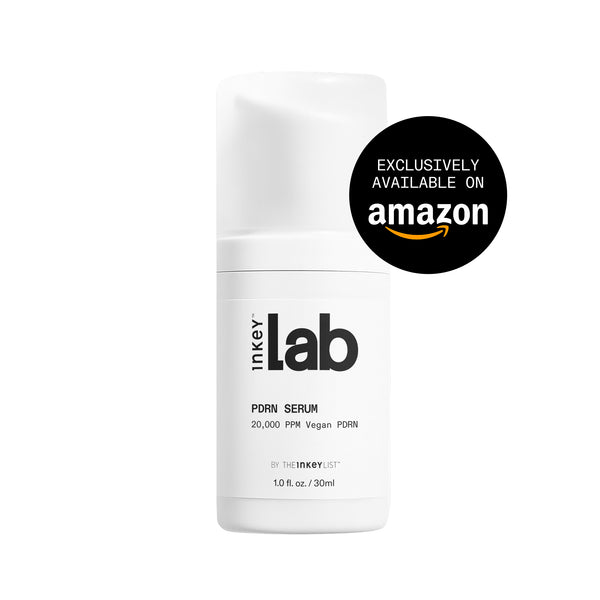
One thing to flag up front so nothing feels like an ambush later. INKEY’s own PDRN Serum is vegan and plant-derived, and it costs $18. We will get to why that matters, and we will show our working when we do.
Salmon Sperm Serum Explained: What Is Actually In The Bottle
Let us deal with the literal question without flinching, because the squeamishness around it is the single biggest barrier to people understanding an otherwise straightforward ingredient.
A salmon sperm serum is a topical skincare product formulated with PDRN, or polydeoxyribonucleotide. PDRN is a fragment of DNA. The DNA in question has most commonly been sourced from salmon milt, which is the soft roe or seminal fluid of male salmon. That is the origin of the name, and it is accurate rather than sensational.
Why salmon became the industry standard source
The obvious follow-up question is why anyone looked at a fish in the first place. The answer is less strange than it sounds. Salmon DNA fragments share a high degree of sequence similarity with human DNA, which made salmon an efficient and consistent raw material once researchers began working with DNA fragments in a medical context. Salmon milt is also abundant as a by-product of an existing food industry, which made it commercially practical to process at scale. Biological similarity plus reliable supply is how an ingredient becomes a category standard, and that is broadly what happened here.
None of that means salmon is the only possible source. It means it was the first source to become practical, which is a different claim entirely. We will come back to that.
The naming mess, cleared up
Here is the thing that confuses more readers than any other part of this topic. You will encounter this ingredient under at least four names, sometimes on the same product page:
- Salmon sperm serum, the informal name that travels furthest on social media
- Salmon DNA serum, the slightly more polite consumer-facing version
- Salmon PDRN, the more precise term when the source material is specified
- PDRN serum, the ingredient-led name used on most formal product listings
These are all pointing at the same underlying ingredient category. The differences between them are differences of vocabulary and marketing register, not differences of chemistry. If you have been trying to work out how salmon DNA serum differs from PDRN serum, the honest answer is that in most cases it does not.
There is one more name worth knowing, and it is the one that will actually appear on a legally compliant ingredients list. PDRN is listed under the INCI name Hydrolyzed DNA. If you flip a bottle over looking for the word “PDRN” in the ingredients panel, you will not find it. You are looking for Hydrolyzed DNA, usually sitting near the end of the list, which is normal for an ingredient used at a low single-digit percentage.
About the ick
We should address this directly rather than joke our way around it. The name sounds alarming. A lot of people’s instinctive reaction is that they are putting something biological and faintly unpleasant on their face, and that reaction is entirely reasonable given the words involved.
What is actually in the bottle is a purified, processed, fragmented and standardized DNA molecule. It has been extracted, broken down, filtered and quality-controlled to a pharmaceutical-grade specification. Nothing in the finished formula resembles its origin in any meaningful sense, in the same way that nothing in a bottle of hyaluronic acid resembles the fermentation vat it came out of. The ick is a response to the word, not to the substance.
We say this because telling the truth about ingredients is the whole job. The name is genuinely off-putting. The ingredient is genuinely just a DNA fragment. Both of those things are true at once.
Where PDRN came from before it came for your shelf
PDRN did not begin as a beauty ingredient, and that history is the most credible thing about it. It started in wound healing and regenerative medicine, where DNA fragment preparations were studied for their role in supporting tissue recovery. From there it moved into aesthetic medicine, largely in South Korea and parts of Europe, where it became an established injectable treatment. Topical skincare is the most recent chapter, not the first one.
This matters for how you calibrate expectations. As Medical News Today notes in its coverage of the salmon sperm facial, the ingredient’s roots in medicine give it a starting credibility that ingredients invented for cosmetics rarely have. But an ingredient’s medical pedigree travels with the delivery method it was studied in. An injectable treatment and a serum you smooth on after cleansing are not the same intervention, even when they share an active.
Consumer coverage has generally landed in a similar place. Healthline’s overview of the treatment frames topical and clinical routes as related but distinct, with a good safety profile across the board and realistic rather than dramatic expectations for what a topical can deliver. That is a fair summary, and it is the framing we would use ourselves.
So: topical serums and injectables are cousins, not twins. We are going to give that comparison a proper section rather than a throwaway line, because it is the part most articles skate over. If what you actually want is the full ingredient breakdown rather than the salmon angle, our full PDRN ingredient guide is the better page for you and you should go there instead.
With the what settled, the next reasonable question is how it behaves once it is on your skin.
How PDRN Works On Skin
PDRN is understood to work by signaling. Rather than exfoliating, resurfacing or forcing a rapid change, it interacts with skin in a way that encourages the skin’s own renewal processes to keep doing what they already do.
In practice, two effects get discussed most often. PDRN is associated with helping support the skin’s natural collagen production over time, and it is associated with hydration support, which is the part people tend to notice first because it shows up as bounce and plumpness rather than as a measurable structural change.
The mechanism also explains its tolerability. Because PDRN works with the skin rather than stripping or resurfacing it, it is generally low-irritation. There is no purging phase, no retinization period and no photosensitivity, which is why it suits people whose skin cannot comfortably handle stronger actives, and why it can be used morning and evening from the first application.
That is the short version, and it is deliberately short. There is a lot more to the mechanism, and we have covered it properly elsewhere. If you want the receptor-level detail, molecular weight, and why formulation quality changes the outcome, start with the PDRN ingredient page and then read our deeper explainer on what PDRN is in skincare, the science and how it works. Both go further than this section is trying to.
Now to the terms, because the vocabulary around this ingredient causes more confusion than the biology does.
Salmon DNA, Salmon PDRN And Polynucleotides: Decoding The Terms
Four names, one ingredient family, and a great deal of unnecessary confusion. This section untangles it, because knowing which word means what is the difference between reading a label usefully and guessing.
Salmon DNA: the broadest term
Salmon DNA is the catch-all. When a product, a video or an article refers to salmon DNA, it is almost always referring to PDRN or a closely related DNA fragment ingredient. It is the term people reach for when they want to describe the category without getting technical, and it is the one with the highest search volume in the US precisely because it is the most approachable phrase.
The limitation of the term is that it tells you nothing about processing, fragment size or concentration. Two products both marketed on salmon DNA can be formulated to wildly different standards. The phrase describes an origin, not a specification.
Salmon PDRN: the precise version
Salmon PDRN is the same thing said properly. It is PDRN where the source material has been specified as salmon. If you see salmon PDRN on a product, you are being told two useful things at once: the ingredient class, and where it came from.
This is the term to look for if source matters to you, either because you want the traditional fish-derived version or because you are specifically trying to avoid it. It is also the term most likely to appear in technical or clinical write-ups, where vagueness is less tolerated than it is in marketing copy.
Salmon DNA serum: the product format
Salmon DNA serum describes the delivery format rather than the ingredient. It is a leave-on treatment product, usually applied after cleansing and before moisturizer, formulated to carry PDRN into contact with the skin.
Here is the part that actually helps you shop. When you look at a salmon DNA serum, or any PDRN serum, the question worth asking is not whether PDRN is on the ingredients list. It is how much is in there. An ingredient can appear on a label at a level far too low to do anything meaningful, included for the claim rather than for the skin. This is common across the whole of skincare and PDRN is no exception.
A well-formulated product will tell you the concentration, either as a percentage or in parts per million. A product that stays silent on concentration is asking you to take it on faith. Our own PDRN Serum discloses 20,000 PPM, which is 2%, and we put that number on the packaging deliberately, because a disclosed figure is the only way you can compare one product against another with any confidence.
There is a second distinction hiding inside this, and it is a sharp one. There is a real difference between a clinically tested ingredient and a clinically tested formula. A brand can run a small consumer study on a finished product and describe it as clinically tested without the active inside it ever having been studied at that concentration. Both can be legitimate. They are not equivalent, and the phrasing rarely makes the difference obvious.
Practical things worth checking on any PDRN product:
- A disclosed concentration, in PPM or percentage
- Whether the ingredient itself has clinical data, not just the finished formula
- Low molecular weight, which relates to how well the fragment can penetrate rather than sit on the surface
- The source, whether marine or plant-derived
- Whether it is formulated for daily use, morning and evening
Polynucleotides, briefly
Polynucleotides and PDRN are closely related terms for the same family of DNA fragment ingredients. The word polynucleotide, often shortened to PN, is used more frequently in clinical settings, particularly in Europe and the UK, where it is the standard term for injectable treatments. PDRN is the term that has travelled further in consumer skincare.
For the purposes of reading a product label, treat them as pointing at the same ingredient family. That is genuinely all most people need from that distinction.
It is also worth knowing that PDRN does not exist in isolation. It sits alongside a small group of next-generation renewal ingredients that have moved from clinical settings into consumer skincare over the past few years, exosomes chief among them. If you are weighing one against the other, we have compared them directly in PDRN vs exosomes, which is the more useful read if you are trying to decide where to spend.
The takeaway from all of this is simple, and slightly deflating for anyone hoping the name on the box would settle it. The name tells you very little. The disclosed source and the disclosed concentration tell you almost everything.
Which brings us to the question everyone actually wants answered: does any of it work, and where is the evidence strongest?
Salmon Sperm Facial vs At-Home PDRN Serum: An Honest Comparison
This is the section where we could oversell, and where we are not going to. If you are choosing between booking a salmon sperm facial and buying a serum, you deserve an accurate picture of what each one is, including the parts that are inconvenient for us.
What a salmon sperm facial actually involves
A salmon sperm facial is an administered clinical treatment, not a product you apply yourself. In practice it usually takes one of two forms. The PDRN or polynucleotide preparation is injected into the skin in a series of small deposits, or it is delivered via microneedling, where controlled micro-channels are created in the skin and the preparation is applied into them.
Either way, the defining feature is the same: the ingredient is placed into the skin rather than onto it, by someone qualified to do that.
The practicalities are worth being clear-eyed about:
- It is a course of treatment, not a single appointment. Protocols commonly involve several sessions spaced weeks apart.
- The cost sits at a different order of magnitude to any at-home product, and it repeats with each session.
- There is downtime. Expect some redness, swelling or small puncture marks, with recovery varying by individual and by technique.
- It requires a qualified practitioner, and the quality of the outcome depends heavily on who is holding the needle.
- Results are maintained rather than permanent, so the schedule continues if you want to keep them.
The treatment’s rise from a niche clinical procedure to something with genuine mainstream recognition has been well documented, including in Allure’s coverage of PDRN and the salmon sperm facial, which traces how quickly it moved from specialist clinics into general beauty conversation.
Where the evidence is strongest
We are going to say this plainly, because hedging it would be dishonest. Injectable and clinically administered polynucleotide treatments have the longer and stronger evidence base. That is not a close call, and it is not something we are going to bury in qualifications.
The reason is delivery, and it is not complicated. Your skin barrier is extremely good at its job, which is keeping things out. A treatment deposited beneath the barrier reaches the tissue it is meant to act on directly and at a known dose. A topical formula has to contend with the barrier, and how much of any given molecule crosses it depends on molecular size, the formulation carrying it and the condition of the skin on the day. Two products can contain the same active and behave very differently for exactly this reason.
That is also why molecular weight comes up so often in PDRN discussions. A large, heavy fragment is far more likely to remain on the surface. A low molecular weight fragment is formulated specifically to improve penetration. It is a meaningful formulation variable, not a marketing flourish.
If someone tells you a serum does what an injectable does, they are selling rather than explaining.
What an at-home PDRN serum realistically does
So what is the case for the serum? It is a real case, it is just a different one.
A topical PDRN serum is a daily, low-commitment, low-irritation way to work with the ingredient. It is not a substitute for a clinical procedure and we are not going to pretend it is. What it is, genuinely, is the most sustainable way most people will ever engage with this ingredient.
The advantages are practical rather than dramatic:
- Consistency. Twice a day, every day, for months. Cumulative exposure over time is its own kind of result, and it is the kind that clinical courses cannot replicate between appointments.
- Accessibility. No booking, no practitioner, no travel, no waiting list.
- Cost. The gap between a serum and a course of injectable treatment is not a small premium. It is a different budget category entirely.
- No downtime. You apply it and get on with your day. Nothing to recover from, nothing to schedule around.
- Tolerability. For people who cannot or will not have needles anywhere near their face, this is the only route available, and it is a perfectly reasonable one.
There is also something quietly underrated about a product you will actually keep using. The best skincare active in the world does nothing sitting in a drawer, and the most effective clinical protocol does nothing if the follow-up appointments never get booked.
Why they are complementary, not competing
The framing of clinic versus at-home is mostly a false binary, and in practice people rarely treat it as one.
A large share of people using topical PDRN are using it to maintain between in-clinic appointments, keeping the ingredient in their routine during the weeks and months when they are not in a treatment chair. Others use a topical as an entry point, a way to work with the ingredient and see how their skin responds before deciding whether the clinical route is worth the investment. Both are sensible. Neither requires you to pick a side.
One genuinely important practical note. If you have had an in-clinic procedure, your skin has been through something, and the barrier will be temporarily compromised. Follow your practitioner’s specific aftercare protocol before you apply anything at home, including a PDRN serum. Aftercare varies by treatment, by depth and by individual, and the person who performed your procedure is the only one positioned to advise you on yours. Do not take timing guidance from an article, including this one.
For the broader picture of how PDRN is used clinically as well as topically, our PDRN ingredient page covers the full context.
Having conceded that the clinical route has the stronger evidence, there is one question left that changes the calculation for a lot of people. If you want PDRN at home, does it have to come from a fish at all?
Vegan PDRN: The Plant-Derived Alternative To Salmon DNA
For a long time, the answer was effectively yes. If you wanted PDRN, you were getting salmon. That is no longer the case, and the alternative is more interesting than a simple ethical substitution.
Why people look for an alternative
The reasons are varied and all of them are legitimate:
- Vegan and vegetarian preferences, where a fish-derived ingredient is simply a non-starter regardless of how well it performs
- Fish allergies and sensitivities, where even a highly purified marine-derived ingredient raises a question the person would rather not have to ask
- Religious dietary considerations, which for some people extend to what goes on the skin as well as what goes in the body
- Sustainability concerns, tied to aquaculture and marine sourcing more broadly
- The ick, which we are counting as a legitimate reason because for a lot of people it is the deciding one and there is no point pretending otherwise
Artemisia capillaris, the plant behind vegan PDRN
INKEY’s vegan PDRN is derived from Artemisia capillaris, a hardy plant with a long history of use in traditional East Asian medicine. It is a tough, resilient species, and its extract yields the DNA fragments that make up plant-derived PDRN.
The scientific interest in this particular plant is not new or speculative. Published research on Artemisia capillaris has examined its bioactive properties and its relevance as a source material, which is what makes it a credible starting point rather than a convenient marketing story.
More broadly, the case for plant-derived PDRN as a category has been developing in the peer-reviewed literature. A study available on PubMed, with a free-to-read version on PMC if you want to read the full text without hitting a paywall, supports plant-derived PDRN as a viable route more generally. We are linking the open-access mirror deliberately, because being told to trust a study you cannot actually read is not education.
What the supplier data shows
The vegan PDRN in our formula is INJIN PDRN, and the ingredient itself has been clinically studied at 2%, which is the concentration we use. According to clinical data from the ingredient supplier, INJIN, 2% INJIN PDRN was associated with:
- a 30% increase in fibroblast proliferation†
- a 25 to 35% increase in collagen synthesis over 8 to 12 weeks†
- a 45% improvement in hydration after 4 weeks†
Two things about how to read those numbers. First, they are supplier data, which we are labelling as such rather than dressing up as independent research. Second, they are ingredient-level data at a specified concentration, which is the distinction we made earlier about clinically tested ingredients versus clinically tested formulas. That is the more demanding standard of the two, and it is the reason we are comfortable putting the figures in front of you with the source attached.
The hydration figure is the one most people will recognize soonest, because hydration shows up as visible bounce and plumpness on a timescale of weeks. The collagen figures operate on a longer horizon, which is the honest framing for any ingredient in this category. This is a cumulative ingredient. Consistency over months is what it rewards.
The accessibility argument
Here is where we plant a flag, because it is the part of this we care most about.
PDRN arrived in consumer skincare priced as a luxury. Premium PDRN products routinely sit at luxury price points, and a lot of them decline to disclose how much PDRN is actually inside. You are asked to pay a premium and to trust the formulation, without being given the number that would let you evaluate either.
We think that is backwards.
Clinical-strength PDRN, with the concentration disclosed on the box, at $18.
Our PDRN Serum is $18 for 30ml, with a disclosed 20,000 PPM (2%) concentration of vegan, plant-derived INJIN PDRN. Low molecular weight, formulated for penetration rather than surface residence. Vegan. Fragrance-free. Suitable for AM and PM use. pH 4.0 to 4.5.
It is also low-irritation, which is worth dwelling on for a moment, because it is the practical advantage that gets least attention. There is no introduction period, no purging phase and no photosensitivity. You do not need to build up tolerance, alternate nights or schedule around it. Anyone who has spent three uncomfortable weeks introducing a retinol knows how much friction that removes, and if you are weighing the two ingredients against each other, our comparison of PDRN vs retinol walks through where each one earns its place.
Being vegan does not make an ingredient better on its own. What makes plant-derived PDRN worth considering is that it removes the animal-sourcing question entirely for the people it matters to, without asking them to accept a lesser ingredient in exchange. That is the whole argument, and it does not need inflating.
Knowing which PDRN to choose is one thing. Knowing where to put it is another.
Building A PDRN Routine: How To Layer It And What To Pair It With
PDRN is one of the easiest actives to slot into an existing routine, largely because it demands so little accommodation from everything else. Here is exactly where it goes and what it works alongside.
Where PDRN sits
PDRN is a treatment step. It goes on after cleansing, onto clean and dry skin, before anything heavier.
Apply one pump of PDRN Serum to face and neck, morning and evening. Press it in rather than dragging it across the skin. Follow with moisturizer. In the morning, finish with SPF, not because PDRN creates any sun sensitivity, but because sunscreen is the single highest-value step in any routine concerned with the long-term appearance of skin, and no serum outperforms it.
The morning order:
- Cleanse
- PDRN Serum, one pump, face and neck
- Moisturizer
- SPF
The evening order:
- Cleanse, doubling up if you have worn makeup or sunscreen
- PDRN Serum, one pump, face and neck
- Moisturizer
That is the entire routine. No rest days, no alternating schedule, no gradual introduction.
Layering with the Plant-Derived Cica Exosome Serum
If you want the fuller version, PDRN pairs particularly well with our Plant-Derived Cica Exosome Serum.
The sequencing rule is the standard one: lighter textures first. Apply the water-based Plant-Derived Cica Exosome Serum first, then PDRN Serum on top. Layer together for an amplified glow. Between them you are covering renewal, hydration and radiance in two steps.
The Plant-Derived Cica Exosome Serum comes with its own clinical support. It is “clinically proven to visibly improve radiance, hydration, tone, firmness, elasticity, and texture“ as part of its “6-in-1 skin rejuvenation: clinically proven to visibly improve radiance, hydration, tone, firmness, elasticity, and texture“ positioning, and it is “Proven to deliver up to 12-hours of hydration“. In testing, “100% saw more glowing skin, clinically proven“ and it delivers “Clinic worthy rejuvenated skin in 14 days“. In-vitro work on the Cica Exosomes showed a “55% reduction in visible signs of skin stress (redness, puffiness, visible irritation)*“ and a “63% increase in skin renewal activity in 8 hours*“. Like PDRN, it “Helps support natural collagen production”.
If exosomes are new to you as an ingredient class, our exosomes explainer covers what they are and why they turned up in skincare when they did.
Sealing it in
Whatever you layer underneath, finish with a moisturizer that supports the barrier rather than just sitting on top of it. Our Bio-Active Ceramide Moisturizer is $22 and formulated around ceramides, the lipids your barrier is built from. If you want to see the full range of options, the ceramide collection has everything in one place.
A barrier in good condition is not a side quest. It affects how comfortable your skin feels, how well it holds hydration, and how well it tolerates every active you layer onto it. It is the foundation the rest of the routine sits on.
What PDRN pairs with
This is one of PDRN’s genuine practical advantages. It layers comfortably with:
- Retinol. No conflict. Many people use PDRN in the morning and retinol at night, though they can share a routine. If layering conflicts worry you generally, our guide to what not to mix with retinol is the sanity check, and our retinol page covers the ingredient itself.
- Vitamin C. Fine together. Lighter texture first. The vitamin C page has the detail on formats and stability.
- AHAs and BHAs. Compatible. If your skin is feeling sensitized from exfoliation, PDRN’s low-irritation profile makes it a comfortable companion rather than another stressor.
- Hyaluronic acid. A natural pairing. Apply hyaluronic acid to slightly damp skin first, then layer PDRN over it. Our hyaluronic acid page explains why the damp-skin instruction actually matters.
Compare that to the scheduling gymnastics some actives demand and the appeal becomes obvious. PDRN is a cooperative ingredient. It does not ask you to rebuild your routine around it.
What people actually report
We are not going to put invented testimonials in front of you. What we can tell you is what comes up repeatedly in reviews of the Plant-Derived Cica Exosome Serum, and the themes are consistent: the texture is lightweight and absorbs quickly, the glow is visible early, and the hydration holds through the day.
Those three themes recur often enough to be worth reporting as a pattern. They are also, usefully, the things a serum can reasonably be judged on within a few weeks of use, as opposed to the longer-horizon changes that require months and a consistent hand.
That is the practical guidance covered. Here are the questions that tend to come up next.
The Honest Verdict On Salmon Sperm Serum And Vegan PDRN
Three things are worth carrying away from all of this.
Salmon sperm serum is a real ingredient category with genuine science behind it. The name is doing the ingredient a disservice in both directions, making it sound more shocking than it is and distracting from a perfectly reasonable body of research that started in medicine rather than marketing.
The strongest evidence still sits with in-clinic treatments, and anyone telling you otherwise is selling something. A topical serum is not a needle, and delivery genuinely matters. What a topical offers instead is something a clinical course cannot: daily, low-irritation, low-friction consistency over months, which is its own legitimate route to results.
And the source is now a choice rather than a given. Plant-derived PDRN offers the same ingredient category without the animal origin, which for a great many people resolves the vegan, allergy, sustainability and ick questions in one move, with nothing given up in exchange.
If you take one practical habit from this article, make it this: look for a disclosed concentration and a clinically tested ingredient, not just a clinically tested formula. Those two details will tell you more about a PDRN product than any amount of packaging language, and they are the questions the products worth buying are happy to answer.
Skincare has become needlessly complicated, and what most people actually want is clarity they can trust. Clear guidance. Proven ingredients. Real results.
If you want to try plant-derived PDRN, our PDRN Serum is $18 for 30ml, vegan, with a disclosed 20,000 PPM (2%) concentration. For the fuller glow routine, layer it with the Plant-Derived Cica Exosome Serum. And if you are not sure where any of this fits in your current routine, our skincare quiz will build you a personalized one in about two minutes.
†Efficacy data from clinical studies completed using 2% INJIN PDRN, conducted by the ingredient supplier.
*4-week clinical study of 26 people
**Clinical study of 31 people
*In-vitro testing of Cica Exosomes showed a 55% reduction in pro-inflammatory markers and a 63% increase in markers associated with skin renewal after 8 hours.
Frequently Asked Questions
Got a question?
Our askINKEY team are a friendly bunch of skincare experts with deep product knowledge and zero judgement. Whether you're an ingredient obsessive or just starting out, we'll make it make sense. No question too big. No question too small. We Give A Care, Every Day.


