


Retinol for Sensitive Skin: How to Start Without Irritation
Sensitive skin doesn’t rule out retinol, here’s how to introduce it gently, at the right pace, without the sting.
Author
askINKEY skincare advisor
Published
02 February, 2026
Time to read
17 minutes
Sensitive skin can use retinol. We want that on the record before anything else, because the question gets asked constantly and the answer keeps getting buried under caveats. Retinol for sensitive skin is not about whether you qualify. It comes down to two variables you control: the formula you choose and how fast you go.
The hesitation is understandable. Retinol has a reputation for a difficult first month, and that reputation did not come from nowhere. A lot of people have started a retinoid, endured two weeks of stinging, tightness and flaking, watched their face go red and raw, and quietly shelved the bottle. If that happened to you, the problem was almost certainly not your skin. It was a formula that was stronger than you needed, or a schedule that moved faster than your skin could adapt to, or the two combined.
Here is what this guide covers. We will separate skin that is naturally sensitive from skin that has been made reactive, because the fix is different for each. We will explain what encapsulated retinol is and why gradual delivery changes the experience so dramatically. We will lay out the exact introduction schedule, including the patch test most guides leave out. We will name and explain the retinol sandwich method. And we will draw a clear line between normal adjustment and a real problem, so you know when to keep going and when to stop.
Everything here sits inside the broader picture on our sensitive skin hub, which is worth bookmarking if reactive skin is your baseline. First, let’s understand why retinol stings some people and not others.
Sensitive Skin vs Sensitized Skin: Why Retinol Stings
Two words that get used interchangeably describe two genuinely different situations, and telling them apart is the most useful diagnostic you can run on yourself before starting a retinoid.
Sensitive is how your skin is. Sensitized is how it has been treated.
Sensitive skin is a baseline you were born with. It often runs in families, it usually shows up early in life, and it means a lower threshold for reacting to fragrance, temperature changes, friction and active ingredients. It is not damage and it is not something you resolve. It is a setting you build a routine around.
Sensitized skin is acquired. Something has been done to the skin to make it reactive. Over-exfoliation is the most common cause by a wide margin. Add to that a cleanser that strips too aggressively, four actives layered because each one looked good on its own, a move to a drier climate, winter heating, a run of bad sleep, a hard few months, or simply too much of a good thing for too long. Sensitized skin can be indistinguishable from sensitive skin in the mirror, which is why so many people assume they are permanently reactive. The crucial difference is that sensitized skin is usually temporary and it responds to being left alone.
Both come back to the same structure: your skin barrier. It is the outermost layer of your skin, and it has two jobs. Hold moisture in. Keep irritants out. When it is intact, it works invisibly. Water stays where it belongs, skin feels comfortable, and actives are absorbed and tolerated without incident. When it is compromised, everything shifts. Moisture escapes, so skin feels tight and reads dull. Irritants get through more easily, so things that never bothered you start to sting. Products you have used for years suddenly feel sharp. That is not the product changing, it is the barrier signaling for help. Our guide to a damaged skin barrier walks through how to identify and rebuild one.
So why does retinol specifically provoke a reaction? Retinoids accelerate cell turnover. They prompt skin to shed older surface cells faster and bring newer cells up in their place. That acceleration is exactly why retinoids are so effective on fine lines and uneven texture, and it is also why the opening weeks feel unfamiliar. While your skin adapts to a faster rhythm, you can experience dryness, light flaking and tightness that was not there before.
That adjustment window has a name: retinization. Learning the word does more than you would expect. Once you understand that the first few weeks are a documented, expected, temporary phase rather than proof that your skin is rejecting the product, you stop treating every flake as a red flag and you stop quitting on day nine. Retinization is not the product failing. It is the product starting.
Timing, though, is everything. If your barrier is compromised right now, if water stings, if you are peeling, if your face feels hot or is reacting to products it used to tolerate, this is not the week to introduce a retinoid. Repair first, then start. Two weeks of gentle cleansing, a solid moisturizer and nothing else is usually enough. When your skin feels comfortable again, begin. Starting on a compromised barrier is the single most common reason people decide retinol is not for them, when the real issue was sequence.
One note and then we will move on. If you have a diagnosed skin condition, that is a separate conversation for your dermatologist, and nothing here replaces it.
So, can you use retinol on sensitive skin? Yes. The two things that determine how it goes are formula and pace. Formula first.
Why Encapsulated Retinol Changes Things
If a retinoid has gone badly for you before, understanding delivery is the most useful thing you can do before you try again. Not all retinol reaches your skin the same way.
Standard retinol arrives all at once. The full dose lands on the surface, absorbs on whatever schedule your skin allows, and your barrier absorbs the impact. For resilient skin that is often perfectly fine. For sensitive skin, that concentrated arrival is frequently the difference between a product that becomes a habit and a product that gets abandoned in week two.
Encapsulated retinol works differently. Protective carriers hold the retinoids within the formula, support even absorption and release them gradually on skin. That produces three benefits. Better stability, because retinoids are famously fragile and break down when exposed to light and air. More consistent results, because delivery is steady rather than spiking. And a gentler feel with less risk of irritation, because the release is paced. Same active ingredient, calmer arrival.
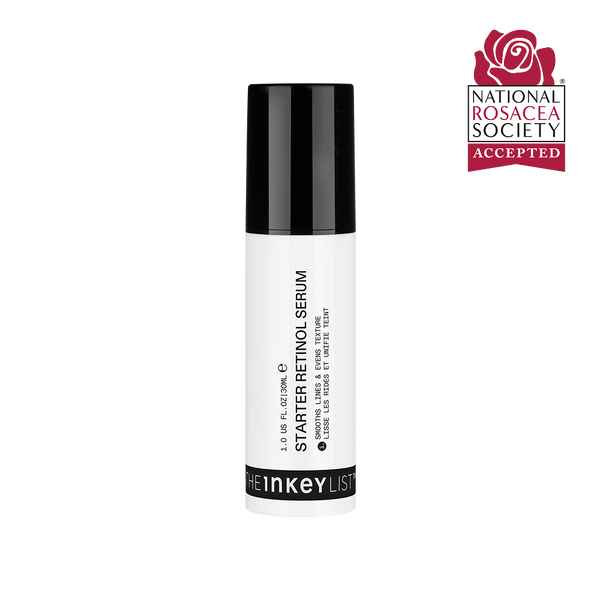
Our Starter Retinol is built around an encapsulated Dual-Retinoid Complex, and encapsulated retinol has been shown to be 2x more effective than standard retinol †
† Based on a 4-week In Vitro study
Here is the actual formula, percentages included, because we would rather you evaluated the ingredients than the adjectives.
- 1% Granactive Pro+. A next-generation retinoid paired with encapsulation technology. It smooths fine lines and refines texture while staying gentle, which is the combination sensitive skin needs and seldom finds.
- 0.01% Retinal. A high-performance retinoid included at a deliberately low level, adding an efficacy boost without adding irritation.
- 0.5% Amisol Trio. A lipid complex that hydrates and keeps the barrier strong, working against the dryness retinoids can cause from within the same formula.
- 0.2% SymRelief®. Calming. It soothes, supports the barrier, and helps reduce redness and discomfort. SymRelief® is a registered trademark of Symrise AG.
- Squalane. Confirmed in the INCI list, contributing to comfort and hydration.
The INCI also includes glycerin, bisabolol, phospholipids, ginger root extract and tocopherol. INCI stands for International Nomenclature of Cosmetic Ingredients, the standardized naming system printed on every product’s ingredient list. We point it out because you should be able to verify what we tell you against the carton.
Then look at the shape of that formula. Two of the five named ingredients are there specifically to counteract dryness and calm skin. Amisol Trio handles hydration and barrier strength. SymRelief® handles soothing and redness. Neither is a garnish. They are structural. That is how a beginner retinoid should be engineered: active and support system formulated together, so the barrier care happens simultaneously with the resurfacing instead of being your problem to solve afterward.
The formula is clinically proven to smooth fine lines from 7 days, without irritation *
* 4-week Clinical study on 30 participants
That phrasing is deliberate. “From 7 days” marks onset, the point at which smoothing becomes visible, not the point at which the work is done. Retinoids operate on a longer arc, and we will map the full timeline in a moment.
Worth naming separately: ceramides are a naturally occurring component of your barrier, and replenishing them is one of the most dependable ways to stay comfortable while a retinoid does its work. They complement a lipid complex like Amisol Trio, and they will come up again when we reach the sandwich method.
For the fundamentals on how the ingredient itself works, our retinol hub goes deeper.
Formula settled. Now the variable that decides the outcome: pace.
How to Introduce Retinol on Sensitive Skin
This is the operational heart of the article, and the instructions are simple. The difficulty is in not getting impatient.
Patch test before your first full application. This is not a formality. Put a small amount on a discreet area, the inner forearm or just behind the jawline both work, and wait 24 hours. Nothing happens, you are good to go. Redness, itching or stinging, and you have learned something important at the cost of one small patch instead of your entire face. If you have never done one, here is why you need to do a patch test.
Evening only, 2 to 3 nights per week to start. You will find advice suggesting once weekly for the first month. That is more conservative than a formula like this requires, and it can drag the adjustment period out unnecessarily. Two to three nights weekly provides enough regular exposure to build tolerance while leaving clear recovery nights between applications. Spread them across the week: Monday and Thursday, or Monday, Wednesday and Saturday.
Increase frequency as your skin builds tolerance. Responsive, not calendar-driven, and that distinction is the entire method. Two comfortable weeks with no tightness or flaking, add a night. Skin feeling tight, dry or flaky, hold at your current frequency until it settles. Genuinely unhappy, drop back a night. There is no universal schedule, only yours. Skin that gets listened to builds tolerance faster than skin that gets pushed.
A pea-sized amount, for the entire face and neck. It will look insufficient the first time. It is not. Retinoids do not work proportionally to how much you apply. Doubling the quantity will not halve the timeline, it will only raise your irritation risk and empty the bottle faster. Apply after cleansing and after your hydrator, and carry it down onto the neck, which ages on a similar schedule to the face and gets skipped constantly.
Follow with moisturizer every time. Not optional, not a finishing touch. Moisturizer is part of the retinol routine. It supports your barrier through the adjustment window and offsets the dryness that comes with accelerated turnover. Skipping it is the quickest way to turn a manageable retinization into a miserable one.
SPF the next morning, without exception. More on that shortly, because it earns its own discussion.
Why evening only? Two reasons, both practical. Retinoids increase your skin’s sensitivity to sunlight, so applying at night and protecting by day is simply the right sequence. And light degrades retinoids, meaning a daytime application delivers less of what you paid for. Nighttime is when the ingredient is most stable and when your skin is already in repair mode.
The timeline, since realistic expectations are what keep people consistent. Expect smoother-looking skin after about a week. At the 4-week mark, significant improvement. Optimal results land between 8 and 12 weeks. That is the honest arc, and anyone promising you a faster one is selling something.
Which leads to the governing principle of this whole article: consistency beats intensity. Two nights a week sustained across three months will do more for your skin than five nights a week for two weeks followed by an irritated retreat. The people who get the best results from retinoids are not the ones with the highest tolerance. They are the ones still using it in month three. Going slowly is not a compromise or a beginner’s handicap. On sensitive skin, it is the strategy.
Not sure Starter Retinol is your right entry point? Our guide to which retinol product is right for you will place you on the ladder.
There is one technique that makes those first weeks noticeably easier, and it deserves its own name.
The Retinol Sandwich Method
The retinol sandwich method is exactly what it sounds like: a thin layer of moisturizer, then a pea-sized amount of retinol, then a thin layer of moisturizer on top. Three steps, that order, in the evening.
The mechanism is easy to picture. The first layer of moisturizer buffers. It sits between the retinol and your skin so the active reaches the surface more gradually and less intensely than it would on bare skin. The top layer seals in hydration and supports your barrier overnight while the retinoid works. You are softening the arrival and reinforcing the recovery inside a single routine.
You may also see us refer to this as the moisture sandwich method on the product page. Same technique, two names.
Who should use it:
- Anyone in their first weeks with a retinoid. The sandwich takes the sharpest edge off retinization, which is precisely when most people abandon ship.
- Anyone who has reacted before. If a previous attempt ended badly, sandwich from night one. There is no medal for going in unbuffered.
- Anyone on a night when skin feels reactive. A cold snap, a long flight, a stressful week, an exfoliation two days ago that was more enthusiastic than necessary. You do not need to skip the night, you can sandwich it.
The honest trade-off: buffering may slightly slow visible progress. Delivering the active more gradually means it works a little more gradually. For sensitive skin that trade is almost always the right one, because the alternative is not faster results, it is a compromised barrier and an abandoned bottle. Slightly slower progress you actually sustain beats faster progress that ends in week two, every time.
What you sandwich with matters. You want something genuinely barrier-supportive, not just occlusive. Our product page specifically recommends Bio-Active Ceramide Moisturizer for extra barrier care and maximum hydration, which makes it a natural fit for both layers. Ceramides reinforce the barrier lipids that retinoids can deplete during adjustment, so you are rebuilding while you resurface.
You can bring hydration into the buffer as well. A hyaluronic acid serum underneath draws water into the upper layers, and applying retinol over well-hydrated skin feels considerably better than applying it over skin that is already tight.
One practical note: give each layer a minute to settle before the next. You are building thin, distinct layers, not mixing everything together on your face.
Even with the right formula and a sensible pace, your skin will do things in the early weeks. Knowing which of those things are expected is what keeps you going.
What’s Normal, What’s Not, and Why SPF Is Non-Negotiable
Retinization follows a fairly predictable pattern, and knowing that pattern in advance is genuinely protective. Here is what sits inside normal.
Mild tingling on application, brief and low-level, resolving within a few minutes. Light flaking or dryness, especially around the nose, chin and anywhere that runs drier already. Slight temporary sensitivity, where neutral products suddenly register. Mild tightness, most noticeable first thing in the morning. All of this typically settles within the first few weeks as skin adapts to its new turnover rate.
It is also worth saying that this is not inevitable. With a formula designed for it, it is not even the norm. In testing on Starter Retinol, 95% experienced zero irritation or redness †
† Based on a 4-week In Vitro study
Now the other side, and this part matters. The following are not normal adjustment: persistent burning that does not fade after application, swelling, weeping or broken skin, sustained intense redness rather than a passing flush, or a rash.
If any of that happens, stop using the retinol. Go back to a gentle cleanser and a good moisturizer and nothing else. No acids, no vitamin C, no scrubs. Give your barrier one to two weeks to settle. Once skin feels genuinely comfortable again, you can reintroduce slowly, at a lower frequency, sandwiched.
Or you can decide not to reintroduce it at all. That is a legitimate outcome, not a failure, and we would rather say so directly than encourage you to push through something your skin is clearly refusing. There are other routes to smoother, more even skin, and we will get to one.
A quick distinction: adjustment is not purging. Purging is a specific, temporary acceleration of what was already forming beneath the surface, with its own timeline and logic. Our guide to what is skin purging covers it properly.
SPF Is Not a Suggestion
Here is the step people skip, and the one that undoes more retinol routines than any formula ever has.
Retinoids leave your skin more sensitive to the sun. That is not fine print, it is a direct consequence of how the ingredient works. Faster turnover means newer, less weathered cells at the surface more of the time, and those cells have had less exposure and less opportunity to build any defense. Pair that with unprotected daylight and two things follow. Your irritation and visible redness risk climbs. And you erode the fine line and texture progress the retinol is making, because UV exposure is the single largest driver of visible skin aging.
So broad-spectrum SPF is not an add-on to a retinol routine. It is part of it. Every morning, on every skin tone, in every season, including the overcast days that feel exempt. They are not. UVA passes through cloud cover and window glass and is present year round, which is why a commute or a desk by a window still counts.
What to look for matters more than which bottle you pick up. You want broad spectrum on the label, meaning protection across both UVA and UVB. You want SPF 30 or higher for daily use. And you want a texture you will genuinely wear every single day, because a sunscreen you skip protects nothing. Apply it as the final step of your morning routine, use enough to cover the face, ears and neck properly rather than a token amount, and reapply through the day if you are outdoors for an extended stretch. Our SPF guide covers application amounts, reapplication and how to build it into a routine that already contains actives.
While we are in the morning, a word on vitamin C. It is an excellent daytime counterpart to an evening retinoid, since antioxidant defense by day and resurfacing by night are genuinely complementary. 15% Vitamin C + EGF Serum fits that slot well. The one thing to avoid is applying vitamin C and a retinoid at the same time, as the combination can occasionally cause sensitivity. Separating them by time of day resolves it completely: vitamin C in the AM, retinol in the PM. Both benefits, no conflict.
That covers the retinol itself. Now let’s situate it in a complete routine.
What to Pair With Retinol, What to Skip, and Where to Go Next
A retinoid never operates alone, and what surrounds it materially affects how well it is tolerated.
Pairs well. Hyaluronic acid draws water into the skin and makes everything layered over it more comfortable. Niacinamide is calming and supports the barrier, which makes it a natural companion through retinization. Ceramidesreinforce barrier lipids directly. For the detail on layering hydration with retinoids, see hyaluronic acid and retinol, can you use them together.
Approach with care. Exfoliating acids and other retinoids are the two categories to be deliberate about, and our product page names them specifically. It is not that they can never share a routine. It is that stacking resurfacing ingredients on sensitive skin in the same session is exactly how barriers get compromised. Keep acids to non-retinol nights and stay conservative on frequency. Running two retinoids at once is rarely the upgrade it looks like. The full picture is in what not to mix with retinol.
The eye area. The skin around your eyes is thinner and more reactive than the rest of your face, which is why it usually objects first. Our Retinol Eye Cream is formulated specifically for the delicate eye area, making it the more comfortable option for most people. Our product page also permits careful use of Starter Retinol around the eye area, avoiding direct contact with the eyes themselves.
The graduation step. Once tolerance is genuinely established, meaning several comfortable months rather than one encouraging fortnight, Advanced 0.2% Retinal Serum is the step up. Retinal converts to its active form in a single step rather than two, so it works faster, and it suits people already confident with retinoids. It is a later move, not a starting point, and there is no requirement to take it. Plenty of people stay with Starter Retinol indefinitely and get exactly what they wanted.
If retinol still is not for you. Some skin does not get along with retinoids, and finding that out is information, not failure. Bakuchiol is the gentler alternative most people move to, working in a similar direction on texture and fine lines with a considerably lower irritation profile. If two careful attempts have both gone badly, bakuchiol is a sensible next step rather than a consolation prize.
A morning glow partner. Separately from all of the above, Exosome Glow Serum works well as a morning glow and hydration step, proven to deliver up to 12-hours of hydration ‡
‡ Clinical study of 31 people
For the wider routine a retinoid belongs to, our guide to the best anti-aging skincare routine lays out the full order of operations, and the retinol hub goes deeper on the ingredient itself.
Now, the questions we get asked most.
The Takeaway
Sensitive skin does not rule out retinol. Formula and pace do the work.
Patch test first. Evening only, 2 to 3 nights per week to begin, a pea-sized amount, moisturizer after, sunscreen every morning. Build up when your skin says it is ready, and give it 8 to 12 weeks before you judge the results. Consistency beats intensity.
Skincare has become complicated. We exist to make the science simple. Clear guidance. Proven ingredients. Real results.
We Give A Care.
Ready to start? Starter Retinol was built with encapsulation technology and calming support for exactly this situation. Add Bio-Active Ceramide Moisturizer if you want to sandwich from night one, and find more on caring for reactive skin at our sensitive skin hub.
* 4-week Clinical study on 30 participants - supports “clinically proven to smooth fine lines from 7 days, without irritation”
† Based on a 4-week In Vitro study - supports “2x more effective than standard retinol” and “95% experienced zero irritation or redness”
‡ Clinical study of 31 people - supports “proven to deliver up to 12-hours of hydration” (Exosome Glow Serum)
Frequently Asked Questions
Got a question?
Our askINKEY team are a friendly bunch of skincare experts with deep product knowledge and zero judgement. Whether you're an ingredient obsessive or just starting out, we'll make it make sense. No question too big. No question too small. We Give A Care, Every Day.


