



How to Prevent Jowls: What Actually Works, and What Doesn’t
What causes jowls, when they start, and the prevention habits with real evidence behind them.
Author
askINKEY skincare advisor
Published
05 September, 2026
Time to read
10 minutes
Jowls are the soft, slightly loose skin and tissue that form along and just below the jawline as facial structure and skin quality change with age. If you have searched how to prevent jowls, you have probably already found a lot of pages promising a lot of things. This one is going to be straight with you instead.
Here is what this article covers: what jowls actually are and where they form, what causes them, at what age they typically start, the prevention habits with the strongest evidence behind them, what skincare can genuinely do for your jawline, whether facial exercises are worth your time, and when it makes sense to speak to a professional.
And here is the honest expectation to set before we go any further. You cannot prevent aging. No topical product changes facial structure. What you can do is slow the skin-quality contributors and delay visible change, and that is genuinely worth doing. That distinction is the foundation everything else in this article rests on.
We make our Bio-Active Ceramide Neck Stick ($17) specifically for the neck and jawline area, so it comes up more than once below. Before that, though, the education. If jowls are one of several things on your mind, our guide to the 10 Most Common Skincare Concerns is a useful hub, and our anti-aging collection is the relevant category if you want to browse while you read.
Let’s start with the anatomy, because understanding what is happening makes the advice make sense.
What Are Jowls, and Where Do They Form?
Jowls form at the point where the jawline meets the lower cheek. They appear when skin and soft tissue that once sat higher on the face gradually descend and settle along the jaw, softening what used to be a clean, defined edge.
That location matters more than people realize. The jawline is a junction. Bone, fat, ligament and skin all meet there, which means a change in any one of those four things shows up in the same place. It is why the jaw often registers visible change earlier than people expect, and why it can look different from one angle to another. The Journal of Cosmetic Dermatology describes lower face aging as exactly this kind of layered process, involving fat pad descent and the loosening of the retaining ligaments that hold facial tissue in position.
It is also worth being precise about what jowls are not, because these concerns get lumped together constantly and they are not the same thing.
- Jowls sit at the jaw junction. They are about contour along the jawline.
- Horizontal neck lines are creases across the neck. Different location, different cause. We cover those properly in how to get rid of neck lines.
- Crepey skin is a texture concern, that thin, finely lined quality skin can take on. We go into it in what causes crepey skin.
- A double chin relates to fullness under the chin, which is a separate issue again.
You can have one of these, or several at once. But they respond to different things, so it helps to know which one you are actually looking at in the mirror.
Jowls vs a sagging jawline: are they the same thing?
Not quite, though they overlap. A sagging jawline describes the overall loss of a clean, defined jaw contour. Jowls are one visible feature of that. Think of the sagging jawline as the general description and jowls as the specific thing you can point to, the softness that gathers along and just below the jaw itself.
In practice most people use the two interchangeably, and that is fine. But if you are trying to work out what to do about it, the distinction is useful, because some of what softens a jaw contour is skin quality and some of it is structure underneath. Those two have very different answers.
Which brings us neatly to the causes.
What Causes Jowls? The Four Drivers
Jowls are caused by four things happening at once: the jawbone loses volume, facial fat pads deflate and shift downward, retaining ligaments loosen, and the skin itself loses collagen and elastin. Three of those four are structural.
That last point is the single most important thing on this page, so here it is stated plainly.
Three of the four drivers behind jowls are structural. No topical product changes them. Understanding that is not discouraging, it is what makes the rest of the advice worth taking seriously.
Let’s take them one at a time.
Bone resorption
The jawbone changes shape over time. It loses volume and definition, the chin can retrude slightly, and the angle of the jaw softens. Research on aging of the mandible documents these changes and their aesthetic consequences.
Think of the jawbone as the scaffolding everything else is draped over. When the scaffolding gets smaller, the covering has further to travel and less to hold onto. This is structural. Skincare cannot touch it, and any product suggesting otherwise is not being honest with you.
Fat pad descent and deflation
Facial fat is not one uniform layer. It sits in distinct compartments, and they behave differently as we age. The deeper pads tend to deflate, losing volume and the support they used to provide. The more superficial pads tend to descend, sliding downward and settling along the jaw.
Descent and deflation are two separate processes, and most content on this topic treats them as one. They are why a face can look both flatter in the upper cheek and heavier along the jaw at the same time. Also structural, also beyond the reach of anything you apply to the surface.
Retaining ligament laxity
Facial tissue is held in position by retaining ligaments, which tether the soft tissue of the face to deeper structures. Over time they attenuate and loosen. When the tethering weakens, the tissue above it has permission to move, and gravity takes the opportunity.
This is the mechanism that explains why jowls can appear relatively suddenly to the person looking in the mirror, even though the underlying change has been gradual. Structural again. Three for three.
Collagen and elastin loss
Here is the one driver skincare has any legitimate influence over. Skin loses collagen and elastin with age, and the elastic fibers that give skin its snap-back quality become fragmented and disorganized. The result is skin that resists deformation less well, so when tissue descends, the skin drapes rather than recovering.
Even here, be clear about the scope. The influence is on skin quality, firmness and appearance. Not on structure. If you want to understand this driver properly, we go deeper in collagen for skin: what you need to know.
One factor worth flagging: menopause. According to the American Academy of Dermatology, skin loses roughly 30% of its collagen in the first five years after menopause. That is a steep drop in a short window, and it explains why so many people describe jawline change as something that seemed to accelerate rather than creep. If loss of firmness is one of several things you are working through, our 10 Most Common Skincare Concerns guide covers how these concerns interact.
So that is what is happening. The next question everyone asks is when.
At What Age Do Jowls Start, and Can You Really Prevent Them?
Most people begin to notice softening along the jawline from their late 30s and into their 40s. The underlying changes start earlier than that, and the timing varies considerably between individuals depending on genetics, cumulative sun exposure and lifestyle.
That variation is real and it is large. Two people the same age can be a decade apart in how their jawline reads, and a meaningful share of that gap comes down to sun exposure over the years rather than luck.
Now the harder question. Can you prevent jowls? Honestly, no, not entirely. You cannot prevent aging and you cannot prevent the structural changes described above. What you can realistically do is slow the skin-quality contributors and delay when visible change appears.
That is not a consolation prize. It is the actual answer, and it is more useful than a promise that will not hold. When people search how to stop jowls, what they usually want to know is whether progression can be influenced at all. It can, at the skin-quality level, and the earlier you start the more leverage you have.
Can you prevent jowls in your 20s and 30s?
This is the window where prevention habits have the most leverage. In your 20s and 30s you are protecting collagen and elastin you still have, rather than trying to compensate for what has already changed. Sun protection especially compounds over decades, and it is far easier to preserve than to improve.
If you are wondering when to begin, we answer that directly in when should I start using anti-ageing products.
Is it too late to start?
No. Sun protection and retinoid use improve skin quality at any age, even when the structural component is already established. Better skin quality means better hydration, smoother texture and a firmer look, and all of that affects how the jawline reads.
What changes with age is the expectation, not the value of the habits. Starting at 50 will not undo structural change, but it will still improve the skin along your jaw and neck, and it will still slow what happens next. If you want a full framework, our best anti-ageing skincare routine is the logical next read.
With expectations set honestly, here are the habits that actually carry evidence.
The Prevention Habits With the Strongest Evidence
Not all prevention advice is equal. Some of it has randomized controlled trials behind it and some of it is a plausible theory somebody repeated until it sounded like fact. Here they are ranked by how strong the evidence actually is.
Daily broad-spectrum sun protection: highest evidence
This is the single most effective thing you can do, and it is not close.
UV exposure is the primary driver of premature collagen and elastin breakdown. It triggers enzymes in the skin that actively degrade the collagen and elastin you already have, on top of suppressing new production. Since collagen and elastin loss is the one jowl driver skincare and behavior can influence, protecting it is where your effort earns the most.
The evidence is unusually good for a lifestyle intervention. A randomized controlled trial on daily sunscreen use found roughly 24% less skin aging in the group applying broad-spectrum sunscreen daily compared with discretionary use. The AAD’s guidance on sun damage and wrinkles reinforces the same point.
Here is the practical part that matters most for jowls specifically. Most people stop applying at the jawline. The face gets protected, the jaw and neck get whatever is left on the hands, and over years that under-protection shows exactly where you least want it. Extend your sun protection down over the jaw and onto the neck, every day, not just on obviously sunny ones. If you want to understand the category properly, read our guide to SPF.
Not smoking: strong evidence
The evidence here is unusually vivid, because researchers found a way to control for genetics almost perfectly.
A study of identical twins published in Plastic and Reconstructive Surgery compared standardized photographs of twin pairs where one smoked and one did not, or where one had smoked significantly longer. Smoking primarily affected the middle and lower thirds of the face, and jowls were among the features most clearly worsened. Notably, the upper face showed far fewer differences.
In identical twins, as little as a five-year difference in smoking history produced visible differences in facial aging, concentrated in the middle and lower thirds of the face.
Same genes, same bone structure, different jawlines. That is about as clean as evidence gets in this field.
Stable weight: moderate evidence
Repeated significant weight fluctuation stretches and re-stretches the skin of the lower face. Each cycle asks the skin to accommodate a different volume, and skin that has lost elasticity recovers less completely each time.
This is offered neutrally and practically, not as a judgment about anyone’s body. Weight changes for all sorts of reasons, many of them entirely outside a person’s control. The relevant point is simply that repeated large swings put more demand on skin elasticity than a steady weight does.
Sleep position: low evidence
You will see a lot of confident advice about sleeping on your back to prevent jowls. Be skeptical.
The mechanism is plausible. Side sleeping does compress one side of the face for hours at a time. But the evidence that it meaningfully causes or prevents jowls is weak, and we are not going to present a theory as a finding. If you already sleep on your back, fine. If you do not, this is genuinely not worth losing sleep over, and there is a certain irony in worrying about it.
Ranking these honestly matters, because it tells you where to spend your attention. Sunscreen is worth a daily habit. Sleep position is worth a shrug.
Behavior covered. Now, what about what you put on your skin?
What Skincare Can Genuinely Do for a Sagging Jawline, and Where the Ceiling Is
Skincare improves skin quality, firmness and the appearance of the jaw and neck. It does not change bone, fat pads or ligaments. That is the ceiling, and it applies to every product from every brand, including ours.
Within that ceiling there is real, worthwhile territory. Here is what is worth your money, ranked by evidence.
Retinoids: highest evidence
Retinoids are the clinical gold standard for improving skin firmness and texture. If you are researching retinol for jowls, this is the honest answer: retinoids will not lift structure, but they are the best-evidenced topical for the skin-quality driver, and better skin quality does change how a jawline reads.
They work by supporting skin renewal and the appearance of firmness over consistent, long-term use. The British Journal of Dermatology covers retinoids as a core topical rejuvenation strategy.
Two things to be realistic about. Results are gradual, measured in months rather than weeks. And consistency beats strength every time. A gentle retinoid used four nights a week for a year does more than a strong one abandoned after a fortnight because it caused irritation. Browse our retinol range, and if you want the ingredient explained properly first, start with retinol explained.
Peptides: moderate evidence
Peptides are short chains of amino acids that act as signals in the skin, supporting the appearance of firmness. The evidence is genuinely moderate, better than nothing and not as strong as retinoids, and we would rather say that than oversell it.
We unpack it honestly in do peptides really work, and if you are choosing between the two categories, peptides vs retinol is the comparison. There is also peptides explained if you want the ingredient basics.
Ceramides: barrier support and the appearance of firmness
Ceramides are lipids that occur naturally in your skin barrier. A well-supported barrier holds hydration better, and better-hydrated skin looks smoother, plumper and firmer along the jaw. This is an appearance benefit rather than a structural one, and it is immediate rather than gradual, which makes it a useful complement to the slower work retinoids do. See ceramides explained for more, and our Bio-Active Ceramide Moisturizer ($22) if you want ceramides in your daily base layer.
The product built for this exact area
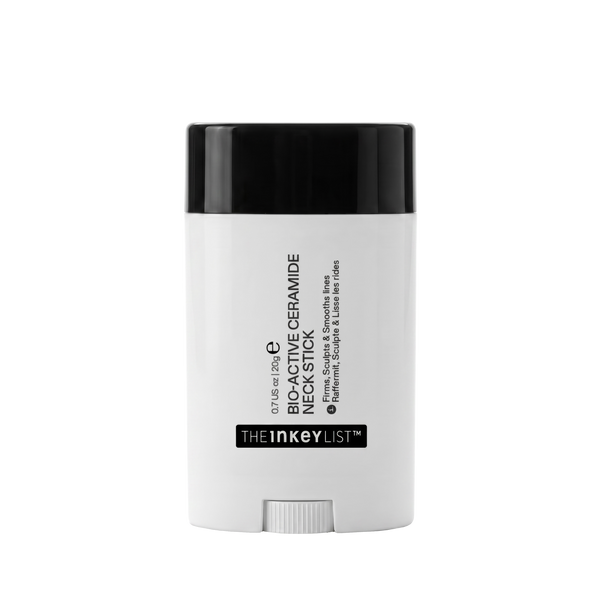
Our Bio-Active Ceramide Neck Stick ($17) exists because the jaw and neck junction is the part of the routine almost everyone skips.
What it is: a solid, gua sha-inspired stick for the neck, jawline and decolletage. 20g.
Why it works: it combines 0.2% Bio-Active Ceramide NP, 1% Gatuline In-Tense MB and 2% CO2llageneer. It is anhydrous, meaning there is no water in the formula and therefore no pH conflict, so it layers happily with retinol, vitamin C and AHAs or BHAs. It contains no retinol, which makes it suitable during pregnancy and breastfeeding.
How to use it: glide it upward across the neck and jawline, after your serums and before your moisturizer, morning and evening.
On results, here is what our testing showed. It is clinically proven to improve tightness of the jawline (by 32% in 56 days). Clinically tested on 28 participants over 8 weeks. It is also clinically proven to improve the lifted appearance of the neck and jawline (by 26% in 8 weeks/56 days). Clinically tested on 28 participants over 8 weeks.
We attach the study condition to every claim on purpose. If you want to know what phrases like this actually mean when brands use them, including ours, read what does dermatologically and clinically tested mean.
Two more that fit here. Our 15% Vitamin C + EGF Serum adds antioxidant support against photoaging, which ties directly back to the UV point above. And our Exosome Hydro-Glow Complex ($24) helps reduce the look of sagging and helps redefine facial contours, if firmness appearance is your priority.
That is the honest topical picture. Now the question we get asked most often.
Do Facial Exercises or Face Yoga Prevent Jowls?
The evidence that facial exercises prevent or reduce jowls is weak. Research is limited, the studies that exist are small, and none of it demonstrates an effect on the structural drivers.
The mechanism is the problem. Jowls are largely about bone volume, fat pad position and ligament laxity. Exercising the muscles underneath does not restore bone, reposition descended fat or re-tension a loosened ligament. Building a muscle under a structure that has changed shape does not change the structure. And some repetitive facial movements may encourage creasing rather than help.
None of this is meant dismissively. People try face yoga because it is free, non-invasive and pleasant, which are all perfectly sensible reasons. Facial massage genuinely feels good and can temporarily reduce the look of puffiness. That is a real if modest benefit and we are not going to pretend otherwise.
What we would suggest instead is a daily massage ritual with actual actives in it. Using our Bio-Active Ceramide Neck Stick ($17) with upward strokes across the neck and jawline gives you the same pleasant, deliberate two minutes, except it also delivers ingredients to the area while you do it. Frame it honestly: it is a delivery method plus a good habit, not a lifting exercise.
For readers chasing the same visual outcome through evidence-backed routes, how to get plump skin is a useful onward read.
Let’s turn all of this into something you can actually do tomorrow morning.
A Simple Daily Routine for the Jaw and Neck
Nothing here is complicated. The hard part is not the routine, it is doing it consistently.
Morning:
- Gentle cleanse.
- Antioxidant serum.
- Neck Stick, gliding upward across the neck and jawline.
- Moisturizer, from our moisturizers collection.
- Daily broad-spectrum sun protection, extended down over the jaw and onto the neck.
Evening:
- Cleanse.
- Retinoid, on alternating nights to begin with.
- Neck Stick.
- Moisturizer.
If you are new to retinoids, do not skip the alternating-nights part. Retinol for beginners: how to start without irritating your skin covers how to build tolerance without the irritation that makes people quit.
If there is one line to take from this entire article, it is this: extend everything past the jawline. Most people stop at the chin. The jaw and neck receive a fraction of the care the face does, across decades, and it shows exactly where you would expect. Whatever you are already using, take it further down.
And consistency beats intensity, every time. The clinical results quoted above came from daily use over eight weeks, not from occasional intensive effort. Two minutes daily outperforms twenty minutes on a Sunday.
For neck-specific product depth, fight tech neck goes further than we do here. For full routine structure, see our skincare routine guide, and for the wider picture, 10 Most Common Skincare Concerns.
When to consider seeing a professional
If the structural component is your main concern, a qualified professional can talk you through the options available. Skincare will not replicate structural intervention, and we are not going to suggest it can.
That is not a sales pitch in either direction. It is simply the honest boundary. Good skincare and good habits do meaningful work on skin quality. If what is bothering you is the underlying structure, that is a different conversation with a different kind of expert, and it is a reasonable one to have.
The Honest Summary on Preventing Jowls
You cannot prevent aging, and no topical product changes facial structure. What you can do is slow the skin-quality contributors and delay visible change, and that is a genuinely worthwhile thing to spend your effort on.
The priority order is not complicated. Daily broad-spectrum sun protection first, because it has the best evidence by a distance. Not smoking second, because the twin research is about as convincing as evidence in this field gets. Consistent retinoid use and firming skincare third, because they improve the one driver that responds to what you apply.
And then the line worth remembering above all the others: extend your routine past the jawline. It is the smallest change in this entire article and probably the highest return. Our anti-aging collection is a good place to start if you want to build from here.
If you want a product made specifically for the jaw and neck junction, that is exactly what our Bio-Active Ceramide Neck Stick ($17) is for. And if jowls are one of several things you are working through, our 10 Most Common Skincare Concerns guide will help you prioritize the rest.
Because at The INKEY List, We Give A Care.
Frequently Asked Questions
Got a question?
Our askINKEY team are a friendly bunch of skincare experts with deep product knowledge and zero judgement. Whether you're an ingredient obsessive or just starting out, we'll make it make sense. No question too big. No question too small. We Give A Care, Every Day.


