



When to Use Vitamin C Serum: Morning or Night, How to Apply &; How Often
Morning or night, before or after moisturizer, daily or not — here's exactly when to use your Vitamin C serum, and why timing changes your results.
Author
askINKEY skincare advisor
Published
17 May, 2026
Time to read
16 minutes
Vitamin C serum is best applied in the morning, on damp skin after cleansing, before your moisturizer and before your sunscreen. That is the short answer, and if it is all you came for, you can stop reading and go rearrange your bathroom shelf. But knowing when to apply vitamin C serum is only useful if you also know why that timing works, where the serum sits relative to everything else you own, and how often you actually need to use it to see something change in the mirror.
This guide covers all of it. When to apply vitamin C serum and why morning wins. Whether night-time use is a mistake or just a missed opportunity. The exact order of your morning routine, step by step. How much to use and how to apply it so it absorbs instead of pilling. How often to use it, and how to build up if your skin is on the sensitive side. Which ingredients belong in a separate routine, and which ones you have been needlessly avoiding. And, honestly, how long results take, because that expectation gap is where most people quit.
One thing worth establishing early, because the entire argument rests on it. The 15% Vitamin C + EGF Serum is built on 15% Ascorbyl Glucoside, a stable, gentle vitamin C derivative. Unlike pure L-Ascorbic Acid formulas, it does not demand careful pH management and it does not degrade the moment it meets air and light. That matters here more than you might expect. It means the timing question in this article is a question of strategy, not a question of keeping a fragile formula alive. You are not choosing a time of day to prevent something going wrong. You are choosing a time of day to get the most back.
If you want the ingredient fundamentals rather than the scheduling, our pillar page on what is Vitamin C covers the science from the ground up. This page is about the clock.
Before the timing detail, a quick orientation on the two INKEY vitamin C products referenced throughout.
The INKEY Vitamin C Products in This Guide
Two products come up repeatedly below, so here is what each one is before we start slotting them into routines.
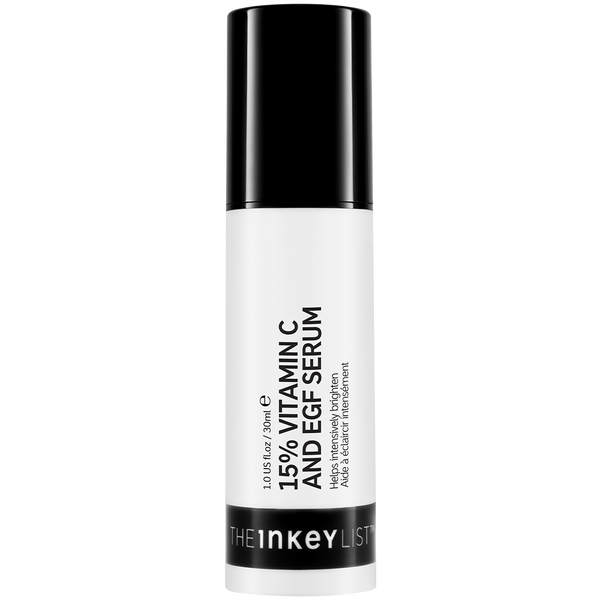
15% Vitamin C + EGF Serum, $20 / 30ml. This is the targeted treatment step and the product the rest of this article is built around. It runs on two actives working in different directions. The first is 15% Ascorbyl Glucoside, a stable vitamin C derivative that converts on skin to brighten and target the look of sun damage and uneven tone. The second is 1% Epitensive EGF, a plant-derived peptide that supports skin renewal and helps improve the appearance of elasticity.
The stability point deserves a moment, because it shapes everything that follows. Pure L-Ascorbic Acid is the most studied form of topical vitamin C, but it is also the most temperamental. It wants a low pH, it is sensitive to air and light, and it has a habit of turning brown in the bottle. Ascorbyl Glucoside is gentler by design. It does not oxidise as readily, it does not require pH gymnastics to stay useful, and it suits sensitive skin far better than a high-strength acid form. Beginner-friendly is the honest positioning, and there is nothing apologetic about it.
Vitamin B, C & E Moisturizer. This one uses Sodium Ascorbyl Phosphate, another gentle stabilised vitamin C, alongside Vitamin B3 (niacinamide) and Vitamin E. Think of the division of labour like this: the serum is the concentrated treatment, the moisturizer is the daily maintenance layer that keeps a lighter dose of brightening in play while it hydrates.
Both are suitable for sensitive skin, and the serum is noted on its product page as safe to use during pregnancy and breastfeeding, where retinol is not. If you want to browse the full range side by side, the Vitamin C Collection has everything in one place, and the what is Vitamin C pillar goes deeper on how the ingredient behaves on skin.
Now to the question this guide is really here to settle.
Vitamin C Serum Morning or Night? The Timing That Changes Your Results
Morning.
Not because vitamin C stops working after dark, and not because anything bad happens if you apply it at 10pm. Morning wins because that is the only time vitamin C gets to do its full job. Use it at night and you still get some of the benefit. Use it in the morning and you get all of it.
Here is the reasoning, and it is worth understanding rather than just accepting, because once you have it, every other timing decision in your routine becomes obvious.
Vitamin C is an antioxidant. Its defining function is neutralising free radicals, which are unstable molecules generated by environmental stress and which contribute to visible skin ageing over time. Harvard Health Publishing describes topical vitamin C as fighting free radicals produced both by external sources such as air pollution and by the body’s own internal processes, and notes that it may help protect against harmful ultraviolet rays when used alongside a broad-spectrum sunscreen.
Now ask the obvious follow-up question. When are you exposed to UV and pollution?
During the day. On the walk to the car. Through the office window. On the commute, at lunch, on the school run, during the twenty minutes you spend outside without thinking about it. Free radical generation is a daylight-hours event, and it happens on overcast days too, because UVA passes through cloud and glass with very little resistance.
An antioxidant applied at bedtime is a lifeguard who arrives after everyone has gone home. Diligent, capable, technically on duty, and facing an empty pool. The protection is present. There is simply very little for it to protect against between midnight and sunrise.
Morning is not a rule for the sake of a rule. It is about putting an antioxidant to work when there is actually something to protect against.
This is also the guidance on INKEY’s own product page, which notes the serum can be used AM and PM but recommends AM, precisely because antioxidants defend against daytime aggressors. So when people ask when to use vitamin C serum day or night, the honest answer is that both are permitted and one is strategic.
Why Vitamin C and SPF Work Better Together
The morning case gets stronger when you look at what vitamin C does alongside sunscreen, because the two are solving different halves of the same problem.
Sunscreen is a barrier. It blocks and absorbs UV radiation before it reaches your skin, and no serum on earth substitutes for that. But no sunscreen is a perfect seal. Application is uneven, we all under-apply, reapplication slips, and some UV gets through regardless. The radiation that makes it past your SPF generates free radicals in the skin, and that is exactly where an antioxidant earns its place.
Sunscreen reduces the incoming load. Vitamin C helps mop up the consequences of what gets through. Neither one replaces the other, and Harvard Health is explicit on this point: topical vitamin C does not remove the need for sunscreen or sun-protective clothing.
There is a second reason this pairing matters, and it is the one most people underestimate. If you are using vitamin C specifically for dark spots and uneven tone, skipping daily sun protection means UV keeps triggering the very pigment production your serum is working to calm. You are bailing out a boat while leaving the hole open. Our page on what SPF actually does explains the mechanics, and if you want the full argument for the pairing, we wrote a dedicated piece on why you always need both Vitamin C and SPF.
The practical instruction is simple. A broad-spectrum sunscreen goes on as the final step of your morning routine, every single day, over the top of everything else. Not as an alternative to vitamin C. As its partner.
Should I Use Vitamin C Serum at Night?
You can. It is not wrong, it will not irritate your skin because of the hour, and nothing is wasted.
It is just a missed opportunity twice over.
The first loss is the one we have already covered. Overnight, there is no meaningful UV or pollution load for an antioxidant to defend against. The serum is doing its brightening and renewal work, but its protective function is essentially idle.
The second loss is bigger, and it is about what you are giving up. Your evening routine is limited real estate, and there are ingredients that genuinely need that slot. Retinol is photosensitive and is best applied at night, where it supports skin renewal overnight without competing with daylight. Exfoliating acids follow similar logic. If vitamin C occupies your PM step, something that actually needs the darkness has to move or disappear. Our Starter Retinol Serum is the obvious example of a product that belongs in that window and does not perform the same way anywhere else.
So the ideal split is not complicated. Vitamin C in the morning, where it protects. Retinol or acids in the evening, where they renew. Two different jobs, two different windows, no overlap and no conflict.
That said, here is the generous version of the answer, because skincare advice that ignores real life gets abandoned. If mornings are chaos in your house and the only moment you reliably get to yourself is after the kids are down, use it at night. A serum applied consistently at 10pm will do more for your skin than a serum applied twice a week at 7am and then forgotten in a drawer. Some use always beats no use. The optimal routine is the one you actually perform.
With the time of day settled, the next question is exactly where in the sequence it goes.
When and How to Apply Vitamin C Serum in Your Morning Routine
Knowing to use vitamin C in the morning is only half the instruction. The other half is where in the queue it goes, and this is where a lot of otherwise good routines quietly waste product.
The governing principle is thinnest to thickest, lightest to heaviest. Water-based products go on first, because they absorb quickly and because nothing oilier is sitting on top of them blocking the way. Richer, more occlusive products go on last, because part of their job is sealing everything underneath. Vitamin C serum is lightweight and water-based, which puts it early in the sequence: straight after cleansing, and well before anything creamy.
Here is the full morning order.
- Cleanse. Start on clean skin. Overnight your face accumulates sweat, oil, shed cells and residue from whatever you applied the night before, and a serum applied on top of that is competing for access before it starts.
- Tone, if you use one. Reach for the Nourishing Rice Milk Hydrating Toner. It is hydrating rather than exfoliating, which is the entire point: it contains no exfoliating acid, so there is nothing to clash with your vitamin C step. Keep acid toners for the evening.
- Apply the 15% Vitamin C + EGF Serum. Onto slightly damp, freshly cleansed skin. A pea-sized amount covers face and neck comfortably.
- Additional serums, if you use them. Hydrating layers go after the vitamin C, not before it. The Hyaluronic Acid Serum ($13) is the common addition here.
- Eye cream. Pat gently around the orbital bone using your ring finger, which applies the least pressure.
- Moisturizer. The Vitamin B, C & E Moisturizer is a natural fit at this step, layering a lighter daily dose of stabilised vitamin C on top of your treatment step while it hydrates.
- Sunscreen. Always the final morning step. Non-negotiable, every day, regardless of weather or season.
Worth noting that this sequence is not an INKEY invention. Harvard Health’s own recommended morning routine follows the same shape: gentle cleanser, vitamin C serum to face and neck, moisturizer, then broad-spectrum sunscreen. When independent dermatological guidance and a brand’s product instructions land on the same order, you can be reasonably confident the order is right.
If your routine is shorter than seven steps, that is completely fine. Nobody needs every one of these. Cleanse, vitamin C, moisturizer, sunscreen is a genuinely complete morning routine, and it will outperform an elaborate ten-step regimen followed erratically.
How to Apply Vitamin C Serum Correctly
Application technique sounds like a fussy detail. It is not. Most complaints about a serum pilling, stinging or “doing nothing” trace back to how it went on rather than what was in the bottle.
Use your fingertips, not your palms. Dispensing into your palm and rubbing your hands together spreads a meaningful proportion of the product across skin that did not need it. Dispense onto fingertips and transfer directly.
Apply to slightly damp skin. Damp skin absorbs water-based formulas more readily. After cleansing, pat with a towel until you are no longer dripping but still faintly dewy, then apply. This is a small change that noticeably improves how the serum spreads and sinks in.
Pat and press, do not rub. Dot the serum across forehead, cheeks, chin and neck, then press it in with light taps. Vigorous rubbing drags at the skin and pushes product around the surface rather than into it.
A pea-sized amount is plenty. More is not better and it is the single most common cause of pilling, where product balls up under whatever you apply next. If your serum pills, try using less before you blame the formula. Overloading also burns through a bottle at three times the necessary rate.
Do not forget your neck. Neck and chest show sun exposure and uneven tone just as clearly as the face and are consistently under-treated. The pea-sized amount stretches to cover both.
Wait about 60 seconds before the next layer. Enough time for the serum to absorb properly rather than mixing wetly into your moisturizer. INKEY’s own product page goes further and suggests giving it around 10 minutes before your next product if you want to give the EGF time to work. Use that as an ideal rather than a rule. A minute is fine on a normal weekday. Ten is a bonus if you happen to be making coffee anyway.
Vitamin C Serum Before or After Moisturizer
Before. Always before.
The logic takes one sentence to explain. Serums are lightweight, concentrated and designed to be absorbed, while moisturizers are heavier, richer and partly designed to seal. Apply the moisturizer first and you have laid down a barrier that your serum then has to negotiate, which means less of the active reaching the skin that needs it.
Serum under moisturizer. Every time. If you remember nothing else about layering, remember that lighter goes under heavier and you will get the order right by default.
While we are on layering, one frequently asked question deserves a straight answer in passing: hyaluronic acid layers happily after vitamin C and the two do not cancel each other out, which we cover properly in our guide to whether can you use hyaluronic acid with vitamin C.
If you are rebuilding your routine from scratch and want the full framework rather than just the vitamin C portion, our guide to how to layer skincare walks through every product category in order. And if you follow a skin cycling schedule, note that the morning vitamin C step stays constant regardless of which night you are on. Cycling governs your evenings. Your mornings do not change.
Order and technique settled, the next question is how often all of this needs to happen.
How Often to Use Vitamin C Serum
Once daily, every morning. That is the target, and for most people it is achievable from the start.
The question of how often to use vitamin C serum generates more anxiety than it deserves, largely because vitamin C gets mentally filed alongside retinol and exfoliating acids as an ingredient requiring careful rationing. With a high-strength L-Ascorbic Acid formula, that caution has some basis. With a stable derivative like Ascorbyl Glucoside, it mostly does not.
If You Are Just Starting Out
If you are new to actives, or your skin runs sensitive, or you have simply had a bad experience with a product before, ease in rather than diving:
- Start with 2-3 mornings per week
- Give it around two weeks at that frequency
- If your skin is comfortable, build up to daily use
- Patch test first, as we recommend with any new product
This is the guidance on INKEY’s own product page, and it is worth framing correctly. It is acclimatisation, not a warning label. The Ascorbyl Glucoside formula is one of the gentler vitamin C options available, and most people tolerate it well from day one. The gradual build is there to give cautious skin an easy on-ramp, not because there is a hazard waiting at the end of it.
A quick word on patch testing, since it is the step everyone skips. It takes two minutes, uses a fraction of a pea-sized drop on your inner forearm or behind the ear, and it is the cheapest insurance in skincare. If you have reactive skin, do it.
A Gentler Way In
If a dedicated serum still feels like a big first commitment, there is a lower-stakes entry point. The Vitamin B, C & E Moisturizer delivers a smaller dose of stabilised vitamin C inside a product you were going to apply anyway. You get brightening support without adding a step, and if it suits you, graduating to the serum later is an easy decision.
This is a genuinely underrated route for anyone with sensitive skin. Our guide on whether can you use vitamin C on sensitive skin goes further into what to expect, and for a full structured introduction there is our best vitamin C skincare routine for beginners.
Once You Are Established
Daily morning use is the goal, and once your skin is used to it there is no reason to hold back.
Missing the occasional day is not a setback. Skipping it on a hectic Tuesday does not reset your progress or undo six weeks of work. What genuinely holds results back is long-run inconsistency: the pattern of using it enthusiastically for ten days, forgetting it for three weeks, restarting, forgetting again. Vitamin C results accumulate. Accumulation requires repetition.
Is Twice a Day Better?
Not really. Applying vitamin C morning and night will not harm your skin, but it is unlikely to accelerate anything meaningfully. Your skin can only use so much at once, and the extra application is spent in the window where an antioxidant has the least to defend against.
That evening slot has a much better use. Retinol or exfoliating acids in the PM will add more to your results than a second vitamin C application ever will, because they are doing something your morning routine is not.
Does Vitamin C Need Cycling or Breaks?
No. Unlike retinol and exfoliating acids, vitamin C does not require scheduled rest days, tolerance breaks or a phased build once you are established. There is no adaptation period after which it stops working and no benefit to periodically stopping.
If you follow a skin cycling routine, this is the part worth internalising: cycling applies to your evenings. Exfoliation night, retinol night, recovery night, repeat. Your morning vitamin C step stays exactly the same throughout, including on recovery nights. It is the constant your routine is built around, not a variable.
Which brings us to the least glamorous truth in this article. Consistency is the real active ingredient. A modest routine performed almost every day will beat an ambitious one performed occasionally, every time, without exception. The product in the bottle sets your ceiling. Your habit determines how close you get to it.
Frequency naturally raises the next question: what else is in the routine, and what needs to stay away from it.
What Not to Mix with Vitamin C, and What Pairs Well
Most of what you have read about vitamin C incompatibility is overstated. Very few ingredient pairings are genuinely dangerous. Almost all of them are questions of timing rather than prohibition, and once you see them that way the whole thing gets much less stressful.
Here is the honest map.
Retinol
Keep these two in separate routines. Not because mixing them causes harm, but because each performs better in its own window and combining them in one step raises the odds of irritation for no additional benefit.
The protocol is as simple as skincare protocols get. Vitamin C in the AM. Retinol in the PM.
Retinol is photosensitive, which makes daytime use impractical, and it supports skin renewal overnight while your skin is in its natural repair rhythm. Over time it helps improve the look of firmness and smoothness. Vitamin C, as established, wants the daylight hours where its antioxidant protection has something to do. Splitting them across the day is not a compromise. It is both ingredients working in the conditions that suit them.
Our page on what retinol does covers the ingredient properly. If you are new to retinoids, the Starter Retinol Serum is the sensible PM half of this pairing, designed for gradual introduction. If you are an experienced retinoid user ready for a step up, the Advanced 0.2% Retinal Serum is the stronger option. And if you want the detailed version of the pairing question we have a full piece on can you use vitamin C and retinol together.
Exfoliating Acids: AHAs, BHAs and PHAs
Same principle, same solution. Keep exfoliating acids in the evening.
Layering acids directly with vitamin C in a single routine increases the chance of irritation, particularly if your skin is at all reactive, and there is no upside to justify it. INKEY’s own product page for the serum is unambiguous under its Heads Up section: do not mix with Retinol, AHAs, BHAs or PHAs in the same routine, and use Vitamin C in the AM with Retinol or Acids in the PM.
This is worth flagging clearly because it corrects advice you may have seen elsewhere, including in an earlier version of this article. The PHA Toner is a gentle exfoliant, and gentle is genuinely accurate, but it still belongs in your eveningroutine rather than alongside your morning vitamin C. For your AM toner step, use the hydrating Nourishing Rice Milk Hydrating Toner instead. If you are restructuring a full routine around these splits, our guide to what not to mix with retinol is a useful companion.
Niacinamide
This one is a myth, and it is time it was retired.
The widespread warning against combining niacinamide and vitamin C traces back to research conducted with high-concentration pure L-Ascorbic Acid under specific laboratory conditions, including heat that bears no resemblance to a bathroom shelf. The concern was that the two could interact and produce flushing or reduced efficacy. That finding has been repeatedly over-extrapolated into a blanket rule covering every form of vitamin C in every formula, which is not what it showed.
Modern stabilised derivatives behave differently. And the clearest proof point is sitting in INKEY’s own range: the Vitamin B, C & E Moisturizer contains a stable vitamin C and Vitamin B3, which is niacinamide, formulated together in one product. Cosmetic chemists do not put two ingredients in the same bottle if they neutralise each other.
So yes, you can use them together. Layer the Niacinamide Serum after your vitamin C, or use a formula that contains both. Our page on what niacinamide does explains why it is such a useful all-rounder, and can you use niacinamide and vitamin C together covers the pairing in full.
If you avoided this combination for years on the strength of an internet rule, you were not being foolish. The advice was everywhere and it sounded authoritative. It was simply based on a study that did not describe the products most people were actually using.
Tranexamic Acid
Not a conflict at all. A genuine partner, and one of the more effective pairings available if uneven tone and dark spots are your primary concern.
Tranexamic acid approaches pigmentation from a different angle than vitamin C, which means the two complement rather than duplicate each other. The practical protocol is the familiar one: vitamin C in the morning, Tranexamic Acid Serum ($19) in the evening. Two shifts, two mechanisms, one target.
What Pairs Well Without Any Thought
Plenty, and it is a longer list than the cautionary one:
- Hyaluronic acid layers straight after vitamin C, no issues
- Peptides sit comfortably in the same routine
- Ceramides and barrier-supporting moisturizers are actively helpful alongside actives
- Sunscreen is not merely compatible, it is essential
- Niacinamide, per the above, is fine
When to Pause
There are a few situations where stepping back briefly is sensible.
After professional treatments such as chemical peels, laser or microneedling, give your skin time to settle before reintroducing actives, and follow your practitioner’s instructions ahead of any general advice including this. During a significant sensitivity flare, when your skin is stinging, tight or visibly irritated, pause actives and focus on gentle cleansing, moisturizer and sunscreen until things calm down. Neither pause needs to be long, and neither undoes your progress.
One more thing people ask about in this context and which we cover properly elsewhere: if you are wondering whether vitamin C can cause breakouts, that question has its own dedicated guide.
With your routine correctly structured, the natural next question is how long any of this takes to show up.
How Long Vitamin C Takes to Work: A Realistic Results Timeline
Let us be straightforward about this, because expectation management is the difference between someone who sees results and someone who gives up in week three.
Vitamin C is not an overnight ingredient. You will not wake up transformed after one application, and anyone suggesting otherwise is overpromising. What vitamin C does is accumulate, and the changes arrive in a reasonably predictable order.
Weeks 2 to 4: Radiance Arrives First
The first thing most people notice is not a specific fix but a general quality. Skin looks more awake. Less flat, less grey, less like it needs an early night. Surface dullness reduces and there is a subtle lift in luminosity that tends to show up in photographs before you consciously register it in the mirror.
It is a modest change and easy to miss if you are staring at your face daily looking for something dramatic. This is a strong argument for a day-one photograph in consistent lighting, because month-to-month comparison reveals what daily observation hides.
Weeks 4 to 6: Tone and Texture
By the second month, changes get more specific. Tone starts looking more even, texture feels smoother under your fingertips, and the luminosity from the early weeks becomes consistent rather than occasional.
This is also where the 1% Epitensive EGF contributes, supporting skin renewal alongside the brightening work and helping improve the appearance of elasticity. It is worth understanding what that second active is doing, and our explainer on what EGF is in skincare covers it.
Weeks 6 to 12: Dark Spots and Uneven Pigment
This is the long game, and it is where patience is genuinely required.
Dark spots, post-blemish marks and areas of uneven pigment respond more slowly than surface radiance because the pigment sits deeper and clears gradually. INKEY’s own product page states that dark spots and uneven tone typically take 6 to 12 weeks to fade significantly, and that is a realistic window rather than a conservative one.
External guidance points the same way. Cleveland Clinic’s advice on vitamin C serum is that it takes about three months to really see the effects, and recommends patience accordingly. Harvard Health similarly notes it may take up to three months of consistent use before improvements become noticeable. Roughly twelve weeks, from two independent medical sources, matching the upper end of INKEY’s own guidance.
If you want to understand what is happening at skin level during this period, our page on what hyperpigmentation isexplains why pigment behaves the way it does and why it takes as long as it does to shift.
What INKEY’s Own Trial Found
In an independent consumer trial of the 15% Vitamin C + EGF Serum:
- 87% agree skin looks brighter*
- 88% saw a visible improvement in the tone and texture of their skin*
- 84% agree skin looks healthier and less dull*
*4-week independent consumer trial of 64 people
Note the four-week window on those figures, and note what they measure. Brightness, tone, texture and reduced dullness are exactly the early-stage changes described above. That consistency between the trial data and the timeline is the point. The four-week wins are radiance-led. The pigment work takes longer.
The Variable That Undermines Everything
There is one factor capable of flattening your results regardless of how diligent you are, and it is the same one we covered earlier.
Daily sun exposure without protection.
Vitamin C works to visibly improve the look of uneven tone. UV exposure keeps triggering new pigment production. Skip sunscreen and you have set the two forces against each other, with your serum trying to calm what the sun keeps restarting. It is the most common reason people conclude a vitamin C serum “did not work” for them, and it usually has nothing to do with the serum.
If you want a broader view of what actually moves the needle on radiance, our how to get glowing skin guide covers the full picture, and how long skincare takes to work applies the same realism to other ingredient categories. The what is Vitamin C pillar goes deeper on the underlying science.
The honest summary: the difference between people who see results and people who do not is rarely the product. It is whether the bottle got used on the unremarkable Wednesday mornings.
Some readers will want more than brightness alone, which opens the next section.
Want More Than Brightness? Where the Exosome Hydro-Glow Complex Fits
Vitamin C is a brightening and antioxidant step. It is very good at that specific job, and for a lot of people it is the only advanced step they need.
If your goals extend past brightening into broader rejuvenation, the Exosome Hydro-Glow Complex ($24) is where to look next. It sits alongside your vitamin C rather than replacing it.
It is compatible with any routine and can be applied after cleansing on damp skin. Think of it as an addition, not a substitution: your vitamin C step stays exactly where it is.
The approved claims for this product are as follows:
- “100% saw more glowing skin, clinically proven*”
- “Clinic worthy rejuvenated skin in 14 days*”
- “55% reduction in visible signs of skin stress (redness, puffiness, visible irritation)*“
- “63% increase in skin renewal activity in 8 hours*“
- “6-in-1 skin rejuvenation: clinically proven to visibly improve radiance, hydration, tone, firmness, elasticity, and texture*”
- “Proven to deliver up to 12-hours of hydration**”
- “Helps support natural collagen production”
*4-week clinical study of 26 people
**Clinical study of 31 people
***In-vitro testing of Cica Exosomes showed a 55% reduction in pro-inflammatory markers
and a 63% increase in markers associated with skin renewal after 8 hours.
If you are weighing up glow ingredients against each other and want to understand how they differ, our comparison of Vitamin C vs Niacinamide vs Exosomes vs PDRN sets them side by side, and what exosomes are covers the ingredient itself in depth.
For everything else people ask about vitamin C timing, here are the quick answers.
Conclusion: The Bottom Line on When to Use Vitamin C Serum
Apply vitamin C serum in the morning, after cleansing, on slightly damp skin, before your moisturizer and before your sunscreen. Everything else in this guide is elaboration on that one sentence.
The essentials, condensed:
- Morning beats night, because vitamin C is an antioxidant and daylight is when there is something to protect against
- Sunscreen is a partner, not an alternative. Without it, UV keeps triggering the pigment your serum is working to calm
- The order is cleanse, tone if you use one, vitamin C serum, additional serums, eye cream, moisturizer, sunscreen
- Use it daily, building up from 2-3 mornings a week if you are new to actives
- Keep retinol and exfoliating acids for the evening. Most conflicts are timing problems, not bans
- Niacinamide is fine. That myth came from studies on a different form of vitamin C
- Expect first radiance at two to four weeks, and meaningful dark spot improvement across six to twelve
Here is the thought that runs underneath all of it. The biggest obstacle to results is rarely the wrong product. It is inconsistency. Most people who conclude vitamin C did not work for them never actually tested it, because a serum used sporadically for a month has not been given the conditions to demonstrate anything.
The habit is the treatment. The bottle just makes it possible.
If you want the underlying ingredient science rather than the scheduling, our what is Vitamin C pillar page is the place to go next.
Ready to Start?
Shop the 15% Vitamin C + EGF Serum - $20 / 30ml. 87% agree skin looks brighter*. Stable, gentle and made for daily morning use.
*4-week independent consumer trial of 64 people
Build Your Own Routine - put together a routine that fits around your vitamin C step and save while you do it.
Take the Skincare Quiz - a personalized routine recommendation in two minutes, ideal if you are still not sure where vitamin C fits for your skin.
Or browse the full Vitamin C Collection to see the range together.
Frequently Asked Questions
Got a question?
Our askINKEY team are a friendly bunch of skincare experts with deep product knowledge and zero judgement. Whether you're an ingredient obsessive or just starting out, we'll make it make sense. No question too big. No question too small. We Give A Care, Every Day.


