

Glycolic Acid for Feet: How to Remove Calluses, Dead Skin and Cracked Heels
Glycolic acid can help remove dead skin and soften calluses and cracked heels, but foot skin plays by different rules - here's how to use it safely, how long it takes, and when to see a podiatrist.
Author
askINKEY skincare advisor
Published
05 August, 2026
Time to read
9 minutes
The skin on your feet is the thickest on your body, and the soles have no oil glands at all, which is why calluses, dead skin and cracked heels build up there faster than anywhere else you put moisturizer. Glycolic acid is an alpha hydroxy acid, or AHA, that works by loosening the bonds holding dead skin cells together, which is exactly why it turns up in products aimed at tough, thickened areas like heels and soles.
This guide covers glycolic acid for feet in full: whether it actually works on plantar skin, why your feet behave so differently from the rest of your body, what glycolic acid does and honestly does not do on calluses and dead skin on feet, how it compares to urea and salicylic acid, a step by step foot care routine, how often to exfoliate, how long results realistically take, and the specific signs that mean you should see a doctor or podiatrist instead of reaching for a cosmetic exfoliant.
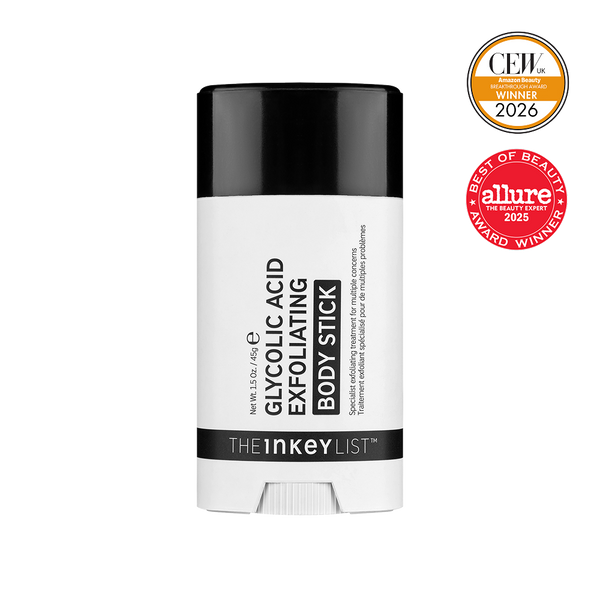
We make our own body care range with this exact problem in mind, and our Glycolic Acid Exfoliating Body Stick($20) is the product most people reach for when heels and soles are the concern. But the ingredient science comes first here, because knowing why your feet do what they do is what makes any routine stick.
Does glycolic acid work on your feet?
Yes. Glycolic acid works well on feet, and it is particularly suited to them. Rather than scrubbing dead skin away, it loosens the bonds holding dead cells together so they shed more easily. On the thickest skin on your body, that chemical approach reaches build-up that scrubbing alone tends to skate over.
Glycolic acid is what dermatologists call a keratolytic. That word simply means an ingredient that helps break down keratin, the tough structural protein that makes up the bulk of your outer skin layer. Think of thickened skin as a brick wall: the dead cells are the bricks and a network of lipids and proteins is the mortar. A foot file works on the surface of the wall. A keratolytic works on the mortar.
That distinction matters more on feet than anywhere else, because there is simply more wall to work through.
The smallest AHA molecule, and why that matters on feet
Glycolic acid has the smallest molecular size of all the alpha hydroxy acids. It is a small, water-soluble molecule, and small molecules move into compacted skin more efficiently than large ones do.
On your face, that property is a nice-to-have. On the plantar surface, meaning the sole and heel, it is the whole argument. You are asking an ingredient to penetrate skin that is many times thicker than facial skin and deliberately built to resist wear. Molecular size stops being a technical footnote and becomes the reason the ingredient is worth using here at all.
This is the core case for glycolic acid on feet, and it is why the same acid behaves so differently on a heel than it does on a cheek. If you want the full ingredient breakdown beyond the plantar context, our guide to what is glycolic acidcovers it properly, and the wider glycolic acid collection shows the different formats it comes in.
Concentration and pH do the heavy lifting
Here is what most people get wrong: they assume a harsher product works better. The research says results come from formulation, specifically the pairing of concentration with an appropriate pH, rather than from aggression.
A 1996 study looked at the clinical and histological effects of glycolic acid at different concentrations and pH levels, testing it on very dry, thickened, scaling skin over three weeks. That is about as close as the literature gets to the kind of build-up you see on a heel. Every combination tested improved the skin’s appearance and hydration. Under the microscope, the stratum corneum thinned while the living epidermis beneath it thickened, which is the signature of genuine renewal rather than surface stripping.
More recent research found that glycolic acid at pH 4 stimulates epidermal renewal in human skin explants, increasing cell turnover and collagen production without raising levels of TNF-alpha, a marker of inflammation. Renewal without an inflammatory response is precisely what you want on skin you need to walk on tomorrow.
Both studies also show a dose relationship: higher concentrations and lower pH generally produce stronger effects, and stronger effects carry more irritation risk. The takeaway is not “gentler is always better.” It is that a well-formulated acid used consistently will beat a harsher one used badly, every time. Our guide to using acids in your skincare routinegoes deeper on how to judge that balance.
Three things glycolic acid actually does on foot skin:
- Loosens the bonds between dead cells so build-up sheds gradually instead of being forced off.
- Thins compacted surface layers while supporting renewal in the living skin underneath.
- Improves how well moisture is retained, because hydration works far better once the barrier of dead cells is thinner.
What glycolic acid will not do
We would rather you know the limits up front than be disappointed in three weeks.
Glycolic acid will not dissolve a thick callus overnight. Callus is months of accumulated protective build-up. It comes down gradually.
It will not fix a deep, bleeding or painful fissure. A fissure is a split in the skin, and acid does not belong on broken skin.
It will not treat a fungal infection or a plantar wart. Athlete’s foot is fungal, plantar warts are viral, and a cosmetic exfoliant addresses neither.
It is not a replacement for professional care. More on exactly when to seek that further down.
Format helps more than people expect on feet. Our Glycolic Acid Exfoliating Body Stick ($20) is practical here because you can run it straight across a heel or sole without decanting anything into your hands, which matters when you are balanced on one leg in the shower. Using glycolic acid on heels is far more likely to become a habit when applying it takes four seconds.
So glycolic acid works. The more interesting question is why your feet needed it in the first place.
Why feet build calluses and dead skin faster than anywhere else
Your feet are not misbehaving. They are built differently.
Almost every frustration people have with dry feet traces back to two anatomical facts, and neither is about hygiene or effort. Once you know them, the rest of this article stops being a list of tips and starts being obvious.
The thickest skin on your body
Your stratum corneum is the outermost layer of your skin. It is made of flattened, dead cells packed together and held in place by lipids, which is where the bricks and mortar comparison comes from. On most of your body it is remarkably thin.
On the soles and heels, it is dramatically thicker. This skin is load-bearing. It is built to absorb the impact of every step you take, and it responds to that job by producing more layers, not fewer.
That means when you apply anything to your feet, you are working against far more material than you are anywhere else. A product that transforms your arms in a week can take a month on your heels, and that is not the product underperforming. It is arithmetic.
No oil glands, no built-in moisturizer
This is the fact that changes how people think about their feet.
The soles of your feet have no oil glands. They physically cannot moisturize themselves.
Sebaceous glands produce sebum, the oil that keeps skin supple and slows water loss. Your face has them in abundance. Your back has them. The soles of your feet have none.
They do have sweat glands, and plenty of them, but sweat is not sebum. Water evaporates. Oil stays and seals. Without any sebum, plantar skin has no built-in defense against drying out, stiffening and losing flexibility.
So when your heels feel tight and rough by Thursday despite moisturizing on Sunday, that is not you failing to keep up. Your feet are the one place on your body with no backup system.
Pressure, friction and why heels crack at the edges
A callus is not a fault. It is a defense.
When skin experiences repeated pressure or friction, it thickens deliberately to protect the tissue underneath. That is a functioning biological response doing exactly what it is designed to do. The problem is not that your skin built a callus. The problem is that thick skin plus no oil equals skin that cannot flex.
Now consider what happens when you stand. Your heel pad spreads sideways under your body weight. Skin that is supple accommodates that expansion. Skin that is thick, dry and inflexible does not, so it splits at the point of greatest stretch, which is the outer rim of the heel. That is why cracked heels form a ring around the edge rather than in the middle, and why heel fissures follow a predictable pattern rather than appearing at random.
Clinical accounts of cracked heels and how to stop them in their tracks point to the same set of contributing factors, and most are ordinary daily habits:
- Open-backed shoes and sandals, which let the heel pad spread unchecked with nothing to contain it.
- Standing for long periods, especially on hard floors, which multiplies the load cycles.
- Hot showers and long baths, which strip what little surface lipid is there. The American Academy of Dermatology suggests keeping showers to five to ten minutes in warm rather than hot water.
- Hot weather and low humidity, both of which accelerate water loss from skin already short on protection.
- Age, as skin gradually retains less moisture and loses elasticity.
- Body weight distribution, which changes how much expansion the heel rim absorbs with each step.
- Worn-down footwear, which stops distributing pressure evenly and concentrates it in one spot.
None of that is a hygiene failing. It is a structural mismatch between what your feet are asked to do and what they are equipped with.
This is also why general body advice underdelivers on feet. Our guide on how to exfoliate body skin covers arms, legs and torso well, but feet are a genuinely different surface with different rules, which is why they get their own article and their own place in our body care range.
Understanding the anatomy explains why exfoliation helps. It does not tell you which exfoliant to choose, and glycolic acid is not the only ingredient people are pointed toward.
Glycolic acid vs urea vs salicylic acid for feet
Search for foot care and three ingredient names come up repeatedly. They are frequently framed as competitors. They are not. They solve different parts of the same problem, and the AAD references all three in its guidance on how to care for dry, cracked heels.
Here is what each one actually does.
Urea, the moisture magnet
Urea: hydrates at low percentages, softens thickened skin at high ones.
Urea is unusual because it does two jobs depending on how much of it is present. At lower percentages it acts as a humectant, meaning it draws water into the skin and holds it there. At higher percentages it becomes keratolytic, softening and breaking down thickened skin.
That dose-dependence is the whole reason urea appears so consistently in foot-specific formulas. It is one of very few ingredients that hydrates and de-thickens at the same time, which suits a surface that is simultaneously too dry and too thick. The AAD references creams containing 10 to 25% urea for dry, cracked heels for exactly this reason.
We want to be straightforward: we do not make a urea foot cream. We are including urea here because you deserve an accurate picture of your options, not a picture edited to flatter our range. If you want to understand the ingredient itself in more depth, we wrote about urea and why it is the next big thing as ingredient education.
Salicylic acid and callus softening
Salicylic acid: oil-soluble, best on targeted spots rather than whole surfaces.
Salicylic acid is a beta hydroxy acid, or BHA. The meaningful difference from an AHA is solubility. BHAs are oil-soluble, which lets them work into oil-rich environments in a way water-soluble acids cannot.
On feet, salicylic acid has a long-established role in softening corns and calluses, and the AAD includes it among the ingredients worth looking for when treating corns and calluses. It tends to be used as a targeted spot treatment on one defined area rather than across a whole sole, which is a genuine practical limitation when your issue is broad, general roughness across both feet.
If you want the general comparison beyond feet, we cover glycolic acid vs salicylic acid and which is right for your skin in its own guide.
Glycolic acid, the all-over option
Glycolic acid: the smallest AHA molecule, suited to broad areas of thickened skin.
Glycolic acid’s advantage on feet is coverage combined with penetration. Small molecule, water-soluble, and comfortable to apply across a whole heel, sole and ball of the foot in one pass rather than dot by dot.
It loosens the bonds between dead cells across the entire surface, which suits the way foot roughness actually presents. Most people do not have one discrete callus. They have generalized thickening with a few worse patches, and that is a coverage problem as much as a potency one.
Glycolic acid also pairs particularly well with moisturizing afterwards, because thinner build-up means whatever you apply next has less to fight through. Think of it as the practical all-over choice for calluses, dead skin and rough heels, not as the single answer to every foot concern.
PHA when your skin is sensitive
PHA: a larger molecule, slower to penetrate, gentler by design.
Polyhydroxy acids, or PHAs, are chemically related to AHAs but built from larger molecules. Larger molecules penetrate more slowly and more evenly, which generally means less potential for irritation.
If your skin is reactive, if you are new to acids, or if you want something you can genuinely use daily on feet and legs together, PHA is the sensible entry point. Our PHA Body Water Cream ($15) does dual duty here, offering gentle exfoliation and hydration in one step, which is useful when foot skin needs both. You can read more about what PHA is, and if reactivity is your main constraint, our roundup of the best exfoliator for sensitive skin is a better starting point than jumping straight to a stronger acid.
If you want the shortest possible version of this whole comparison, it is this. These ingredients are complementary, not rivals. Urea hydrates and softens. Salicylic acid targets defined spots. Glycolic acid handles broad surfaces. PHA keeps sensitive skin in the game. All of them are keratolytic agents or hydrators working on the same wall from different angles.
Acids loosen. Moisture keeps it from coming back. You want both.
Knowing which ingredient does what is useful. Knowing the order to apply things in is what actually changes your heels.
A simple foot care routine to remove dead skin on feet
A foot care routine only works if it is short enough that you keep doing it. This one has four steps and adds about five minutes to a shower you were taking anyway.
-
Soften first. Spend five to ten minutes in warm water, whether that is a bath, a shower or a basin. The AAD recommends soaking a callus in warm water for five to ten minutes, or until it softens, before doing anything else. Softened skin responds far better to both acid and any mechanical removal, and it is genuinely the difference between a file that works and a file that just scrapes. Use warm water, not scalding, and do not extend soaks well beyond ten minutes, because prolonged soaking strips more lipid than it adds moisture.
-
Exfoliate with glycolic acid on clean, slightly damp skin. The AAD specifically advises applying to damp skin after bathing, because damp skin holds moisture that your next step can seal in. Work across the heel, the sole, the ball of the foot and any rough patches you can feel. This is where our Glycolic Acid Exfoliating Body Stick($20) earns its place, because a stick glides straight over a heel one-handed with no mess and no decanting, and a routine you can do while balancing on one foot is a routine you will repeat.
-
Seal in the moisture. This is the step people skip, and it is the one that stops cracks from coming back. Remember that your soles produce no oil of their own, so if you do not apply an occlusive or emollient layer, nothing is holding that water in. A systematic review of moisturizers for the treatment of foot xerosis, meaning abnormally dry foot skin, found consistent evidence that moisturizing works. For very dry, rough areas, our Bio-Active Ceramide Moisturizer ($22) supports the skin barrier with ceramides, the lipids that make up the mortar between your skin cells. For a lighter daily option, or for sensitive skin, our PHA Body Water Cream ($15) hydrates while gently exfoliating, and we broke down the science behind PHA Body Water Cream if you want the detail. If you would rather buy the routine in one go, the Exfoliating Body Duo pairs the exfoliating and hydrating steps together at $33.25, down from $35.00.
-
Reduce calluses gently, and only on softened skin. Use a foot file or pumice stone after soaking, with light pressure and short sideways or circular strokes. Work gradually across a few sessions rather than trying to clear everything at once. The AAD is clear that you should not remove too much and should never file to the point of bleeding. Stop before the skin feels sore, tender or raw. Taking off too much callus at once exposes fragile skin underneath and can genuinely make cracking worse, because you have removed the protective layer without giving the skin below time to adapt. If you have already overdone it, our guide on what to do if you have over exfoliated will help you recover.
Never use a blade, razor or callus shaver on your own feet at home.
That warning is not overcaution. Cutting into a callus removes protective tissue you cannot easily judge the depth of, and it creates an open wound on the part of your body most exposed to pressure and bacteria. Professionals who reduce calluses with blades are trained to assess depth and manage the risk. Reducing gradually with a file gets you to the same place with none of it.
How often to exfoliate feet
Start once a week. If your skin tolerates it comfortably, build to two or three times a week.
Feet handle more frequency than your face because the skin is so much thicker, but frequency should still be earned rather than assumed. Add a session, wait, and see how your skin responds before adding another. If you want the fuller framework for judging this, our guide on how often to use glycolic acid covers it across the whole body.
A few small habits make a disproportionate difference:
- Cotton socks overnight after moisturizing, which keeps product in contact with skin instead of on your sheets.
- Replace worn-through footwear, because shoes that have lost their structure concentrate pressure in exactly the spots you are trying to fix.
- Limit long periods standing barefoot on hard floors, which is one of the most common and least noticed contributors.
- Dry thoroughly between your toes after every shower, not just the parts you can see.
Consistency beats intensity. Twice a week, every week, will outperform one aggressive session a month.
That covers the general routine. Most people arrive here with something more specific in mind.
Cracked heels, foot odor and other common foot concerns
Feet present a handful of recurring concerns, and each needs a slightly different answer. Here is where a cosmetic exfoliant helps, and where it honestly does not.
Cracked heels and heel fissures
There is an important line to draw here, and most content on this subject blurs it.
On one side sits cosmetic dryness: heels that are rough, flaky, tight and starting to show fine surface lines. This responds well to consistent acid exfoliation paired with diligent moisturizing, and it is exactly what the routine above is built for. Catching heels at this stage is the single most effective thing you can do, because you are preventing fissures rather than treating them.
On the other side sit clinical heel fissures. A fissure is a deep split that extends past the surface layer into living tissue. If your heels are painful, bleeding, weeping or showing signs of infection, that is a clinical issue and it is out of scope for any cosmetic exfoliant. DermNet’s clinical overview of cracked heels sets out how fissures develop and why deeper ones need proper management, and the bpac account of cracked heels is similarly clear.
Do not apply acid to broken or bleeding skin. Work around a crack, not over it, and if it is not improving, see someone.
For dry cracked heels treatment that stays firmly in cosmetic territory, the formula is unglamorous and effective: soften, exfoliate consistently, seal thoroughly, and stop making the underlying pressure worse with your footwear.
Foot odor and why exfoliation helps
We are going to be careful here, because this is a topic where overclaiming is routine.
Foot odor is produced when bacteria on the skin surface break down sweat and dead skin cells. The bacteria are not the problem in themselves. They are ordinary skin flora doing what they do. Odor is a byproduct of what they have to feed on.
Reducing dead skin build-up reduces some of that material. So exfoliating can help indirectly. That is the honest mechanism, and it is worth stating what it is not: glycolic acid is not a deodorant and it is not an antibacterial treatment. Anyone telling you an AHA eliminates foot odor is selling past the evidence. We cover the same mechanism in more depth in our guide to glycolic acid for armpits, where odor is the primary concern rather than a secondary one.
What actually moves the needle on foot odor, alongside exfoliation:
- Rotate your shoes so each pair dries fully for at least a day between wears.
- Choose breathable footwear and moisture-wicking socks over synthetics that trap humidity.
- Dry thoroughly between your toes, which is the warmest and dampest part of the foot.
- Change socks during the day if you are on your feet for long stretches or in heat.
- Let your shoes air out rather than storing them in a sealed cupboard immediately after wearing.
Persistent odor that does not respond to any of this, particularly alongside itching, flaking or cracking between the toes, is worth getting looked at rather than exfoliated harder.
Toes, ball of foot and the tops of your feet
Do not treat the whole foot as one surface. It is not.
The skin on the top of your foot is much thinner than the sole, closer to the skin on the back of your hand than to your heel. It needs less product, less frequency and a gentler touch. Applying the same intensity you would use on a heel is the most common way people irritate the tops of their feet.
The ball of the foot and the outer edge of the big toe are pressure points and often thicken alongside the heel, so they are fair targets for the same treatment as the sole. Between the toes, ease off. That skin is thin, stays damp and is easily irritated. Our Glycolic Acid Exfoliating Body Stick makes this easy to control, because you are placing product deliberately rather than spreading it everywhere.
If roughness continues up onto your legs or you are dealing with small bumps rather than thickening, that is a different concern with a different answer, and our keratosis pilaris treatment guide is the right place for it. Similarly, if bumps around the ankle or lower leg turn out to be ingrown hairs, that has its own guide too.
How long until you see smooth feet
Realistic expectations are the difference between a routine that sticks and one abandoned in week two.
Most people notice their skin feels softer and smoother within one to two weeks of consistent use. That early change is real, but it is happening in the uppermost layers.
Visible improvement in genuinely thickened areas takes longer, typically four to six weeks. That is not a product being slow. That is the honest timeline for working down build-up that took months to accumulate on the thickest skin you have.
You are working through skin that took months to build. Give it four to six weeks.
It is also worth setting the expectation that this is maintenance, not a cure. Your skin renews continuously and the pressure on your feet does not stop, so smooth feet are something you keep rather than something you achieve once. The upside is that maintenance is far easier than the initial work.
Most foot concerns respond to consistency. Some of them are not cosmetic at all, and recognizing those is genuinely important.
When to stop and see a doctor or podiatrist
Some foot concerns need a professional, not a skincare product.
If you have diabetes, do not self-treat foot skin with exfoliating acids or mechanical callus reduction without guidance from your doctor, diabetes care team or podiatrist. Reduced sensation and slower healing mean a small injury you cannot feel can become a serious problem. The AAD is explicit that people with diabetes or poor circulation should avoid aggressive self-treatment of corns and calluses and should seek specialist care instead. This is the most important line in this article.
Beyond that, stop and see a doctor or podiatrist if any of the following apply:
- Peripheral neuropathy or any reduced sensation in your feet. If you cannot reliably feel your feet, you cannot feel when you have gone too far, and that is the safety mechanism the whole routine depends on.
- Poor circulation or peripheral artery disease. Slower healing raises the stakes on minor skin damage considerably.
- Deep, painful or bleeding fissures. These are outside what any cosmetic exfoliant is designed for, and DermNet’s guidance on cracked heels sets out why deeper fissures need proper management.
- Signs of infection, including increasing redness, warmth, swelling, pus, spreading pain or feeling unwell in yourself.
- Athlete’s foot, which is a fungal infection and typically presents as itching, flaking, scaling or cracking between the toes. It needs antifungal treatment, not exfoliation.
- Plantar warts, which are viral and require their own specific treatment. Filing or acid exfoliation is not the answer and can spread them.
- A callus that is thickening rapidly, unusually painful, or in a spot that does not match your normal pressure points. Unexplained changes deserve an explanation.
- Any foot skin change you cannot account for, particularly if it is one-sided or changing quickly.
If you are pregnant, managing a diagnosed skin condition, or simply unsure whether a product suits you, check with a healthcare professional before starting.
None of this is a reason for alarm. Most rough, dry, callused feet are exactly what they appear to be and respond well to consistent care. But knowing when a skincare product is the wrong tool is part of looking after your skin well, and we would rather point you to a podiatrist than sell you something that cannot help.
With the boundaries clear, here are the questions we get asked most.
The short version
Feet have the thickest skin on your body and no oil glands on the soles, which is why they need deliberate care rather than occasional attention. That single anatomical pairing explains calluses, dead skin on feet, and why heels crack at the rim instead of the center.
The method is straightforward: soften in warm water, exfoliate with glycolic acid, seal with a moisturizer while skin is still damp, and reduce calluses gradually with a file rather than aggressively.
Be patient with it. Softer skin usually shows up within one to two weeks, and meaningful change in thickened areas takes four to six. Consistency genuinely does outperform intensity here.
And know the line. If you have diabetes, reduced sensation, poor circulation, deep fissures or any sign of infection, see a doctor or podiatrist rather than reaching for an exfoliant. Used sensibly and within its limits, glycolic acid for feet is one of the most practical tools you have for calluses and rough, dry heels.
Ready to build the routine? It is three steps: soften, exfoliate, seal. Our Glycolic Acid Exfoliating Body Stick ($20) handles the exfoliating, and our PHA Body Water Cream ($15) handles the sealing, gently enough for daily use. You can pick up both together in the Exfoliating Body Duo for $33.25, down from $35.00. Browse the rest of our body carerange and use the “Dry and cracked heels” filter to find what fits fastest, or start with what is glycolic acid if you want the science first. Clear guidance, proven ingredients, real results.
Frequently Asked Questions
Got a question?
Our askINKEY team are a friendly bunch of skincare experts with deep product knowledge and zero judgement. Whether you're an ingredient obsessive or just starting out, we'll make it make sense. No question too big. No question too small. We Give A Care, Every Day.


